Backlash Spreads Over Cuts to Local Allocation Tax Stemming from Future Response Fund: “Fiscal Risks Shifted to Local Governments”
- Input
- 2026-09-30 10:36:07
- Updated
- 2026-09-30 10:36:07
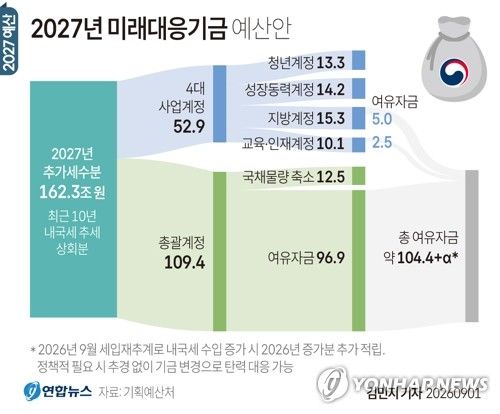
[Financial News] The government’s decision to exclude amounts set aside for the Future Response Fund from the calculation of local allocation tax starting next year has sparked growing opposition from local governments. Under the government’s proposal, next year’s statutory-rate portion of the local allocation tax would be approximately 30.5 trillion won lower than under the existing formula. A request for opinions by the Ministry of the Interior and Safety (MOIS) also found that the council of mayors, county heads and district heads, along with 62 local governments nationwide, had voiced opposition or concerns over weaker fiscal autonomy and reduced allocation tax.
On the 30th, People Power Party lawmaker Kwon Young-jin, a member of the Security and Public Administration Committee of the National Assembly of the Republic of Korea, received from MOIS the results of a request for opinions on the “Amendment Bill to the Local Allocation Tax Act.” The council of mayors, county heads and district heads and 62 local governments nationwide had submitted concerns or objections to the bill.
The government plans to change the way local allocation tax is calculated by establishing the Future Response Fund. The statutory rate for local allocation tax will remain at 19.24% of domestic tax revenue, but the amount set aside for the Future Response Fund will first be deducted from domestic tax revenue before the allocation tax is calculated. As a result, next year’s statutory-rate portion of the allocation tax is expected to be approximately 30.5 trillion won lower than it would be under the existing formula.
Local governments are concerned that reducing allocation tax and distributing funding through fund projects could shrink their own-source revenue. In particular, criticism has mounted that the risks borne by local governments are asymmetric when tax revenue falls or rises.
Gyeonggi Province stated, “When the final accounts fall short of the budget, local governments bear the difference. But when the final accounts exceed the budget, the excess is excluded from the settlement by using the trend figure as a ceiling, creating an asymmetric structure.”
Busan Metropolitan City Government also said, “Contributing even excess tax revenue to the fund is unfavorable to local finances,” and called for clear rules to support local governments through the Future Response Fund if their fiscal conditions deteriorate.
Gangwon State said the amount transferred to the Future Response Fund should be capped to mitigate the impact on local finances, proposing a limit of “70% or less.” South Gyeongsang Province said regions that rely more heavily on local allocation tax could suffer greater damage, widening fiscal disparities between regions, and stated, “A sufficient preliminary impact assessment on local finances must be conducted first.”
Kwon criticized the government, saying, “Although MOIS says it will transfer 30 trillion won in local allocation tax to the fund, it has not disclosed even the detailed calculations or legal grounds showing which local governments will lose how much in budget funding.” He added, “The results of the request for opinions conducted directly by the government also show that the local governments that submitted opinions expressed opposition and concerns.”
Local governments’ concerns were also raised at a government–party consultation meeting held the previous day. The government and the Democratic Party of Korea held a “government–party consultation meeting on the establishment of the Future Response Fund and reform of local allocation tax” at the National Assembly Members’ Office Building on the 29th and heard from the heads of metropolitan and provincial governments. Gyeonggi Governor Choo Mi-ae called for separate distribution criteria for the Local Future Growth Support Grant under the fund’s local account. She said that applying the existing ordinary local allocation tax formula without change could exclude Gyeonggi Province, a non-recipient local government under the ordinary allocation tax system, from receiving fund distributions as well.
Gyeonggi Province proposed a new distribution method that would reflect 30% for basic allocation, 40% for balanced development and 30% for future growth needs. The province argued that every local government should receive a certain amount of funding regardless of whether it receives ordinary local allocation tax.
South Chungcheong Province (Chungnam) Governor Park Soo-hyun called for compensation for the reduction in local allocation tax resulting from the establishment of the Future Response Fund. Under the current formula, Chungnam estimates that its local allocation tax would amount to approximately 8.5 trillion won, but that the introduction of the fund would reduce this by approximately 2.6 trillion won.
Park said, “This year’s excess tax revenue should not be transferred in full to the Future Response Fund. It should instead be used to ease the difficulties faced by local governments.” He said he agreed with the fund’s purpose of investing additional tax revenue in future growth engines, but stressed that the stability of local finances must come first.
Along with compensation for the reduction in local allocation tax, Chungnam requested that the statutory rate for the tax be raised from the current 19.24% to 22%. It also proposed adjusting the ratio of national to local taxes to 7:3 and increasing the share allocated to the fund’s local account.
MOIS said it would review the local governments’ opinions during the legislative process. It also emphasized that if local fiscal conditions worsen, the Future Response Fund could be used to provide additional support to local governments and serve as a fiscal stabilization mechanism.
An MOIS official stated, “We will thoroughly review the opinions of local governments during the legislative process, comprehensively consider the various views and work to ensure that they are reflected in improving the system.”
[email protected] Lee Bo-mi Reporter