KASA Commissioner Oh Tae-seok: "Targeting a 3% Share of the Global Space and Aerospace Market by 2035"
- Input
- 2026-09-30 11:37:10
- Updated
- 2026-09-30 11:37:10
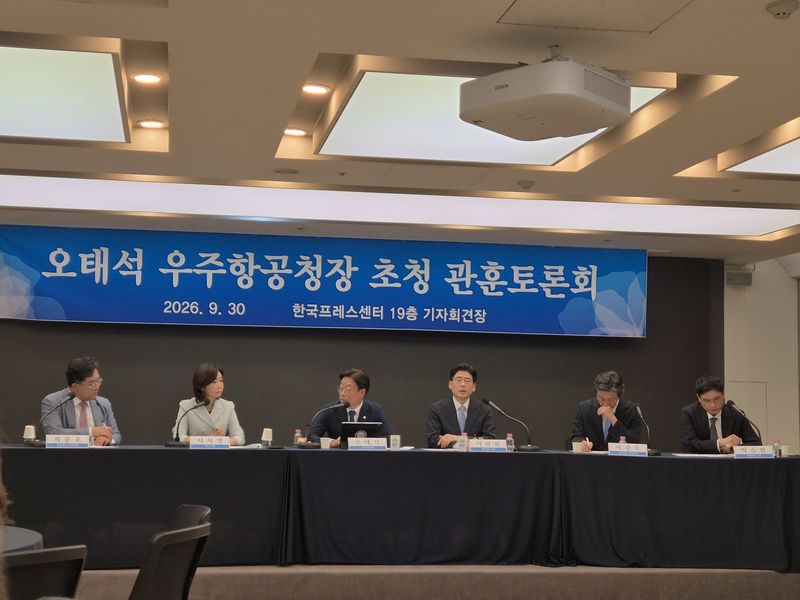
[Financial News] The government has set a goal of increasing South Korea's share of the global space and aerospace market to 3% by 2035. Regarding the possibility of developing a manned space program, it plans to first define the purpose of space exploration before deciding whether to pursue an independent program.
KASA Commissioner Oh Tae-seok made the remarks at the Kwanhun Debate held at the Press Center in Gwanghwamun, Seoul, on the 30th. "As of 2024, South Korea accounted for only 0.7% of the global space and aerospace market," he said.
Commissioner Oh stated, "To achieve this, we will shift our policies from being centered on research and development to focusing on industrial growth and create a strong space and aerospace industry ecosystem." He cited the development of the satellite industry—including the construction of a space highway and a low-Earth-orbit satellite communications network—as well as lunar and deep-space exploration and the advancement of the future aviation industry as key plans.
Commissioner Oh stressed, "We will increase launch reliability through repeated launches of Nuri (KSLV-II) and secure stable launch demand by using domestic launch vehicles for satellites developed in South Korea." He added, "The fact that the launch of Arirang 6 has been delayed for four years is precisely why we need domestic launch vehicles." He also outlined the plan, saying, "For the time being, we will rely on overseas launch vehicles, but we intend to launch the Next-Generation Medium-Sized Satellite 5 using Nuri (KSLV-II)."
"We will also actively develop the satellite industry. We will improve industrial competitiveness by producing high-performance satellites quickly and at low cost," he said. He added, "For national security and communications sovereignty, we will build a Korean low-Earth-orbit satellite communications network by 2035." He emphasized that the government would improve cost-effectiveness by appropriately combining domestic and overseas launch vehicles while pursuing various forms of private-sector and international cooperation.
Asked about the need to foster a large space company like SpaceX of the United States, he said, "That is a decision for companies to make themselves." He added, "The space industry requires a wide range of capabilities. There are areas that startups and existing companies can take on."
He also announced plans to launch a lunar-orbit communications satellite in 2029 and a small lunar lander in 2030 using Nuri (KSLV-II). He outlined a policy direction to explore Mars by 2045. However, he took a cautious stance on a manned space program.
Commissioner Oh said, "The countries that currently have manned space programs are the United States, China, and Russia, while India is conducting research to establish one. Japan, Canada, and Europe, on the other hand, do not have independent manned space programs and are cooperating with the United States." He added, "A manned space program entails a financial burden, so I believe we need to make choices and focus based on the purpose of our space exploration. We will develop a roadmap and proceed with it in the next basic plan for space development."
Regarding KASA's organizational restructuring, he said, "As KASA adjusts its role from conducting research to serving as an agency that supports space-related activities, its members are also being reorganized around support functions." He added, "We are also working closely with the National Aeronautics and Space Administration (NASA), but that does not mean we must recruit NASA researchers. We are pursuing a variety of international partnerships, including with Europe."
Regarding advanced air mobility (AAM), he said, "Because it does not require airports, it could be a groundbreaking means of transportation." He added, "We also need to create an aerial transportation environment so that AAM can become more widespread."
[email protected] Yeon Ji-an Reporter