Delivery Motorcycle Crashes Concentrate 42% Between 5 and 9 p.m. as Orders Surge; Incheon Sees Increase for Second Consecutive Year
- Input
- 2026-09-30 09:59:10
- Updated
- 2026-09-30 09:59:10
【Financial News, Incheon—Han Gap-su, Reporter】 Delivery motorcycle crashes are rising again in Incheon. After surging during the COVID-19 pandemic, the number of crashes declined for a while but increased for two consecutive years starting in 2024. This runs counter to the nationwide trend of declining two-wheeled-vehicle crashes. The crashes were concentrated at intersections in neighborhoods with clusters of restaurants and commercial facilities.
According to the Incheon Institute's report, titled "Characteristics of Two-Wheeled-Vehicle Traffic Crashes in Incheon and Analysis of Vulnerable Areas," released on the 30th, 11,358 two-wheeled-vehicle traffic crashes occurred in Incheon between 2016 and 2025. These crashes left 178 people dead and 4,193 seriously injured.
Two-wheeled-vehicle crashes in Incheon rose sharply from 2019, when delivery platforms rapidly expanded. The number increased 31.2%, from 893 in 2018 to 1,172 in 2019. During 2020 and 2021, when COVID-19 was widespread, the annual average climbed to 1,402 crashes—43.1% higher than before the pandemic.
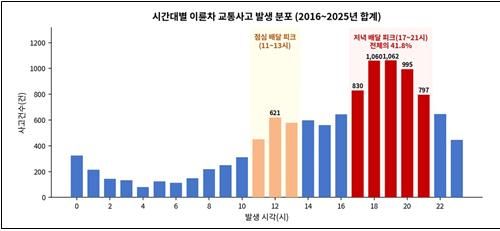
Crashes then declined but began rising again after reaching a low of 1,082 in 2023. The number rose to 1,126 in 2024 and 1,276 in 2025, marking two consecutive years of growth. In particular, crashes in Incheon increased 13.3% in 2025 from the previous year, while nationwide two-wheeled-vehicle crashes fell 7.6%. Incheon's share of crashes nationwide also rose to 9.0%.■ Crashes Concentrate During Evening Delivery HoursThe time period with the most crashes was 5–9 p.m. A total of 4,744 crashes, or 41.8% of all crashes, occurred during those hours. Another 1,651 crashes occurred between 11 a.m. and 1 p.m., the lunchtime delivery period.
The hours when delivery demand peaks overlap with the period when crashes are most concentrated. Crashes on Fridays and Saturdays accounted for 32.2% of the total.
By contrast, although fewer crashes occurred during the late-night hours, each crash resulted in more severe harm. The fatality and serious-injury rate for crashes between midnight and 5 a.m. was 43.7%, higher than the overall average of 36.8%. The Incheon Institute analyzed that safety measures should reduce crashes themselves during the evening by addressing factors such as signal violations, while minimizing crash severity late at night through speed control and improved visibility.
Two-wheeled-vehicle riders were the most vulnerable people involved in these crashes. At the time of a crash, 28.3% of two-wheeled-vehicle riders were killed or seriously injured. The corresponding rate for drivers of other vehicles was 7.8%.
Two-wheeled vehicles were the victims in approximately six out of every 10 crashes, or 58.5%. In such cases, passenger cars accounted for 79.1% of the other vehicles involved.
At the same time, crashes in which two-wheeled vehicles were at fault were also not uncommon. Vulnerable road users—including pedestrians, cyclists, and personal mobility device users—were involved in 27.3% of these at-fault crashes. The main traffic violations by two-wheeled-vehicle riders were failure to drive safely, at 51.1%, and signal violations, at 27.7%.
Among deceased two-wheeled-vehicle riders whose injured body parts were identified, 73.8% had injuries to the head, face, or neck.■ Two-Wheeled-Vehicle Riders Suffer Most of the Harm When Crashes OccurCrashes were concentrated in certain areas. Namdong District recorded the most, with 2,361, followed by the West with 2,260, Bupyeong District with 2,060, and Michuhol-gu with 1,903. These four districts accounted for 75.6% of all crashes.
An analysis of crash locations using GPS identified 18 crash hot spots, including Buheung Five-way Intersection in Bupyeong District; Ganseok Five-way Intersection and Gil Hospital Intersection in Namdong District; Bupyeong Market Rotary; and Seokbawi Four-way Intersection in Michuhol-gu.
Most of these areas were intersections on arterial roads in station-area neighborhoods or residential and commercial districts, where restaurants and shops are concentrated. Intersections accounted for 58.5% of all two-wheeled-vehicle crashes.
The Incheon Institute proposed prioritizing the installation of rear-facing automated enforcement equipment at intersections with frequent crashes and improving visibility at intersections. It also said dedicated spaces should be secured in areas with clusters of restaurants so delivery motorcycles can wait temporarily.
The institute noted that simply tightening enforcement against illegal parking could push delivery motorcycles onto sidewalks or side streets. It therefore stressed that waiting and parking spaces should be provided alongside enforcement.
The Incheon Institute also called for cooperation with delivery platforms. It said the industry should be consulted to ensure that time limits and dispatching or compensation systems do not lead riders to compete over speed. Information on the times and locations where crashes are concentrated should also be incorporated into safety training and driving management.
Because this study was based on traffic-crash data, it could not directly confirm whether individual crashes actually occurred during delivery work. The Incheon Institute said future research should directly analyze delivery motorcycle crashes by linking delivery-platform operation data with crash records.
[email protected] Han Gap-su Reporter