Lula Trapped by High Prices vs. Bolsonaro Bound by His Father... Brazil's Presidential Election at Stake
- Input
- 2026-09-30 15:13:11
- Updated
- 2026-09-30 15:13:11
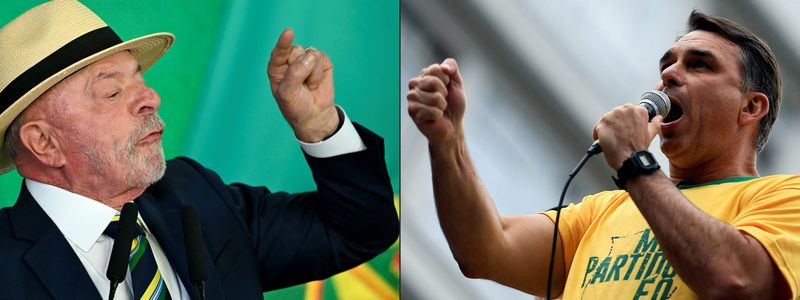
A Two-Horse Race Driven by Strategic Voting... Lula vs. Bolsonaro
Poll results show an increasingly clear concentration of support around President Lula and Senator Flávio Bolsonaro. According to a Quest poll, Lula led the first round with 39% support, followed by Bolsonaro with 37%.Augusto Cury, the well-known author-turned-candidate whose support once approached 10%, had fallen to 4%. Ronaldo Caiado (4%) and Renan Santos (3%), who had formed the middle tier, were also losing ground. As election day approaches, support for undecided voters and minor candidates is shrinking, intensifying the phenomenon of "strategic voting," in which votes are flowing toward the two leading candidates.
A Nexus poll showed a similar trend. While the two leading candidates together had approximately 80% support, the combined support of the three middle-tier candidates did not even reach 15%.
Is a Right-Wing Wave Also Reaching Brazil?
Regardless of whether left-wing President Lula or right-wing candidate Bolsonaro wins, this election is expected to have a major impact on the political landscape of Latin America. In recent presidential elections, Latin America has shifted sharply to the right, including Argentina, Chile, Bolivia, Colombia and Peru. A Lula victory could slow this right-wing governing trend, known as the "blue tide," while a Bolsonaro victory would effectively bring about a "right-wing unification" of South America.Backed strongly by the U.S. administration of Donald Trump, these right-wing forces have targeted chronic security problems and economic instability while pressuring left-wing candidates. In recent elections in Colombia and Peru, left- and right-wing forces clashed until the final stages, but the right ultimately gained the upper hand by a "razor-thin margin" of less than 1%. Brazil's election is also likely to be an extremely close contest, with the winner potentially prevailing by only around 1–2 percentage points.
Inflation Is a Major Burden for Lula
The blue tide that has swept across South America is an unfavorable factor for President Lula, who is seeking a fourth term overall. To make matters worse, deteriorating domestic cost-of-living indicators have become a major weakness for the Lula administration.According to Brazil's statistics agency, consumer prices in September rose 4.47% from a year earlier, exceeding all market forecasts. Residential electricity rates, food costs and gasoline prices led the increase, bringing inflation close to the upper bound of the central bank's target for the year.
Although the central bank is trying to contain inflation by adjusting the scale of its policy-rate cuts, the current economic situation poses a major challenge for President Lula. More than 80% of all households are struggling with debt, while credit-card delinquency has reached an all-time high.
Lula's camp has responded by emphasizing measures to support people's livelihoods, including cash assistance. However, the prevailing assessment is that these efforts are insufficient to revive weak consumer sentiment.
Dependence on the U.S. and His Father's Shadow Are Bolsonaro's Achilles' Heel
Bolsonaro, too, has a fatal weakness. He has ridden the political halo of his father, former President Jair Bolsonaro, who was sentenced to 27 years in prison for plotting a coup and is under house arrest. Paradoxically, however, this has stirred strong voter opposition to "dynastic succession" and "the return of forces bent on destroying democracy."Particularly damaging is Bolsonaro's public pledge to pardon his father if he becomes president. His father, notorious as "Brazil's Trump," faces serious legal troubles. In addition, Bolsonaro's excessive reliance on the Trump administration and right-wing networks has drawn criticism that he is "dependent on foreign powers," limiting his ability to expand his appeal among centrist voters.
[email protected] Hong Chae-wan Reporter