Korean War Recovery Site Recreated in Figurines... 'Operation Return' Exhibition Opens at Yongsan Station
- Input
- 2026-09-30 11:55:27
- Updated
- 2026-09-30 11:55:27
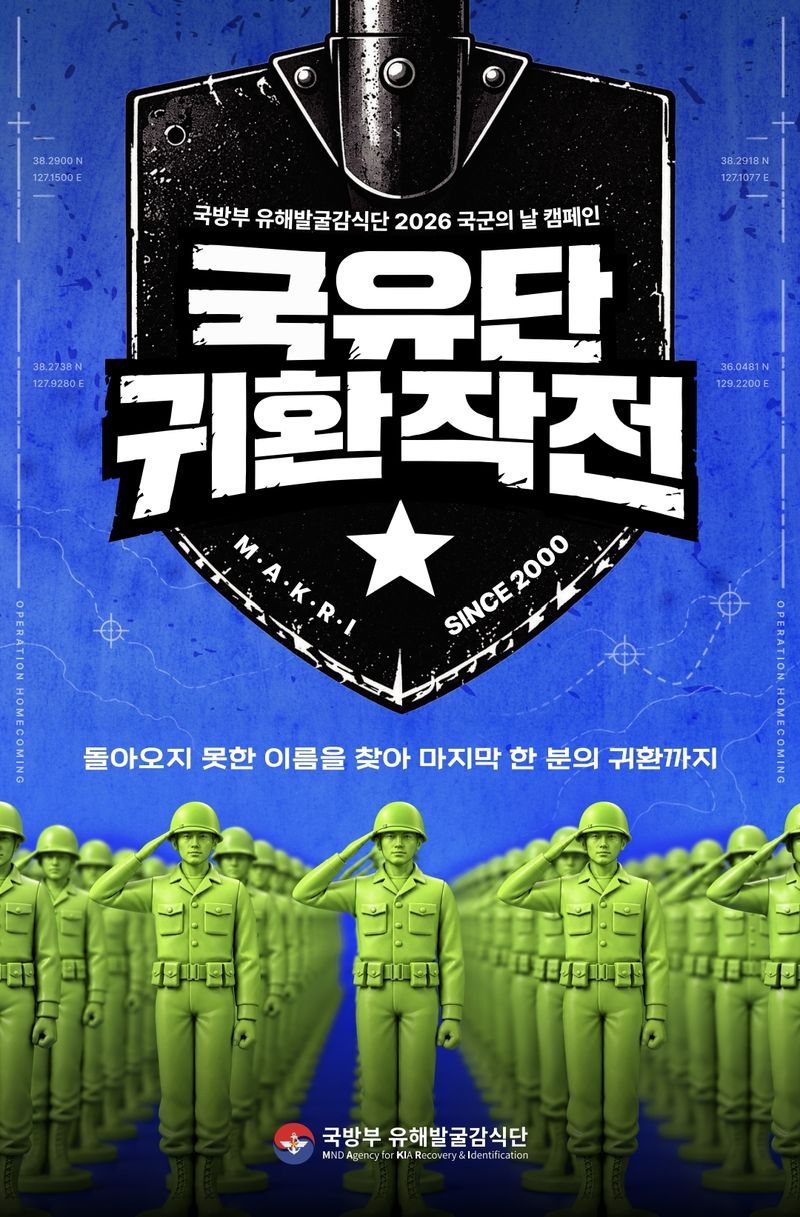
The Ministry of National Defense Agency for KIA Recovery and Identification announced on the 30th that it will hold the 'Operation Return' figurine exhibition, dedicated to the return of unrecovered Korean War fallen service members, at a pop-up photo zone in front of Dopamine Station near Exit 2 of Yongsan Station for one month starting October 1. The exhibition was created to honor the fallen heroes' spirit of sacrifice by presenting the recovery and identification work that has continued for more than 70 years since the armistice agreement as a single narrative called 'Operation Return.'
The exhibition space is divided into a 'Heroes Who Returned' booth, which tells the stories of service members whose remains were recovered, whose identities were confirmed, and who were returned to their families, and a 'Heroes Who Have Not Returned' booth, symbolizing service members who remain unrecovered in the mountains and fields. The agency has also placed unique QR codes next to the figurines, allowing visitors to view and verify each service member's recovery status and story directly on a mobile screen. A media wall beside the exhibits continuously screens the entire process, from the recovery of remains through examination and final identification.
Jeon Byeong-hui, head of the Ministry of National Defense Agency for KIA Recovery and Identification, said, "This exhibition system transparently presents in one space the history of those who have already returned and the existence of fallen service members who have yet to return." Jeon added, "I hope it will serve as an opportunity, on Armed Forces Day, to carefully reflect once again on the noble spirit of sacrifice of those killed in the Korean War and the importance of the remains recovery project."
The message the agency seeks to convey through the Operation Return exhibition is the spirit of preparedness, which reminds us that we must never again experience the pain of fratricidal conflict, as well as the importance of securing genetic data from bereaved families that can be compared with the recovered remains of those who have not yet returned to their families. The agency recently achieved the final identification of the late Sergeant Han Gil-jin. Since the remains recovery project first began in April 2000, a total of 278 Korean military personnel killed in the war have been returned to their families.
Military authorities emphasized that public interest and participation are essential to identifying the national heroes who gave their lives for South Korea but have yet to return to their families. DNA samples can be collected at public health centers, military hospitals, and other locations nationwide. Bereaved families of Korean War fallen service members may formally apply, including relatives within the eighth degree of kinship on both the paternal and maternal sides of the fallen individual. If the service member's identity is conclusively confirmed through the genetic information provided, the relevant laws stipulate that the family will receive a reward of 10 million won.
[email protected] Lee Jong-yoon Reporter