Jun Young-hyun: "Agentic AI will transform how we work" ... Samsung brings AI scholars together
- Input
- 2026-09-30 09:00:00
- Updated
- 2026-09-30 09:00:00
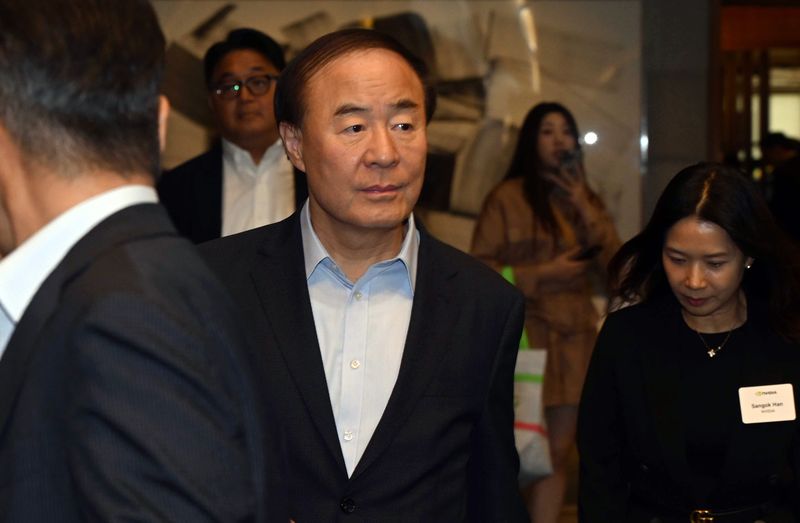
[Financial News] Jun Young-hyun, Vice Chairman and Head of Samsung Electronics' semiconductor (DS) division, said, "Agentic artificial intelligence (AI) will bring fundamental changes to the way we work and to organizational culture, going beyond simple technological innovation." He added, "Together with global AI leaders, we will explore the direction we should take and pursue practical innovation in AI technology."
Jun Young-hyun made the remarks in a welcome address at Samsung AI Forum 2026, held on the 30th at Samsung Electronics' Seocho office in Seocho-gu, Seoul.
Now in its 10th year, the AI Forum was held under the theme 'Agentic Shift: From Intelligence to Impact.' Discussions focused on ways to connect AI technologies, including agentic AI and physical AI, to real-world work and results. The forum was attended by 400 people, including 100 professors and researchers from AI graduate schools in Korea and 300 Samsung Electronics employees working in AI. It was also livestreamed on YouTube.
The morning session featured keynote speeches by experts from big tech companies and leading scholars driving the global AI ecosystem. Richard Ho, OpenAI's vice president in charge of hardware, discussed the changes that agentic AI, which makes autonomous decisions based on large language models (LLMs), could bring to companies and industries. David Green, an AI technology leader for Asia-Pacific and Japan at Amazon Web Services (AWS), drew attention by presenting security and governance strategies for implementing agentic AI safely and cost-effectively in enterprise environments.
Ranjay Krishna, a professor at the University of Washington and a prominent researcher in physical AI, presented a new paradigm for overcoming the reasoning limitations of vision-language models and implementing high-performance robotics AI with small models. Yoonhyung Kim, a vice president at Samsung Research and an adjunct professor at MIT, introduced next-generation architectural innovations in agentic intelligence designed to strengthen agents' capabilities and expand their range of applications.
The afternoon session was divided into two tracks: the AI Technology track of the DX Division and the AI Transformation (AX) Innovation track of the DS Division. Both tracks covered specific research achievements and application cases.
The AI Technology track featured presentations on efficient AI, physical AI, and continual learning. The physical AI session introduced the possibilities, limitations, and future prospects of world models and robot-based models, which are regarded as breakthroughs in physical AI, along with Samsung Electronics' related research achievements.
The AX Innovation track featured presentations on AI being directly applied to the semiconductor business and examples of AI transformation by global partners. Global partners such as Dell Technologies and Anthropic attracted attention by introducing ways to apply trustworthy AI agents to business operations, as well as methods and cases for building enterprise AI factories.
[email protected] Lim Su-bin Reporter