RICON: Full-Scale Construction Market Recovery to Come After 2027
- Input
- 2026-09-30 08:30:35
- Updated
- 2026-09-30 08:30:35
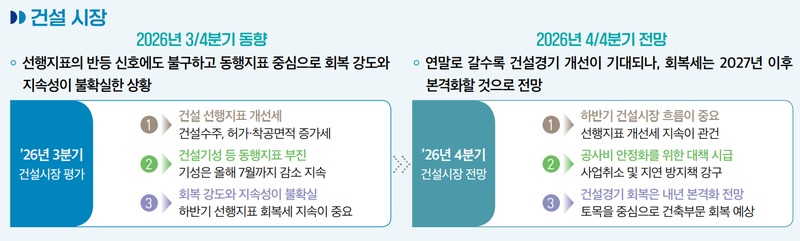
In its third-quarter 2026 report, "Construction Market and Issues Through Indicators," released on the 30th, RICON assessed the construction, specialty construction and housing markets and offered this outlook for the fourth-quarter trends.
Cumulative construction orders through July increased 15.8% from the same period a year earlier. Building permits and the area of construction starts also rose 1.4% and 4.5%, respectively, while other leading indicators, including apartment supply volumes, also turned upward.
By contrast, construction work completed declined 5.1% this year, delaying a recovery in coincident indicators. Monthly construction orders also fell 17.8% in June and 34% in July, respectively, making it uncertain whether the rebound will continue.
RICON expects construction market conditions to improve toward the latter part of the fourth quarter. However, it projects that civil engineering and building construction will recover together from 2027, when the effects of expanded social overhead capital (SOC) investment under expansionary fiscal policy, semiconductor mega-projects and Third New Towns projects begin to emerge.
The specialty construction sector saw its contract value rise, led by subcontracts, on the back of overall growth in construction orders. However, RICON said it was too early to determine whether industry conditions had improved, as the contract value is a nominal amount that includes inflation and the Business Survey Index (BSI) remains at its lowest level in the past three years.
The contract value in specialty construction is also likely to increase in nominal terms in the fourth quarter, but RICON said it would take time for the shock of rising construction costs caused by the war involving Iran to subside. Higher construction costs, jurisdictional disputes between general and specialty contractors, and the slump in regional supply markets were also cited as burdens.
The gap between the Seoul metropolitan area and regional markets widened in the housing sector. Seoul's apartment sales price index rose 5.3% from the beginning of the year as of July, while the increase in regional areas was limited to 0.1%.
The "Aug. 13 Measures to Expand Housing Supply in the Seoul Metropolitan Area" are also expected to have a limited short-term effect on stabilizing prices, given the time lag between construction starts and occupancy.
In the fourth quarter, sales and rental prices could rise together as a strong rental market coincides with a recovery in consumer sentiment. Seoul's jeonse supply-demand index reached 127.5, its highest level in about five years, while the housing market consumer sentiment index for the Seoul metropolitan area and the Bank of Korea (BOK) Consumer Sentiment Index (CSI) for housing price outlook have also risen since the second quarter.
Park Seon-gu, head of RICON's Economic and Financial Research Division, said, "For the supply expansion effects of the Aug. 13 measures to appear in the field, policy responses to improve project financing (PF) conditions, stabilize construction costs and restore construction demand in regional areas must be pursued in tandem."
[email protected] Choi Ga-young Reporter