Average Age of Regional OB-GYN Specialists Nears 60... Influx of Young Doctors Has Also Dried Up
- Input
- 2026-09-30 10:19:26
- Updated
- 2026-09-30 10:19:26
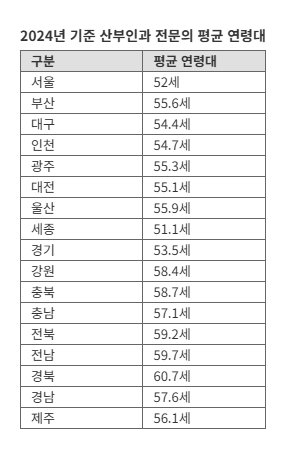
According to data submitted by the Health Insurance Review & Assessment Service (HIRA) to So Byung-hoon, a member of the Health and Welfare Committee of the National Assembly from the Democratic Party of Korea representing Gwangju-si Gap in Gyeonggi Province, the average age of OB-GYN specialists in major regional cities and provinces had risen to around 60 as of 2024.
North Gyeongsang Province had the highest average at 60.7, followed by Jeonnam at 59.7, Jeollabuk-do at 59.2, Chungcheongbuk-do at 58.7, Gangwon State at 58.4, South Gyeongsang Province at 57.6, and South Chungcheong Province at 57.1.
The pace of aging is also accelerating. Compared with 2020, the average age of OB-GYN specialists in Gangwon State rose by 3.8 years, from 54.6 to 58.4. During the same period, the average increased by 3.7 years in Jeonnam, from 56.0 to 59.7; by 2.9 years in South Gyeongsang Province, from 54.7 to 57.6; by 2.8 years in Chungcheongbuk-do, from 55.9 to 58.7; and by 2.5 years in North Gyeongsang Province, from 58.2 to 60.7.
By contrast, the influx of young specialists who will provide maternity care in the future remains minimal in regional areas. As of 2024, OB-GYN specialists in their 30s or younger were concentrated in the Seoul metropolitan area, with 262 in Seoul and 190 in Gyeonggi Province.
In province-level areas outside the capital region, the numbers were mostly in the single digits: 4 in Jeonnam, 5 in North Gyeongsang Province, 5 in Sejong Special Self-Governing City, 7 in Gangwon State, 7 in Jeollabuk-do, 7 in South Gyeongsang Province, and 8 in South Chungcheong Province.
If the specialists in their 50s and 60s currently staffing delivery rooms in regional areas retire, there will not be enough successors to take over. In particular, as it becomes increasingly difficult to secure specialists who can handle not only delivery-room operations but also emergency obstetric surgery, concerns are mounting that regional gaps in medical care could become a reality.
So Byung-hoon said, "The average age of OB-GYN specialists in regional areas has surpassed 60, and having only four or five young doctors across an entire province means that regional maternity care is facing a generational break." He added, "Given that it has become clear that simply raising reimbursement rates cannot reopen closing delivery rooms or bring back doctors who are leaving, the government must designate maternity care infrastructure as an essential national public good and develop fundamental structural solutions, including regional emergency transfer networks."
[email protected] Jeong Sang-hee Reporter