"It Doesn't Stop at Building"... What SH Envisions for Public Housing Communities in an Aging Society
- Input
- 2026-09-30 14:46:34
- Updated
- 2026-09-30 14:46:34
■ "Aging at home, not in a facility"... Annual savings of 153.4 billion won
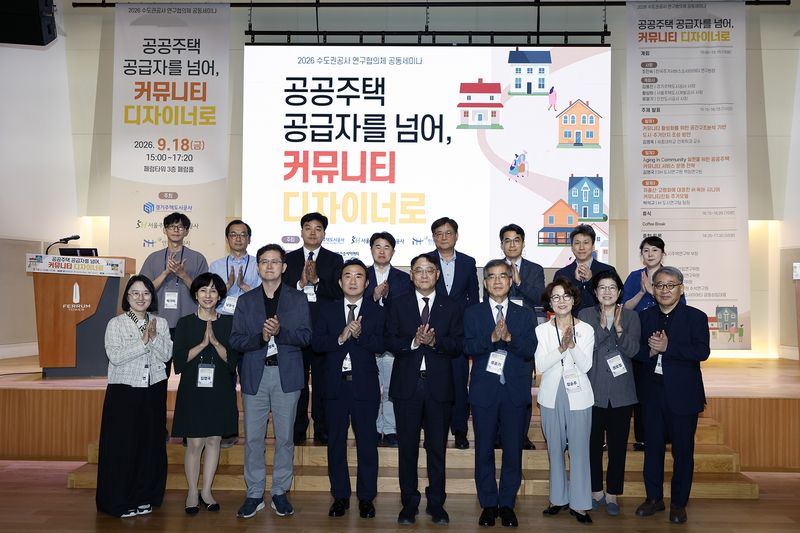
According to SH on the 30th, the SH Urban Research Institute proposed a 'Seoul-style AIC' model at the 2026 Joint Seminar of the Metropolitan Area Public Corporations Research Council, held jointly with Gyeonggi Housing & Urban Development (GH) and Incheon Metropolitan City Development (iH) on the 18th. Seoul-style AIC, or Aging in Community, is an operating model that redefines public housing as a core public asset for integrated care, with accessibility, public value and scalability.
More than 50% of residents in public rental housing, where economically vulnerable groups primarily live, are older adults. This is two to three times the national average and demonstrates that public housing communities should be the top priority for integrated-care policy.
In particular, approximately 31,000, or 32.2%, of the 96,242 older residents in SH rental housing are in the 'pre-frail stage (welfare golden zone),' when functional decline begins. An analysis found that annual social costs could be reduced by up to 153.4 billion won if these residents are supported in continuing to live in their existing homes instead of moving to facilities.
Advanced countries such as Japan and the Netherlands have already shifted their policies from facility-centered care to housing-centered 'community care (local care systems)' after experiencing fiscal crises in long-term care and other areas. South Korea, too, stands at a turning point as it enters a super-aged society.
Kim Young-guk, a senior researcher at the SH Urban Research Institute, said, "South Korea is now at the last golden window for taking preventive action. Public housing can serve as a base for building a local care system more quickly and at minimal cost."
■ Senior citizens' centers to become 'integrated-care hubs' for local communities
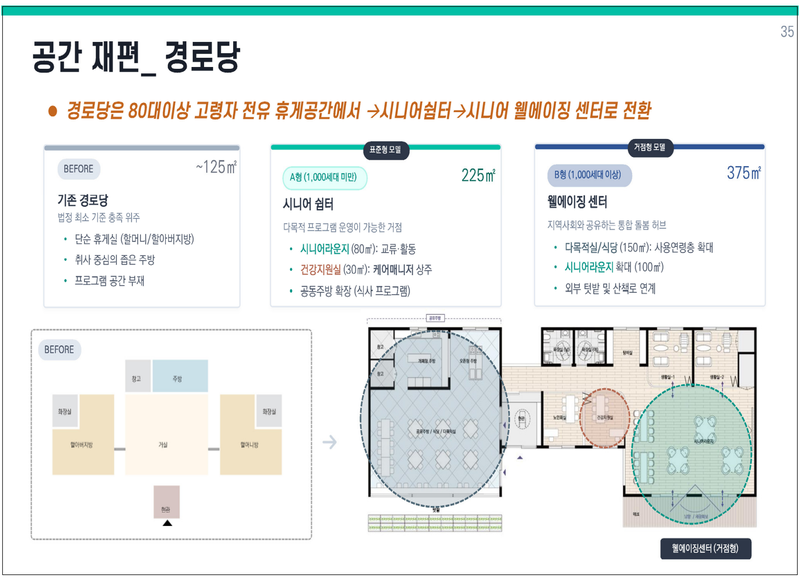
To this end, the SH Urban Research Institute proposed significantly expanding and repurposing existing senior citizens' centers, which were designed simply as places for rest. They would be transformed into 'Senior Shelters' capable of hosting multipurpose programs and 'Well-Aging Centers,' integrated-care hubs shared with the local community.
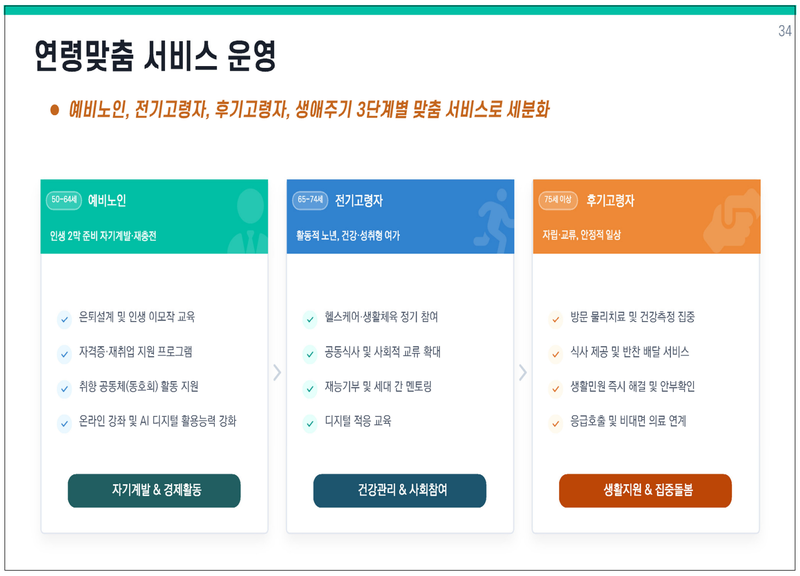
The services provided there have been organized into five areas based on residents' everyday needs: 'health management,' centered on physical activities; 'social interaction,' focused on communal meals and hobby clubs; 'self-development,' including smartphone training and reemployment assistance; 'daily-life support,' such as side-dish deliveries and welfare check-ins; and 'emergency response,' including emergency call systems linked to smartwatches. These services will be tailored to residents' ages and divided into three groups: pre-seniors (ages 50–64), younger older adults (65–74), and older older adults (75 and above).
The implementation framework for sustainable operations also stands out. Kim explained, "A collaborative governance structure can be established in which five key stakeholders—the national government, local governments, SH, the private sector, including social enterprises, and residents—divide responsibilities. Operational innovation is needed, including stationing housing welfare specialists and community leaders in each housing complex to provide close support ranging from health counseling and care for households in crisis to resolving complaints." SH President Hwang Sang-ha stated, "We will faithfully fulfill our role as community designers who work with residents to build communities where they can communicate with and care for one another."
[email protected] Jeon Min-gyeong Reporter