Biohealth Industry Employs 1.15 Million... Employment Growth Outpaces Overall Industry
- Input
- 2026-09-30 11:12:36
- Updated
- 2026-09-30 11:12:36
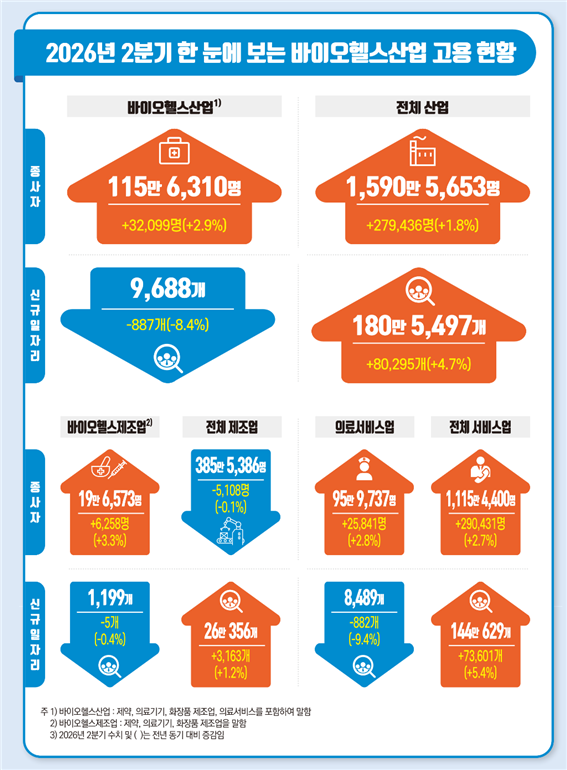
According to the Korea Health Industry Development Institute (KHIDI) on the 30th, the biohealth industry employed 1,156,000 people in the second quarter of 2026, up 2.9% year on year, or 32,000 workers. During the same period, employment across all industries grew by 1.8%, making the biohealth industry's growth rate 1.1 percentage points higher.
The pharmaceuticals, medical devices and cosmetics sectors, which make up biohealth manufacturing, employed 197,000 people, an increase of 3.3%. This contrasts with a 0.1% decline in employment across the overall manufacturing industry.
Among the individual sectors, the cosmetics industry posted the most notable employment growth. It employed approximately 45,000 people, up 8.8% from a year earlier. Employment increased particularly among younger workers, rising 9.9% among those aged 29 or younger and 9.0% among those in their 30s.
The pharmaceutical industry employed 87,000 people, an increase of 2.0%. Although the number of pharmaceutical workers aged 29 or younger fell by 4.4%, young workers accounted for 23.5% of the industry's total workforce—the highest proportion within the biohealth industry.
The medical device industry employed 65,000 people, up 1.4%. Its employment base expanded mainly at medium-sized and large establishments. The number of establishments with 30 to fewer than 300 employees rose 7.2%, while those with 300 or more employees increased 5.6%. By contrast, establishments with fewer than 30 employees declined 0.6%.
The medical services sector employed 960,000 people, an increase of 2.8% from a year earlier. This was similar to the 2.7% growth recorded across the overall services industry. However, employment growth in medical services has gradually slowed, from 4.8% in the third quarter of last year to 4.1% in the fourth quarter, 3.6% in the first quarter of this year and 2.8% in the second quarter.
A total of 9,688 new jobs were created. Medical services accounted for 8,489 of them, or 87.6% of the total. They were followed by pharmaceuticals with 436 jobs, cosmetics with 398 and medical devices with 365.
Choi Young-im, director of KHIDI's Biohealth Innovation Planning Division, said, "Despite an overall decline in manufacturing employment, biohealth manufacturing continued to grow, showing relatively solid employment trends. Youth employment is expanding, with the pharmaceutical industry maintaining a high share of young workers and the cosmetics industry recording strong employment growth, particularly among people in their 20s and 30s."
The statistics were compiled to reflect the 11th revision of the Korean Standard Industrial Classification (KSIC), so some figures differ from those based on the previous 10th revision.
[email protected] Jeong Sang-hee Reporter