7.43 Million Buildings Nationwide Covering 4.3 Billion Square Meters... Permits, Groundbreakings and Completions All Decline
- Input
- 2026-09-30 07:33:52
- Updated
- 2026-09-30 07:33:52
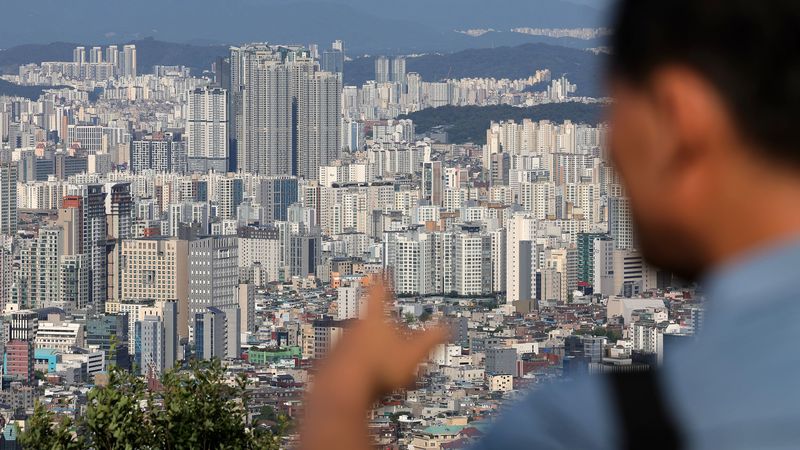
[Financial News] As of the end of last year, the number of buildings nationwide had surpassed 7.43 million, with their total gross floor area exceeding 4.3 billion square meters. However, the areas covered by building permits, construction starts and completions all declined, indicating a contraction in new construction activity.
The Ministry of Land, Infrastructure and Transport (MOLIT) said on the 30th that the number of buildings nationwide stood at 7,438,642 as of the end of 2025, up 17,039, or 0.2%, from the previous year. Their total gross floor area reached 4.37503 billion square meters, an increase of 60.04 million square meters, or 1.4%. The additional floor area was equivalent to approximately 8,409 soccer fields, based on a standard area of 7,140 square meters, or about 2,280 Jamsil Baseball Stadiums, based on an area of 26,331 square meters.
The Capital Metropolitan Area added 2,272 buildings to reach 2,077,588, covering 1.99731 billion square meters. The provinces added 14,767 buildings to reach 5,361,054, covering 2.37771 billion square meters. However, the pace of growth slowed. Gross floor area increased by 1.6% in the Capital Metropolitan Area and 1.2% in the provinces, down from 2.0% and 2.1%, respectively, in 2024. Building counts rose by just 0.1% in the Capital Metropolitan Area and 0.3% in the provinces.
Over the past 10 years, the number of buildings grew by an annual average of 0.6%, while gross floor area increased by an average of 2.3% per year. MOLIT explained that the higher growth rate for gross floor area indicates a trend toward an increasing number of larger buildings.
Residential buildings accounted for 2.01549 billion square meters, or 46.1% of the total, while commercial buildings accounted for 964.60 million square meters, or 22.0%. Industrial buildings and residential buildings recorded the highest year-on-year growth rates, at 1.7% and 1.4%, respectively.
Apartments clearly dominated residential buildings. By specific use, apartments accounted for 1.31670 billion square meters, or 65.3%, followed by detached houses at 332.75 million square meters, or 16.5%; multi-household houses at 171.87 million square meters, or 8.5%; multi-family houses at 133.65 million square meters, or 6.6%; and row houses at 45.56 million square meters, or 2.3%. Over the past five years, the number of apartment buildings grew by an annual average of 2.0%, while their gross floor area increased by 2.5% per year. In contrast, the number of detached and multi-household houses declined by an average of 0.2% annually. By city and province, apartments accounted for the highest shares of residential floor area in Sejong City at 85.4%, Gwangju at 76.9% and Busan at 75.2%. Detached houses accounted for the highest shares in South Jeolla Province at 41.8% and Jeju Province at 35.0%.
Among commercial buildings, Type 2 neighborhood living facilities accounted for the largest share at 305.62 million square meters, or 31.7%, followed by Type 1 neighborhood living facilities at 249.20 million square meters, or 25.8%, and business facilities at 197.32 million square meters, or 20.5%. Business facilities posted the highest year-on-year growth rate, at 4.0%.
By contrast, new construction activity contracted across the board. Last year, the area covered by building permits totaled 114.82 million square meters, down 8.4% from the previous year. Construction starts fell 9.6% to 82.35 million square meters, while completed floor area declined 15.4% to 100.03 million square meters. The area covered by permits has fallen for four consecutive years from 177.30 million square meters in 2021, while construction starts dropped by about half over the same period, from 158.81 million square meters.
Detailed building statistics can be accessed through the Building Administration System and are also available through the Customized Building Statistics service of the Building Life-Cycle History Management System.
[email protected] Jeong Kyung-soo Reporter