"I Thought I’d Pulled a Muscle in My Back, So I Lay Down in the Massage Chair..." On Wednesday Night, the Aorta of a Family Breadwinner in His 40s or 50s Tore [Off the Record: The Body]
- Input
- 2026-09-30 19:00:00
- Updated
- 2026-09-30 19:00:00
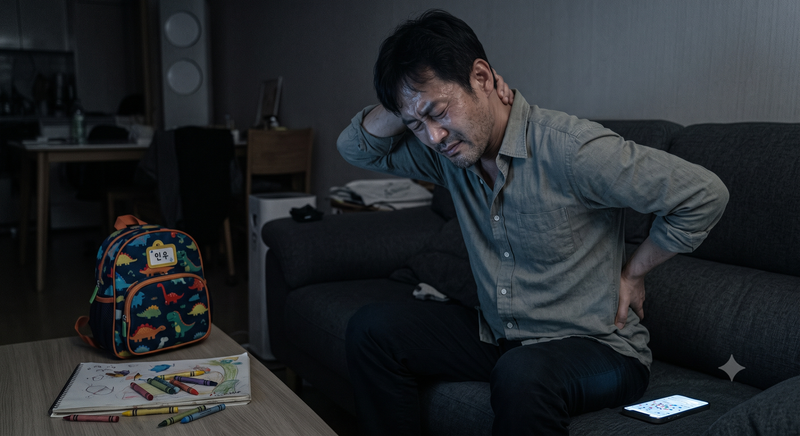
[Financial News] After enduring the first day of a hellish commute through sheer willpower, he arrives at Wednesday night, September 30.
With even his adrenaline depleted, the body of a family breadwinner in his 40s or 50s is hit with the accumulated fatigue of the holiday and the stress of daily life, piled on with merciless interest. After dinner, he sits blankly watching television on the living-room sofa when the middle of his back, between the shoulder blades, begins to ache.
"I drove long distances over the holiday and overdid it a bit yesterday. I must have pulled a muscle in my back."
Most middle-aged men ask their wives to put a pain patch on their backs or lie down in the expensive massage chair in the living room, hoping to loosen their knotted muscles.
But the moment he lies in the massage chair and its rollers begin moving across his back, the dull pain suddenly changes. An unimaginable agony erupts, as if an axe were splitting his body in two. Cold sweat pours down, and he cannot even scream.
This was not muscle pain that could be relieved with a pain patch or a massage chair. The aorta—the largest and thickest blood vessel connected to the heart—was tearing lengthwise.
The hallmark symptom of acute aortic dissection is sudden, severe pain in the chest or back. Patients often describe it as "tearing" or "like being cut with a knife."
The aorta consists of three layers: the intima, media and adventitia. In people with chronic high blood pressure, or when blood pressure surges to extreme levels because of stress, exposure to cold air during the autumn change of seasons can cause a tiny tear in the innermost layer, the intima.
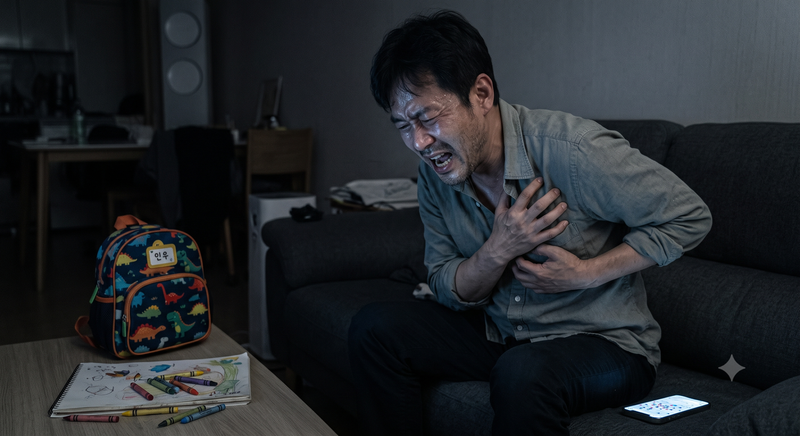
The tragedy begins when blood surging from the heart under tremendous pressure rushes through this small tear like a wave.
The blood forces its way between the aorta's intima and media, tearing the vessel wall upward and downward. That is why patients describe the pain as "starting in the chest and tearing its way down through the back toward the waist." As the dissection advances along the aorta, the pain may also move from the chest to the back or abdomen.
The problem is the reckless endurance and mistaken assumptions of men in their 40s and 50s. Statistics from The Korean Society of Cardiology show that aortic dissection occurs more than twice as often in men as in women and is concentrated among people in their 40s to 60s. ACC/AHA guidelines state that most aortic dissections occur between the ages of 50 and 70. Domestic studies have also found hypertension in 63.5% of patients.
Middle-aged men who have neglected their high blood pressure because they feel uneasy about taking medication often mistake tearing pain in the back and lower back for a slipped disc or acute muscle pain. They go to an orthopedic clinic or lie down in a massage chair, wasting the golden window for treatment.
Aortic dissection is an ultra-emergency condition in which the mortality rate rises by 1% with every hour that passes after onset. If surgery is not performed within 48 hours, half of patients die after the tear progresses through the adventitia and the vessel ruptures completely. More than the massage itself, the critical problem is that emergency treatment may be delayed while patients mistake the condition for ordinary muscle pain and try to endure it with massages or hot compresses.
The breadwinners of South Korea have lived as if heavy shoulders and stooping backs were their fate. They console themselves that the pain comes from the burden of life, then reach for a pain patch in the drawer.
But when faced with sharp pain that feels as if it is tearing apart the back and chest, any comfort or endurance is a luxury. It is not the weight of life; it is the sound of a physical catastrophe as the blood vessel of your heart can no longer withstand the strain and begins to collapse.
Rather than lying down because of the pain, call 119 emergency services and get into an ambulance immediately. That is the only way your burdened back can still be there for your family tomorrow.
[email protected] Jeon Sang-il Reporter