"Changing only the order of atomic layers to add new functions": Materials design method developed
- Input
- 2026-10-02 03:00:00
- Updated
- 2026-10-02 03:00:00
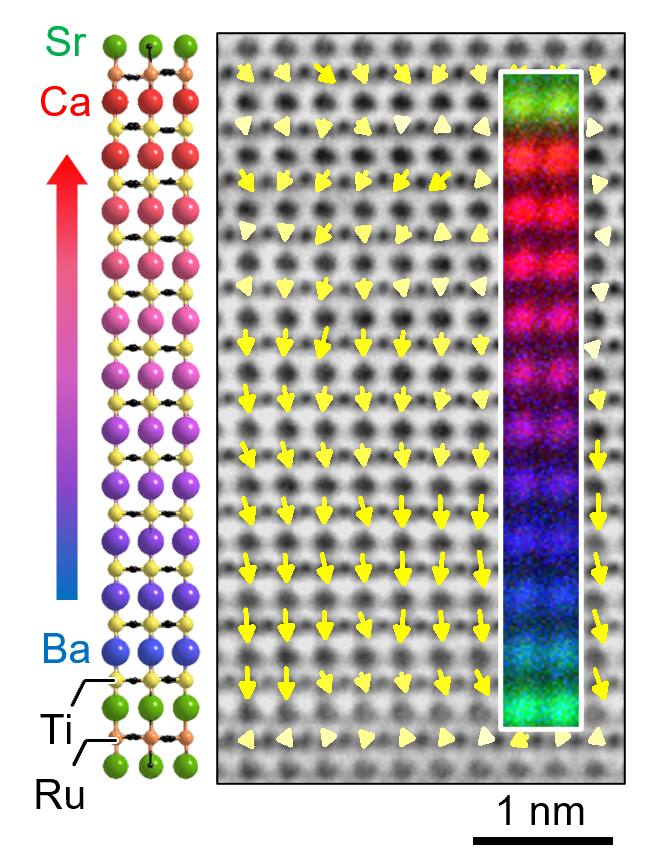
The Ministry of Science and ICT said on the 2nd that a joint research team led by Professors Dae-Su Lee, Gil-Ho Lee and Choi Si-Young of Pohang University of Science and Technology (POSTECH), and Professor Se-Young Park of Soongsil University, precisely designed the compositional arrangement of atomic layers to implement new functions in metals and ultrathin insulating materials.
The findings, produced under the Ministry of Science and ICT's Basic Research Program, including the Core Research and Leading Research Centers programs, were published on the 2nd in Science, the world's leading academic journal.
According to the research team, new elements have traditionally been added or the ratios of existing elements changed to give materials new functions. However, these processes can alter or eliminate the properties a material originally possessed, making it difficult to add new functions while preserving its existing strengths.
The team developed a "selective atomic gradient" design method that leaves atoms associated with a material's electronic properties unchanged while slightly varying, from one atomic layer to the next along the thickness direction, the ratio of selected atoms of different sizes.
By creating differences in atomic ratios along the thickness direction, like a gradient in which colors gradually change, the atoms became slightly displaced toward one side, forming polarity within the material. Reversing the order of the atomic layers also reversed the direction of the polarity. No such directional alignment appeared in a material in which the same types and quantities of atoms were mixed uniformly.
When the design method was first applied to a metal thin film, the material retained its existing ability to conduct electricity well, while its resistance differed depending on whether current flowed in one direction or the opposite direction. Changing the order of the atomic layers also reversed the direction of the resistance difference, confirming that the material's electrical directionality can be controlled during fabrication. When the method was then applied to an ultrathin insulating material approximately 5.1 nanometers (nm) thick, leakage current was greatly reduced while its ability to store electrical energy remained high.
In particular, its ability to convert temperature changes into electrical signals was approximately 100 times higher than that of a representative comparison thin film of similar thickness. Reversing the order of the atomic layers also reversed the direction of the electrical signal generated by temperature changes.
The findings are expected to contribute to the development of electronic devices that operate differently depending on the direction of current, next-generation semiconductor ultrathin insulating films with reduced leakage current, and infrared and thermal sensors that detect temperature changes.
Professor Dae-Su Lee, who led the study, said, "We demonstrated that new functions can be added by changing only the order in which atoms are stacked, without adding new elements, while preserving a material's original strengths." He added, "We plan to extend this method to a wider range of materials, including magnetic materials and superconductors, and conduct follow-up research to implement it in actual devices such as ultrathin insulating films and thermal sensors."
[email protected] Yeon Ji-an Reporter