"AI Data Centers Must Have Power Infrastructure and an Ecosystem for Corporate Use"
- Input
- 2026-09-29 18:28:15
- Updated
- 2026-09-29 18:28:15
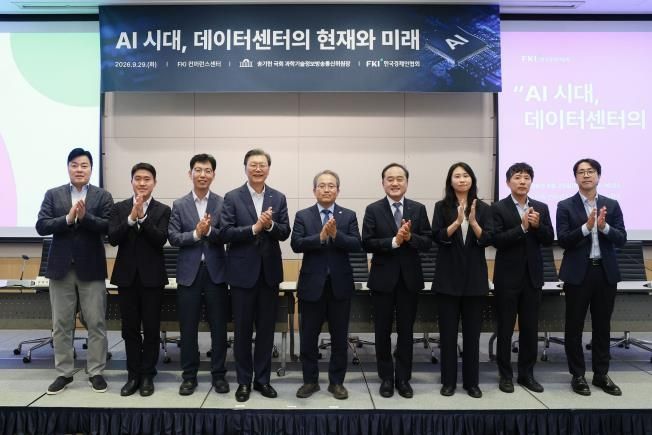
[Financial News] Experts have called for urgent action to secure stable power supplies and suitable sites, develop policies tailored to the characteristics of different types of data centers, and link them with local industries if investments in artificial intelligence (AI) data centers are to lead to AI-driven productivity gains across industries.
The Federation of Korean Industries and Song Ki-heon, chair of the Science, ICT, Broadcasting, and Communications Committee of the National Assembly, held the "AI Era: The Present and Future of Data Centers" seminar on the 29th at the FKI Tower Conference Center in Yeouido, Seoul. They discussed global policy trends and development challenges facing the domestic data center industry.
In his opening remarks, Song Ki-heon said, "Enhancing AI competitiveness requires not only securing advanced technologies and infrastructure but also establishing institutional support." He added, "We will examine the difficulties faced by industries and establish an institutional foundation to promote data center investment and the growth of the AI infrastructure industry."
In his welcoming remarks, Kim Chang-beom, full-time vice chairman of FKI, said, "As securing computing resources has emerged as a key competitive advantage determining the fortunes of nations and companies, investment in data centers must lead to tangible productivity gains across the economy." He added, "The starting point is to build stable infrastructure, including power and telecommunications, while simultaneously creating a utilization ecosystem in which companies and research institutions can collaborate and use it effectively."
Thematic presentations offered specific policy alternatives based on regulatory trends in leading countries and the state of domestic infrastructure.
Nayeong Kim, a director at Wood Mackenzie, said, "Our analysis of around 100 related policies in North America, Europe, and Asia found that North America is focusing on rapid power supply and easing the burden on consumers, while Europe is concentrating on grid-connection readiness and stronger energy-efficiency standards." She explained, "Asia is seeking a balance between attracting investment and strengthening infrastructure management."
She also noted, "The order and cost-sharing arrangements for connecting data centers to power grids, as well as methods of supplying electricity, are common challenges for all countries." She recommended, "As investment expands, it is necessary to consider the speed and stability of power supply together with operational efficiency."
Based on an analysis of 97 domestic data centers—69 in operation and 28 under construction or planned—Lee Je-hoon, head of FKI's New K-Industry Team, divided data centers into training-oriented and inference-oriented facilities and called for policies tailored to each type.
Lee Je-hoon emphasized, "For training-oriented data centers, where operating and construction costs are important, the key is to reduce costs through electricity-rate and tax support and by using idle land near industrial complexes and power-generation sources. For inference-oriented data centers, where access to demand centers is important, improving grid-connection conditions in the Seoul metropolitan area must go hand in hand with creating a relevant demand base outside the metropolitan area."
During the panel discussion, Jeongcheol, the association's chief research executive and president of the Korea Economic Research Institute, served as moderator. Participants discussed development strategies and cooperation measures for the data center industry under the theme "Three Mega-Projects and Policy Direction for Data Centers."
Jeongcheol said, "Because data centers are complex infrastructure combining power, regulation, and investment incentives, industrial and energy policies must be designed together." He added, "For the three mega-projects to become the foundation for AI transformation across all industries, infrastructure development and the creation of a utilization ecosystem must be pursued simultaneously from the construction stage."
[email protected] Park So-hyun Reporter