[Editorial] There Is No Reason to Hesitate Over the Comprehensive and Progressive Agreement for Trans-Pacific Partnership (CPTPP), but Measures for Agriculture and Fisheries Must Come First
- Input
- 2026-09-29 18:10:16
- Updated
- 2026-09-29 18:10:16
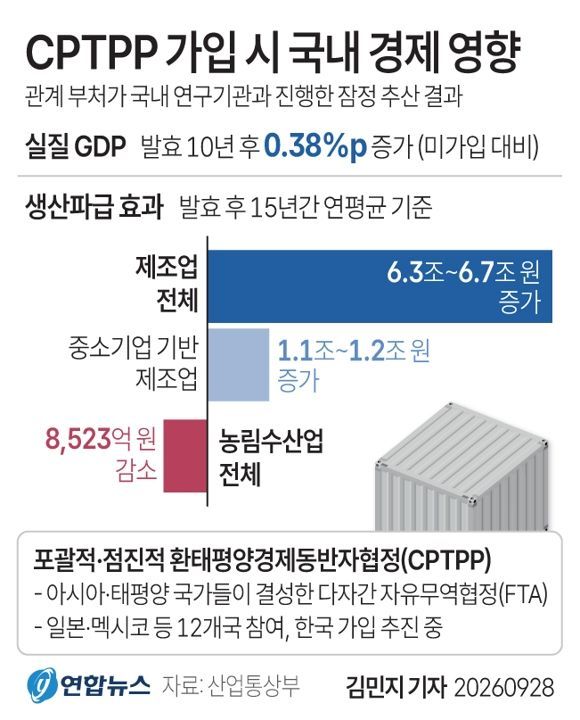
According to the provisional results of an economic impact analysis released on the 28th by the Ministry of Trade and Industry and other relevant ministries, real GDP 10 years after the agreement takes effect would be 0.38 percentage points higher than if Korea did not join. The impact on manufacturing output is expected to reach up to 6.7 trillion won annually on average over 15 years. By contrast, output in agriculture, forestry and fisheries is estimated to decline by approximately 850 billion won annually on average over the same period.
CPTPP is a 'mega free trade agreement (FTA)' that covers not only tariff elimination but also broad trade rules on digital issues, labor and the environment. Twelve countries, including Japan, Canada, Australia and the United Kingdom, participate, and the member economies account for approximately 15% of global GDP. Amid the spread of protectionism and continued supply chain restructuring, joining a major economic bloc is an important task for export-dependent South Korea. An analysis that the increase in manufacturing output would be nearly eight times the decline in agriculture, forestry and fisheries output also supports the economic case for joining.
However, the damage to agriculture and fisheries should not be judged solely by the numbers. South Korea already has FTAs with 10 of the 12 members, excluding Japan and Mexico. If it joins CPTPP, it would have to further open its market to Mexico, with which it has no FTA, and Japan, where only the Regional Comprehensive Economic Partnership (RCEP) applies. An increase in low-priced imports of agricultural products as a result could weaken the economic foundations of rural and fishing communities already grappling with aging populations and financial difficulties. This is why concerns have emerged that export companies would reap the benefits while farmers and fishers bear the burden.
The government's release of the analysis ahead of the public hearing is meaningful in terms of transparency. It must now draw up substantive countermeasures. After carefully analyzing the scale of damage by product, the government should present concrete income-compensation measures. It should also devise ways to strengthen competitiveness, such as supporting seafood processing and improving distribution structures. As the spread of K-food has expanded export opportunities for agricultural and fishery products, market opening could also become a new opportunity. It is also worth recalling that efforts to join CPTPP in 2022 were halted amid farmers' and fishers' opposition over the high market-opening rate and the possibility of importing seafood from Fukushima.
President Lee Jae Myung said on X (formerly Twitter) on the 29th that he would meet with representatives of the agriculture, fisheries and livestock sectors in person soon and listen fully to their views. He also proposed making up the shortfall in the FTA damage-support fund with public funds and using part of the increase in exports to compensate for the losses. It is positive that the president has personally shown his willingness to communicate. However, the new funding mechanism must be carefully designed to avoid controversy among stakeholders. The National Assembly, too, should cooperate on a bipartisan basis to reduce unnecessary conflict. If sophisticated compensation and structural reform are pursued together, CPTPP could become a new springboard for the South Korean economy.