[Editorial] Unemployment Benefits Are Leaking Away; Consider Reductions and Step Up Enforcement
- Input
- 2026-09-29 18:10:04
- Updated
- 2026-09-29 18:10:04
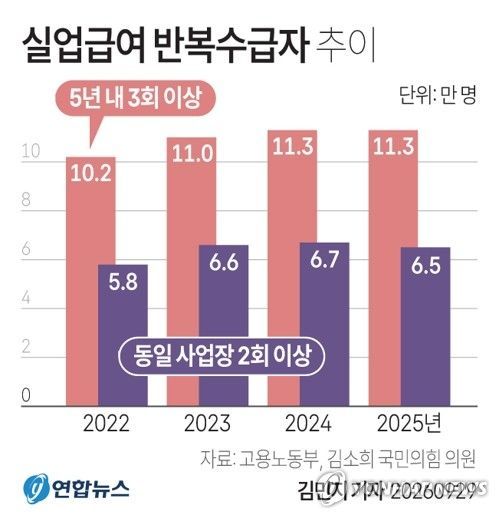
Repeat receipt is a particular problem. Data obtained by the office of Kim Sohee, a People Power Party lawmaker on the National Assembly Committee on Climate, Energy, Environment and Labor, from the Ministry of Employment and Labor show that 113,000 people received unemployment benefits three or more times within five years last year. The figure has continued to rise, from 102,000 in 2022. The unemployment benefits paid to them totaled 599.7 billion won last year, averaging about 5.3 million won per person. Some 65,000 people received benefits after repeatedly leaving and rejoining the same workplace, while one person received them as many as seven times.
Moral hazard surrounding unemployment benefits can generally be divided into ordinary fraudulent claims and repeat receipt. Fraudulent claims are crimes for which there is no excuse. The number of cases detected exceeds 20,000 every year. Many involved people concealing the fact that they had found work during the benefit period and colluding with employers to receive their wages in cash. There was also a person who, after voluntarily quitting, colluded with the owner of a former business contact to fabricate a short-term employment contract.
In one recent case, authorities found that a business owner operating five workplaces outside the capital region had recruited fictitious workers through four brokers over the past seven years and pocketed 540 million won in unemployment benefits, among other funds. Such fraudulent claims are no different from crimes that steal the share belonging to workers and employers who faithfully paid their insurance premiums.
Repeat receipt should be viewed differently from fraudulent claims. Unemployment benefits are intended for people who have involuntarily left their jobs and are seeking reemployment. The number of people who received benefits five or more times rose from 13,000 in 2022 to 15,000 last year, and the amount paid to them last year reached 61.086 billion won. An increase in repeat receipt resulting from short-term employment is undesirable for several reasons. It indicates that structural factors, such as instability in the labor market, are at work.
In the contract and short-term job markets, people may repeatedly lose their jobs for legitimate reasons beyond their control. Therefore, not all repeat recipients can be viewed as potential abusers. The fact that someone received benefits several times alone does not mean that the person committed fraud or engaged in moral hazard. However, there is a strong possibility that cases involving deliberate exploitation of the system are mixed in. This includes deliberately repeating the cycle of quitting and rejoining jobs. Authorities must conduct a thorough investigation into whether the system's loopholes were exploited.
Unemployment benefits are the last line of defense for helping people who have lost their jobs get back on their feet. We must plug the leaks and build a robust safety net. First and foremost, it is urgent to block channels for fraudulent claims at the source. In particular, authorities must examine whether the growing number of repeat claims is turning into fraudulent receipt. If warning signs emerge, they should determine what is happening on the ground through field investigations.
Specifically, authorities should consider whether investigations are needed by industry, workplace, and reason for leaving a job, focusing on groups with high numbers of repeat claims. Based on this, they need to distinguish and manage legitimate repeat claims and suspicious cases. If unemployment benefits are too generous or can be obtained fraudulently too easily, they undermine people's willingness to work. Prompt reforms to the system and related policies are needed, including adjusting benefit levels and cracking down firmly on fraud.