Ruling Party: "DMZ Mines Were Laid During the Yoon Suk Yeol Administration"... Countering Claims of Lee Jae-myung Administration Responsibility
- Input
- 2026-09-29 16:51:37
- Updated
- 2026-09-29 16:51:37
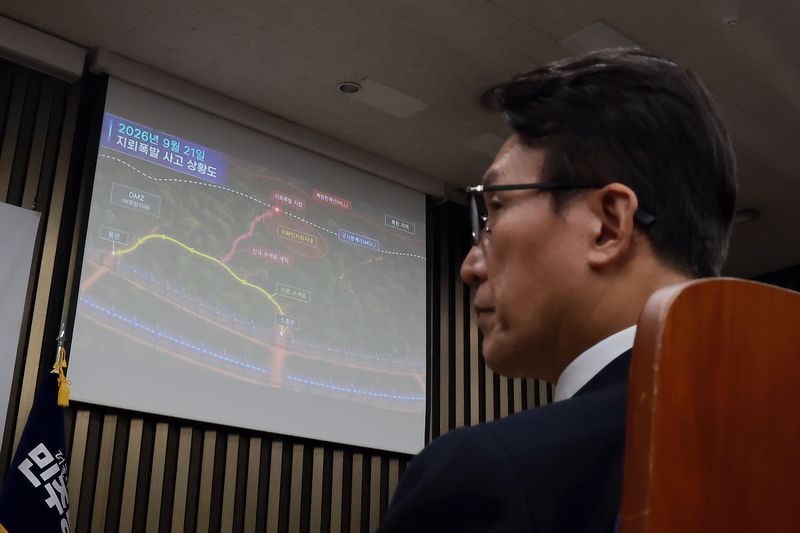
Kim Byung-joo, a lawmaker from the Democratic Party of Korea, explained at a general meeting of lawmakers held at the National Assembly that North Korea began installing mines after declaring "two hostile states" at the end of 2023 and effectively turning the Military Demarcation Line into a border, with the related work entering full swing in April 2024. Kim said, "The Yoon Suk Yeol administration essentially stood by and did nothing at the time," adding, "I believe that if decisive action had been taken, the unfortunate incident we are seeing today would not have occurred."
However, Kim also explained that the South Korean military had detected North Korea's movements and called on the UNC to respond. After identifying changes in the terrain near the MDL through aerial photographs, the military asked the UNC to conduct an on-site inspection and requested that North Korea's actions be classified as both a violation of the Armistice Agreement and a provocation. Kim said, "The UNC surprisingly determined that it was neither a violation of the Armistice Agreement nor a provocation," adding that the UNC's assessment at the time was that North Korea's barbed-wire fences and mines were part of a "defensive system," rather than being intended for attack. He continued, "I was also extremely angry. I asked why the UNC was being so passive."
Kim also dismissed allegations of a "cover-up and delayed investigation" over the delay in examining the site after the incident. The location was an unidentified minefield without an existing search route, requiring the military to clear a new path of approximately 200 meters to reach the site. UNC approval and the deployment of surveillance and escort forces were also necessary. Kim said, "It is fake news that we initially refused the investigation even though the UNC had requested it first," and rejected the claim that the investigation schedule had been moved up at the People Power Party's request, saying, "That is completely untrue. The UNC Military Armistice Commission and our military assessed the situation and selected the most appropriate date."
At the same time, Kim called for a stronger response to North Korea. He announced that additional North Korean mines had been found during the on-site inspection, saying, "It has been confirmed that North Korea installed mines as far south as the area south of the Military Demarcation Line." He added, "We believe that North Korea clearly violated the Armistice Agreement and that this was also a provocation."
National Defense Committee members from the Democratic Party of Korea proposed that the committee issue a statement condemning North Korea. Kim said he understood that the UNC Military Armistice Commission also viewed the incident as a violation of the Armistice Agreement and a provocation, adding, "Our party needs to condemn North Korea more strongly and work out a response to it."
[email protected] Song Ji-won Reporter