Jeju 4.3 and Gwangju May 18 Memories Linked in 'Yoon Sang-won' Exchange Exhibition
- Input
- 2026-09-29 16:35:08
- Updated
- 2026-09-29 16:35:08
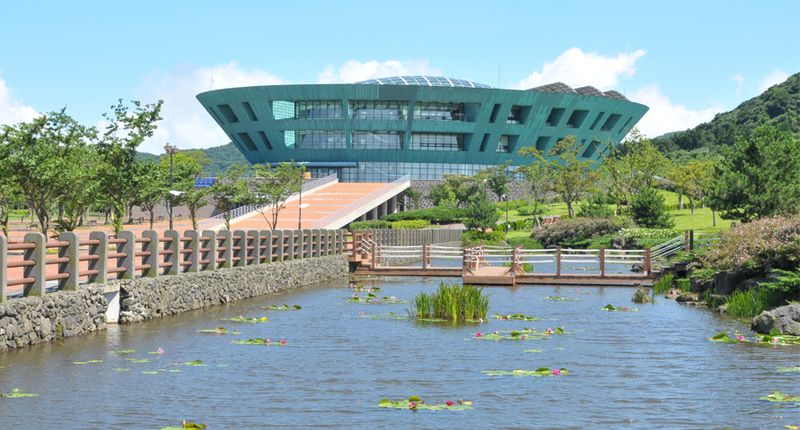
【Financial News Jeju = Reporter Yong-bok Jeong】 An exhibition linking the memories of Jeju 4.3 and the May 18 Democratization Movement through art will be held at the Jeju 4.3 Peace Memorial Hall. The exhibition revisits the life of Yoon Sang-won, who served as a spokesperson for the citizens' militia during the May 18 Democratization Movement, and the events in Gwangju in May 1980 through a series by artist Ha Seong-heup.
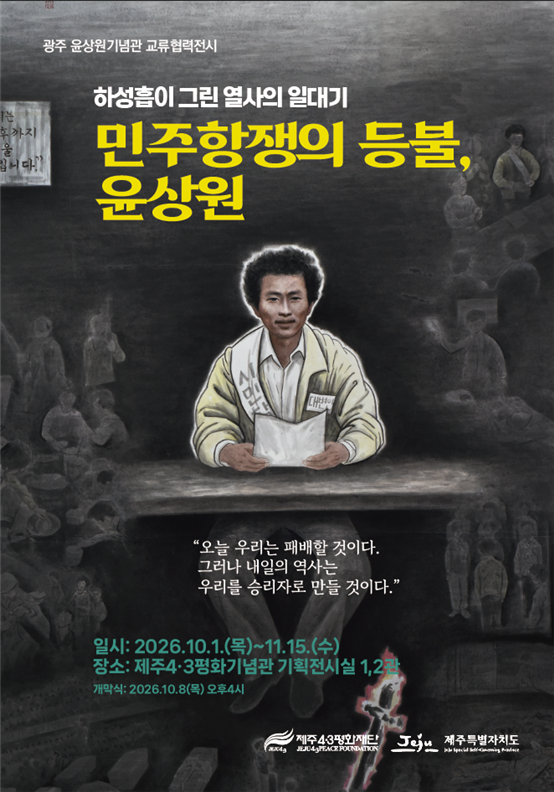
The Jeju 4.3 Peace Foundation said on the 29th that the special exhibition 'Yoon Sang-won, a Beacon of the Democratic Uprising' will be held in the special exhibition room of the Jeju 4.3 Peace Memorial Hall from Oct. 1 to Nov. 15. The opening ceremony will take place at 4 p.m. on Oct. 8.
The exhibition was organized as an exchange and cooperation project between the Jeju 4.3 Peace Foundation and the Gwangju Yoon Sang-won Memorial Hall. It focuses on looking back at the memories left by Jeju 4.3 and the May 18 Democratization Movement through the life and artworks of a person connected to May 18, viewed from Jeju.
At the center of the exhibition is Ha Seong-heup's series depicting Yoon Sang-won's life. The works follow Yoon Sang-won's experiences and scenes from Gwangju in May 1980, showing how an individual's life intersected with a chapter of modern Korean history. Ha has worked primarily on May 18 and Yoon Sang-won and has consistently presented a series portraying Yoon Sang-won's life.
The May 18 Democratization Movement began as citizens' resistance to the martial law forces' heavy-handed crackdown and shooting in Gwangju in May 1980, eventually developing into a large-scale uprising. Extensive records remain, including statements, declarations, diaries and photographs created by citizens at the time. Related records have been inscribed in the UNESCO Memory of the World.
The exhibition does not present Jeju 4.3 and May 18 as the same historical event. The two events differed in when they occurred, as well as in their political and social backgrounds and their courses of development. Jeju 4.3 involved armed conflict and suppression that began with the March 1 shooting incident in 1947 and continued until 1954, resulting in the deaths of countless residents. A government fact-finding report established the large-scale civilian deaths caused by state power.
Against the backdrop of these differences, the Jeju 4.3 Peace Foundation designed the exhibition to examine the histories of the two regions together through their shared experiences of state violence and human rights violations, efforts to uncover the truth and restore victims' honor, and the expansion of social memory.
The exhibition is also significant because it was organized as an exchange exhibition with the Gwangju Yoon Sang-won Memorial Hall. Established in 2008 under a special law, the Jeju 4.3 Peace Foundation carries out additional fact-finding investigations, memorial and family-support programs, cultural and academic research, peace education, and peace-exchange projects.
The exhibition differs from conventional history exhibitions in that it foregrounds one person's life and artworks rather than presenting historical events primarily through documents and timelines.
Visitors will follow Yoon Sang-won's personal history and encounter the Wildfire School, citizens' resistance, and the situation in Gwangju in May 1980 through the artworks. The exhibition title, 'Yoon Sang-won, a Beacon of the Democratic Uprising,' also reflects its aim of examining the choices made by citizens at the time and the community's memory through one individual's life.
Im Mun-cheol, chair of the Jeju 4.3 Peace Foundation, said, "Jeju 4.3 and May 18 are histories that awakened the values of truth and justice, democracy and human rights amid the pain of state violence. I hope this exhibition will serve as an opportunity to connect the memories of Jeju and Gwangju and reflect on the meaning of the democracy protected by citizens."
[email protected] Yong-bok Jeong Reporter