[Exclusive] Deaths without next of kin among people under 40 rise 71% in four years... Young people left alone, too
- Input
- 2026-09-29 15:53:43
- Updated
- 2026-09-29 15:53:43
[Financial News] As deaths without next of kin are rising rapidly among young people as well as older adults, calls are growing for measures to address social isolation, including severed ties with family and acquaintances. Experts emphasized that support systems must do more than identify socially isolated young people; they must also keep them connected to social networks over time.
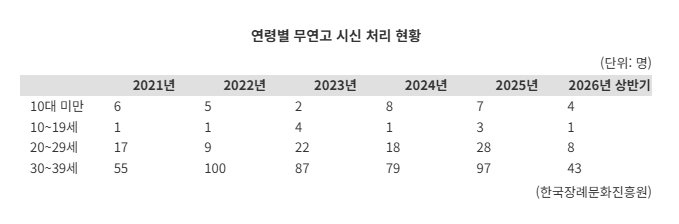
According to data provided by the Korea Funeral Culture and Policy Institute on the 29th, the number of unclaimed bodies processed for people under 40 rose from 79 in 2021 to 135 last year, a 70.9% increase over four years.
By age group, the number increased across every group from children under 10 to people in their 30s. The figure for children under 10 rose from six to seven over the same period, while the number for teenagers increased from one to three. Among people in their 20s, the number rose from 17 to 28, a 64.7% increase.
People in their 30s recorded the largest increase. The number of deaths without next of kin among those in their 30s surged from 55 in 2021 to 100 in 2022, before reaching 87 in 2023, 79 in 2024 and 97 in 2025. That represents a 76.4% increase over four years. People in their 30s accounted for 71.9% of the 135 people under 40 who died without next of kin last year.
Deaths without next of kin among young people have continued this year. In the first half of this year, 56 unclaimed bodies of people under 40 were processed: four involving children under 10, one involving a teenager, eight involving people in their 20s and 43 involving people in their 30s. Those in their 30s accounted for 76.8% of the total.
Although the absolute number of deaths is lower than among older adults, some say deaths without next of kin can no longer be viewed as an issue affecting only the elderly. Cases have emerged among young people in which no family member or acquaintance is available to take custody of the remains, or next of kin refuse or avoid doing so. This has fueled calls for greater attention to the breakdown of social relationships underlying the problem.
Experts stressed that responding to deaths without next of kin among young people requires a system that continues to connect isolated young people to social networks after they are identified, so they do not become disconnected again.
Lee Seo-yeon, a professor in the Department of Home Economics Education at Chonnam National University, said, "Identifying young people is important, but we also need to find ways to ensure that they can remain within social networks after they are identified." She added, "From a policy perspective, it is important to identify people who have become disconnected from their families or society and support them in maintaining those relationships." She said continuous support through local communities and welfare institutions is necessary to prevent isolated young people from becoming disconnected again after receiving assistance.
Yongho Chon, a professor in the Department of Social Welfare at Incheon National University, cited weakening ties among families and relatives as a factor behind the increase in deaths without next of kin among young people. Chon explained, "Ties among relatives have weakened compared with the past, and when low income or health problems are added to the mix, relationships can break down even among immediate family members, such as parents and children." He added, "If this disconnection continues for a long time, it can lead to situations in which family members refuse to take custody of the remains, even when family exists."
Some also said opportunities should be expanded for young people to reconnect with society before social isolation becomes prolonged. Chon added, "When failures to find employment are repeated, young people may reduce their interpersonal relationships and become isolated at home because of a sense of failure and declining self-esteem." He continued, "Policies should expand opportunities for young people to work and meet others through social activities, alongside welfare support such as mental health counseling."
[email protected] Lee Dong-hyuk Reporter