Korean Society of Interventional Cardiology Launches Campaign with Comedian Kim Soo-yong to Prevent Recurrent Heart Attacks
- Input
- 2026-09-29 15:37:57
- Updated
- 2026-09-29 15:37:57
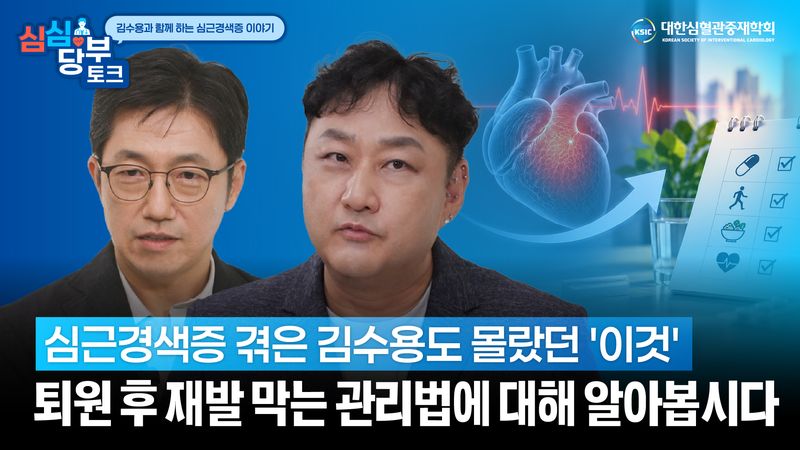
On the 29th, World Heart Day, the Korean Society of Interventional Cardiology released a video titled "Simsim Dangbu Talk" as part of its 2026 Jeo-jeo-ik-seon 365 Campaign. The video features Kim Soo-yong and Yoon Young-jin, a cardiology professor at Wonju Severance Christian Hospital. It recounts the circumstances surrounding Kim's heart attack and his experience managing his health after treatment, while explaining the importance of managing LDL cholesterol to prevent recurrence.
According to the Korea Disease Control and Prevention Agency's 2023 Statistics on Cardiovascular and Cerebrovascular Diseases, the number of myocardial infarction cases in South Korea rose 40.3%, from 24,786 in 2013 to 34,768 in 2023. In particular, recurrent myocardial infarction cases increased 90.8% over the same period, from 1,768 to 3,373. This was about 2.5 times the 36.4% increase in first-time myocardial infarction cases.
Myocardial infarction has a mortality rate of 20–30% even at the first occurrence, and the fatality rate can rise to 68–85% if it recurs. Continuous management is therefore necessary even after treatment.
In the video, Kim Soo-yong said he felt a crushing pain in his chest before a filming session last November. Thinking it was muscle stiffness, he applied a pain-relief patch and headed to the filming location. After undergoing an electrocardiogram test at a local clinic, he was advised to visit a major hospital, but he did not go immediately and later suddenly collapsed at the filming site. After receiving CPR from colleagues and emergency treatment from 119 emergency medical responders, Kim underwent treatment. He explained that he has since quit smoking and visits the hospital every three months for blood tests, ultrasound examinations and other checkups.
Professor Yoon Young-jin stressed that people who experience chest pain lasting more than 30 minutes or cold sweats should not try to determine the cause on their own, but should promptly go to an emergency room. He explained that widening a blocked blood vessel through a procedure does not mean treatment is over. The disease can recur at the site where a stent was inserted, and the mortality rate of patients who have experienced myocardial infarction twice can be nearly twice that of patients who have experienced it once.
In particular, patients at very high risk of cardiovascular disease, including those with myocardial infarction, are advised to lower their LDL cholesterol to below 55 mg/dL and reduce it by at least 50% from baseline. Accordingly, they should return to the hospital within one month of treatment whenever possible for a lipid test and to check whether they have reached the target level and how they are responding to treatment.
In the video, the society also presented "three aftercare rules" for preventing recurrent myocardial infarction: visit the hospital for a lipid test within one month of treatment whenever possible, lower LDL cholesterol to below 55 mg/dL, and continue maintaining the target level without stopping treatment on one's own even after reaching it.
Professor Yoon Young-jin said, "Myocardial infarction is not a disease that can be cured through a procedure; it is a condition whose risk of recurrence must be managed for life." He added, "Lowering LDL cholesterol to below 55 mg/dL and maintaining it over the long term is key to preventing recurrence." He also stressed, "Because LDL cholesterol levels can rise again if medication is stopped arbitrarily, prescribed medication must be continued."
Bon-Kwon Koo, president of the Korean Society of Interventional Cardiology, said, "We hope this video will encourage patients with myocardial infarction to return to the hospital for a lipid test within one month of treatment whenever possible and to consistently manage their LDL cholesterol at the target level."
[email protected] Jeong Sang-hee Reporter