Jeju's Borrowed Funds Reach 1.56 Times Its Fiscal Funds as Borrowing Burden Expands for Third Straight Year
- Input
- 2026-09-29 16:06:17
- Updated
- 2026-09-29 16:06:17
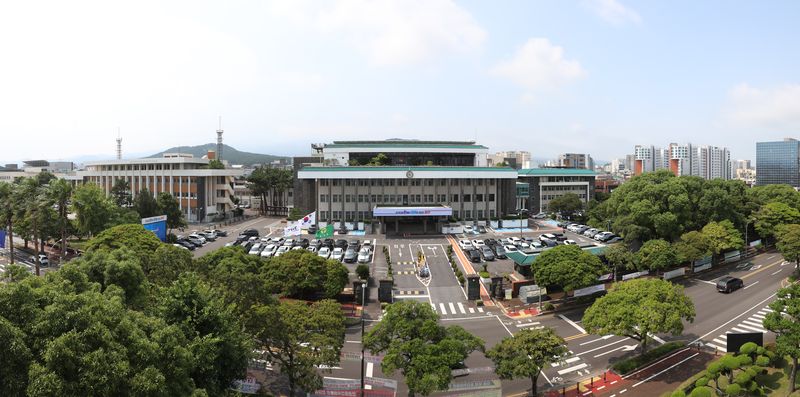
【Financial News, Jeju—Reporter Jung Yong-bok】 Jeju Special Self-Governing Province borrowed 1.56 times more from the central government and financial institutions, among others, than the cash and short- and long-term financial products it held. The borrowing liabilities-to-fiscal funds ratio rose for the third consecutive year, from 82.1% in 2022 to 155.8% last year.
According to Jeju Special Self-Governing Province on the 29th, the borrowing liabilities-to-fiscal funds ratio stood at 155.8% at the end of last year, up 25.8 percentage points from 130.0% a year earlier.
Fiscal funds consist of the cash and short- and long-term financial products held by Jeju Special Self-Governing Province. Borrowing liabilities are funds borrowed from the central government or financial institutions, among others, that must be repaid in the future. A ratio of 155.8% means that for every 100 won in fiscal funds, there are 155.8 won in borrowing liabilities.
■ 155.8 Won in Borrowing Liabilities for Every 100 Won in Fiscal Funds
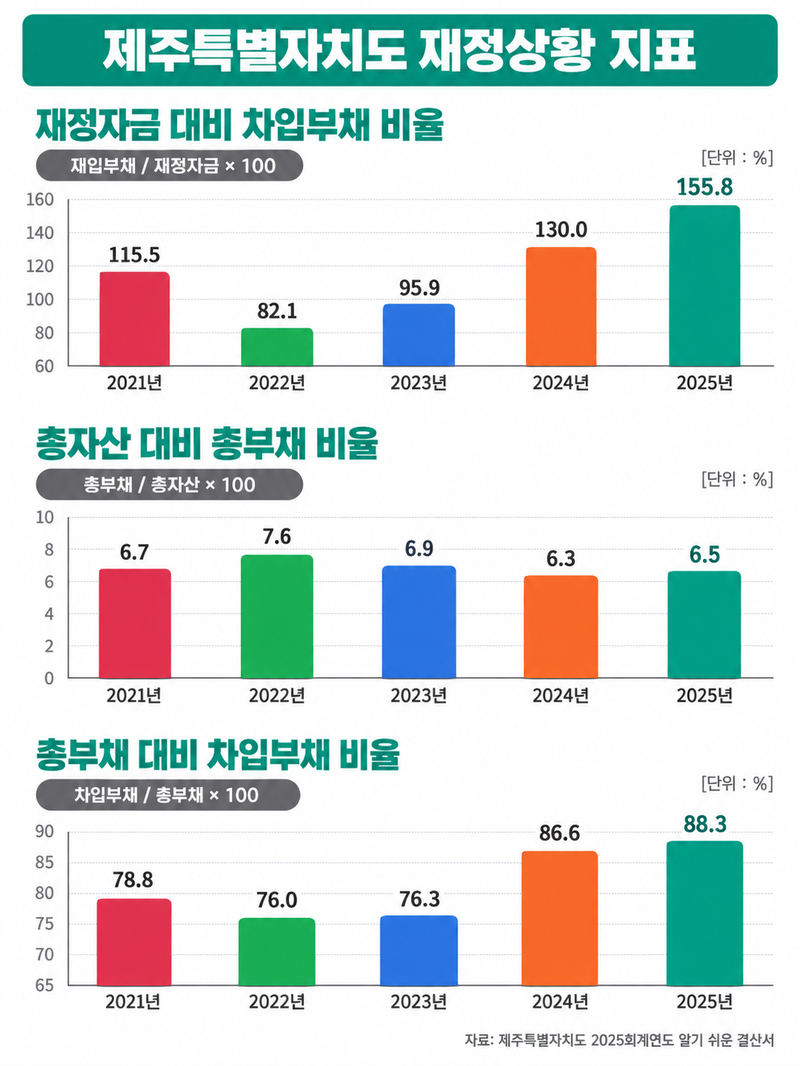
The upward trend has been clear since 2022. The borrowing liabilities-to-fiscal funds ratio fell from 115.5% in 2021 to 82.1% in 2022. It then rose for three consecutive years, reaching 95.9% in 2023, 130.0% in 2024 and 155.8% last year.
Jeju Special Self-Governing Province explained in its settlement report that the continued rise in the ratio since 2022 has increased the burden of repaying borrowed money with funds on hand. Borrowing may increase to finance investments aimed at revitalizing the local economy, but the recent upward trend needs to be examined from a fiscal management perspective, the province said.
Borrowing liabilities also accounted for a growing share of total liabilities. The ratio rose from 76.0% in 2022 and 76.3% in 2023 to 86.6% in 2024 and 88.3% last year. The figure increased by 1.7 percentage points in the past year alone.
In other words, the structure in which most liabilities arise from borrowed funds, including short- and long-term borrowing and local government bonds, has become more pronounced.
Jeju Special Self-Governing Province's total liabilities stood at 1.9495 trillion won at the end of last year, an increase of 101.8 billion won from 1.8477 trillion won a year earlier. Long-term borrowing liabilities accounted for 1.3531 trillion won of the total.
■ Total Assets Exceed 30 Trillion Won, but 72.3% Are Infrastructure
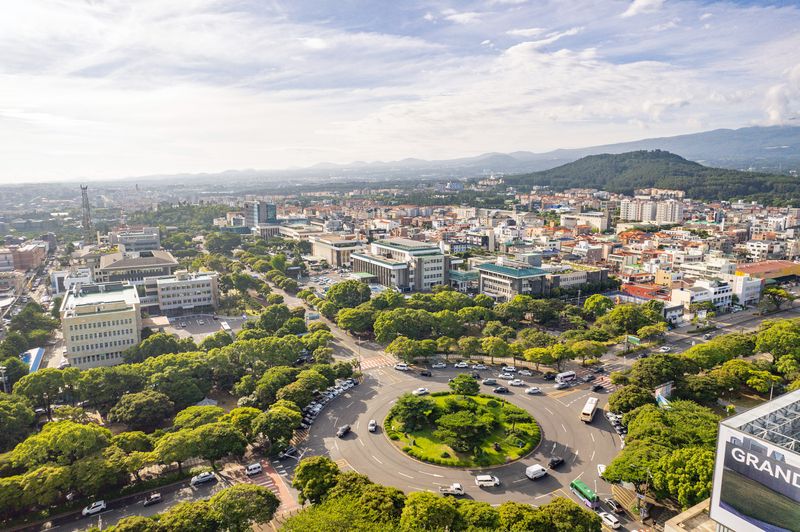
The increase in borrowing pressure does not mean that Jeju Special Self-Governing Province is immediately facing a fiscal crisis.
Total assets stood at 30.0531 trillion won at the end of last year, up 751.7 billion won from the previous year. Net assets, after excluding total liabilities, also increased by 649.9 billion won to 28.1036 trillion won.
Total liabilities accounted for 6.5% of total assets. Although the ratio rose 0.2 percentage points from 6.3% a year earlier, liabilities remained in the single digits as a share of total assets.
However, local government assets differ in nature from the cash-like assets of a company. Infrastructure, including roads, waterworks and ports, accounted for 21.7335 trillion won of Jeju Special Self-Governing Province's assets, or 72.3% of the total.
Because these facilities provide public services to residents, they cannot easily be regarded as assets that can be freely sold to repay debt. This is why the settlement report presents the borrowing liabilities-to-fiscal funds ratio separately from the liabilities-to-total-assets ratio. The former shows the relationship between the cash and financial products actually held and the money borrowed, regardless of the overall size of the assets.
■ Record-High Revenue of 8.5123 Trillion Won, Including 204.1 Billion Won in Local Government Bonds
Jeju Special Self-Governing Province recorded its highest-ever revenue last year. Total revenue for fiscal year 2025 was 8.5123 trillion won, up 579.4 billion won, or 7.3%, from 7.9329 trillion won the previous year. It also exceeded the previous record of 8.2855 trillion won set in 2022.
Jeju Special Self-Governing Province attributed the increase in revenue mainly to higher government subsidies and improved local consumption tax collections.
Revenue consisted of 1.8762 trillion won in local tax revenue, 547.6 billion won in non-tax revenue, 1.9394 trillion won in local allocation taxes and 2.3325 trillion won in subsidies. Funds received through local government bonds amounted to 204.1 billion won, accounting for 2.4% of total revenue.
Expenditure grew faster than revenue. Total expenditure last year was 7.8611 trillion won, up 589.2 billion won, or 8.1%, from the previous year. Over the past five years, expenditure grew by an average of 5.4% annually, 1.1 percentage points faster than the 4.3% average growth in revenue.
The year-end settlement surplus, calculated by subtracting expenditure from revenue, was 651.2 billion won. Of this amount, carryovers to the following year accounted for the largest share at 419.4 billion won, as the funds had already been earmarked for specific projects. The net surplus carried forward was 185.9 billion won, while actual repayments of government subsidies totaled 44.7 billion won.
This is why the entire year-end settlement surplus cannot be regarded as freely available fiscal funds.
■ Local Government Bonds in the 450 Billion-Won Range in 2026, Continuing the Expansion of Borrowing
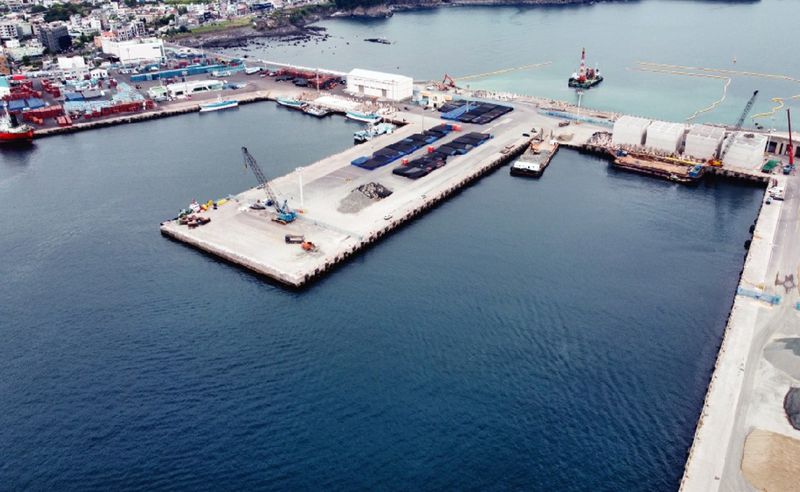
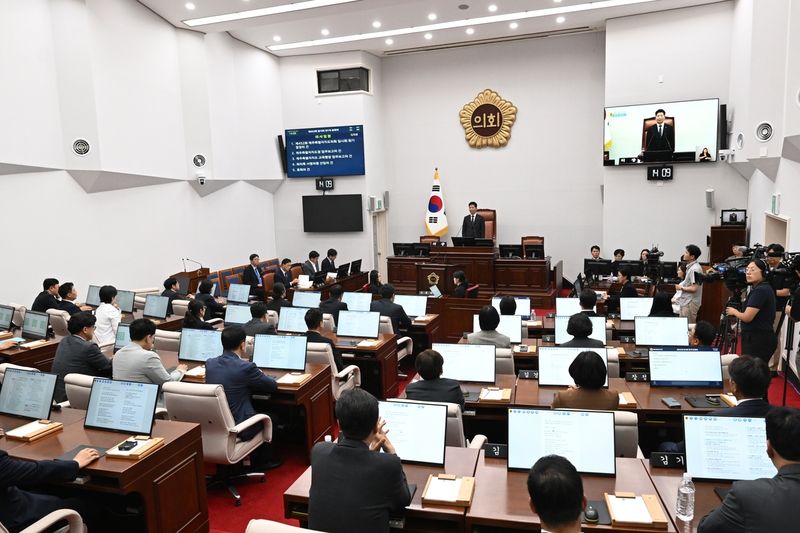
Last year's settlement figures need to be considered in connection with this year's fiscal management. During a provincial administration question session at the Jeju Special Self-Governing Provincial Council on the 3rd, Jeju Governor Wi Seong-gon explained that local government bond issuance had increased sharply from the usual 200 billion-won range to the 450 billion-won range this year.
Wi Seong-gon also said at the time that local government bonds needed to be managed appropriately because managed debt had already reached a high level. He added that a roadmap and plan would be prepared to reduce the debt.
With the borrowing liabilities-to-fiscal funds ratio reaching 155.8% in the 2025 settlement and local government bond issuance expanding this year, it has become increasingly important to determine whether the increase in borrowing is a one-year phenomenon or part of a medium-term trend.
However, the 204.1 billion won in local government bond revenue recorded in last year's settlement and this year's issuance in the 450 billion-won range are based on different standards. The former refers to revenue actually received during fiscal year 2025, while the latter refers to the issuance volume during fiscal management in 2026. The two figures should not be simply compared as an increase or decrease on the same basis.
What matters is not the total amount of local government bonds itself, but how the borrowed funds are used and how the repayment structure is designed.
Local government bonds may be necessary for projects that provide benefits over a long period, such as infrastructure, because they distribute costs across generations. Conversely, if borrowing increases to cover recurring revenue shortfalls, the burden of repaying principal and interest from future fiscal resources will also grow.
Fiscal soundness must be assessed not only by the size of debt but also by how efficiently the budget was executed.
Last year's budget execution rate was 93.5% for the general account and 96.5% for other special accounts. The execution rate for the three public enterprise special accounts covering water supply, sewage and public bus transportation was relatively low at 80.9%.
The settlement report alone does not make it possible to determine which factor—project delays, carryovers or unused funds—was primarily responsible for the lower execution rate of the public enterprise special accounts. Additional detailed data are also needed to determine which projects received the borrowed funds, the average interest rate, when maturities are concentrated, and the annual principal and interest repayment amounts.
A full assessment of Jeju's finances cannot rely solely on the figure of 1.9495 trillion won in total liabilities. Although liabilities account for 6.5% of total assets, borrowing liabilities have risen to 155.8% of fiscal funds. Even after last year's record-high revenue, local government bond issuance is expected to expand to the 450 billion-won range this year.
The key questions going forward are where the borrowed funds will be invested, whether those investments will lead to local economic growth and increased internally generated revenue, and how much funding can be secured over the medium and long term to cover principal and interest payments.
[email protected] Jung Yong-bok Reporter