Jeju Economy Returns to Standstill Just One Quarter After Rebound... Nation Grows 3.7%
- Input
- 2026-09-29 15:16:41
- Updated
- 2026-09-29 15:16:41
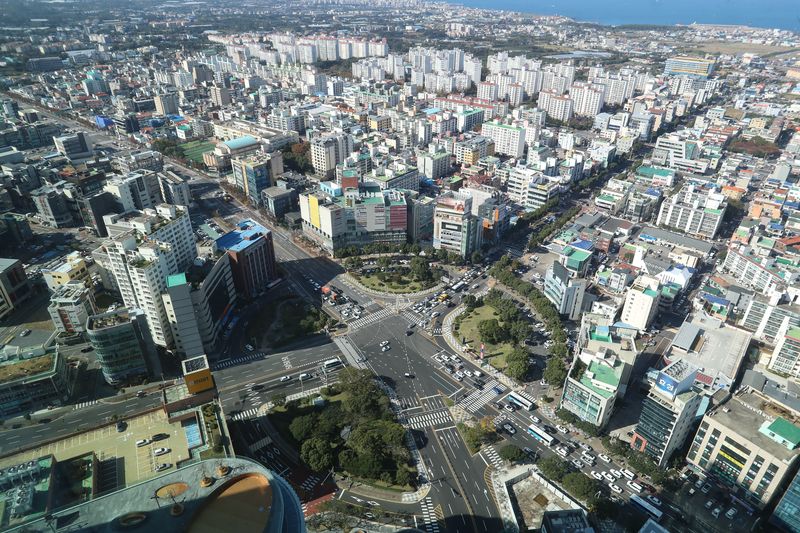
[Financial News, Jeju — Reporter Jeong Yong-bok] Jeju Province’s economy, which rebounded 1.8% in the first quarter after four consecutive quarters of contraction last year, stopped growing again in the second quarter. While the national economy grew 3.7% from a year earlier, Jeju Province’s real gross regional domestic product (GRDP) came in at 0.0%.
Services, which account for 74% of the Jeju economy, grew in some tourism- and consumption-related sectors, but the sector’s overall growth rate stood at just 0.7%. Mining and manufacturing and construction also declined by 3.3% and 3.2%, respectively.
According to the preliminary second-quarter 2026 real GRDP figures released by the Ministry of Data and Statistics on the 29th, Jeju Province’s GRDP growth rate was 0.0% from the same period a year earlier.
GRDP is an indicator that combines the value added generated by newly produced goods and services in a region over a given period. This growth rate is measured in real terms, excluding the effects of price changes. A rate of 0.0% does not mean there was no growth compared with the first quarter; it means the figure remained at the same level as in the second quarter of last year.
Of the 17 cities and provinces nationwide, 12, including North Chungcheong and Gyeonggi, grew, while four—South Jeolla, Daejeon, Ulsan and Gangwon—contracted. Jeju Province was the only region to record no change. It ranked 13th in terms of growth.
North Chungcheong posted the highest growth rate at 11.9%, supported by increases in semiconductors and electronic components. It was followed by Gyeonggi at 5.9%, Seoul at 5.5%, South Chungcheong at 3.3% and Gwangju at 3.1%. South Jeolla, Daejeon, Ulsan and Gangwon declined by 2.8%, 2.0%, 1.0% and 0.4%, respectively.
■ Rebounded 1.8% in the First Quarter but Returned to Standstill in the Second
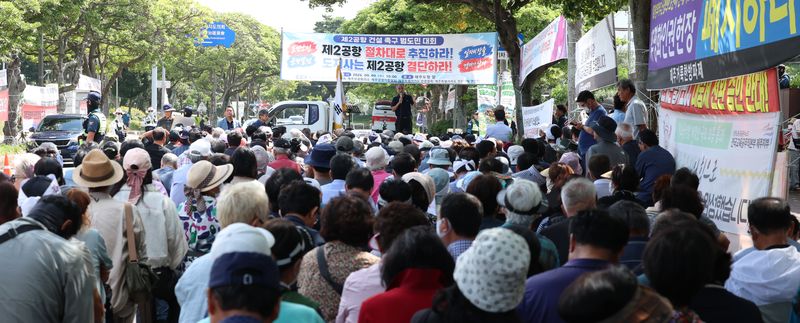
The Jeju economy failed to escape contraction throughout last year.
Quarterly growth rates in 2025 were -0.4% in the first quarter, -3.4% in the second, -3.1% in the third and -0.5% in the fourth. Based on the time series released this time, Jeju Province’s annual growth rate last year was -1.9%, the second-lowest in the country after South Jeolla at -2.0%.
Jeju Province grew 1.8% in the first quarter of this year, returning to positive growth after five quarters. However, that was less than half the national growth rate of 3.8%, and the figure fell back to 0.0% in the second quarter.
The industrial trend also changed from the first quarter. Mining and manufacturing in Jeju Province grew 3.7% in the first quarter but declined 3.3% in the second. The decrease was influenced by lower production of nonmetallic minerals and semiconductors and electronic components.
Construction declined 3.2%. After falling 16.4% in the second quarter of last year, 16.2% in the third and 14.9% in the fourth, the rate of decline narrowed sharply to 8.6% in the first quarter of this year, but the sector has yet to return to positive growth.
Construction nationwide also declined 3.5% in the second quarter. The construction slump is not limited to Jeju Province, but Jeju has yet to break free from the prolonged downward trend that has continued since 2024.
■ Services Account for Three-Quarters of the Economy, but Growth Is One-Fifth of the National Rate
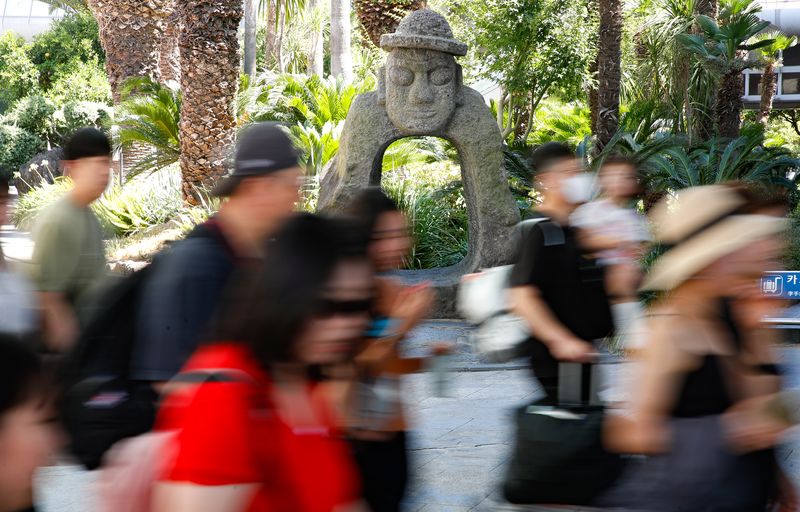
A recovery in services is crucial for Jeju Province’s growth to gain momentum.
Based on nominal GRDP in 2024, services accounted for 74.0% of the Jeju economy. That was 16.0 percentage points higher than the national average of 58.0%. Activity in tourism, consumption, transportation, accommodation and food services therefore has a particularly large impact on the regional economy as a whole.
However, Jeju Province’s service-sector growth rate in the second quarter was 0.7%. This was 2.7 percentage points lower than the national rate of 3.4% and the second-lowest among the 17 cities and provinces, ahead of only Gangwon at 0.5%.
There were clear differences among service industries. Wholesale and retail trade grew 2.8%, transportation and storage 2.2%, and accommodation and food services 2.7%. Industries directly linked to tourist movement and spending maintained their growth.
Health and social welfare grew 4.6%, culture and other services 3.6%, education 2.5% and public administration 2.0%.
By contrast, information and communications declined 20.1%. The sector also fell 24.2% in the first quarter, recording a decline in the 20% range for two consecutive quarters.
Business services also declined 3.5%. Real estate fell 0.3%, while finance and insurance grew only 0.2%.
In other words, growth in tourism- and consumption-related industries was not enough to offset declines in information and communications, business services and other sectors.
■ Construction Orders Up 464%, but Output Down 3.2%
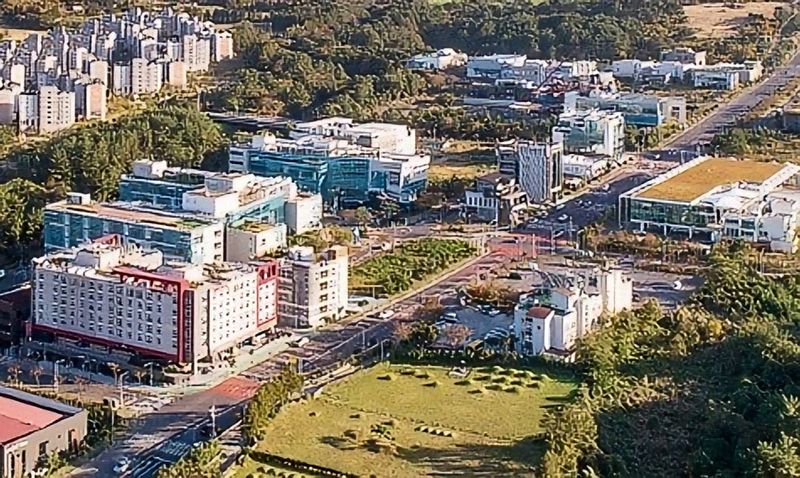
Viewed alongside other economic indicators, the conflicting trends in the Jeju economy become even clearer.
According to the second-quarter regional economic trends released last month by the Jeju Office of the Ministry of Data and Statistics, construction orders in Jeju Province rose 464.2% from the same period a year earlier. The increase was driven by a sharp rise in orders for civil engineering projects.
Exports rose 347.0%, led by other integrated-circuit semiconductors and components, while retail sales increased 2.3%. The employment rate also rose 1.7 percentage points from a year earlier.
On the surface, there were several positive figures in orders, exports, consumption and employment. Yet overall GRDP growth during the same period was 0.0%.
The fact that construction orders and construction GRDP moved in opposite directions does not mean the statistics are contradictory.
Construction orders represent the amount contracted for projects to be carried out in the future. By contrast, construction value added in GRDP measures how much production was generated through work actually performed during the quarter. Even after a large-scale project is awarded, time may be needed for construction to begin, work to progress and value to be added.
That is why whether the 464.2% increase in construction orders in the second quarter leads to actual construction in the future will be an important indicator of a recovery in Jeju’s construction sector.
The same applies to exports. A sharp increase in exports of specific semiconductor-related items does not mean that total manufacturing output and value added in the region will rise at the same rate. The range of exported items differs from that of overall manufacturing, as do the timing of production and customs clearance.
■ Service Production Down 3.0%, but GRDP Up 0.7%
The same caution is needed when interpreting service-sector indicators. According to the second-quarter regional economic trends released in August, service-sector production in Jeju declined 3.0% from a year earlier. Jeju Province was the only one of the 17 cities and provinces nationwide to record a decline in service-sector production.
In this quarter’s GRDP, real value added in Jeju’s service sector increased 0.7%.
The two figures are not contradictory. The service-sector production index measures changes in the production activities of businesses in each industry, while quarterly GRDP estimates the value added newly generated in a region by using the industrial production index together with administrative data. Because the coverage, source data and calculation methods differ, the figures may not move in the same direction or by the same magnitude.
However, both statistics have one point in common: the recovery in Jeju’s service sector is weaker than the national recovery. Jeju was the only region where the service-sector production index declined, while the service-sector growth rate measured by GRDP was just 0.7%, well below the national rate of 3.4%.
For the Jeju economy to establish a clear growth trend again, it will be important to see how much indicators such as tourist numbers, exports and construction orders translate into actual increases in production and value added. In particular, the key point to watch next quarter will be whether the recovery in services, which account for three-quarters of the economy, spreads from wholesale and retail trade, accommodation and food services to information and communications, business services and other sectors.
This quarter’s GRDP is experimental statistics rather than an officially approved national statistic. It is designed to show regional economic trends quickly within 90 days after the end of a quarter by using industrial production indexes and administrative data. Past figures may be revised later as source data are supplemented and preliminary and final annual regional income results are released.
[email protected] Jeong Yong-bok Reporter