KOSDAQ (Korea Securities Dealers Automated Quotations) Promotion-and-Relegation System to Launch Next Year; Direct Entry into 'Select' for New Listings Under Review
- Input
- 2026-09-29 15:47:41
- Updated
- 2026-09-29 15:47:41
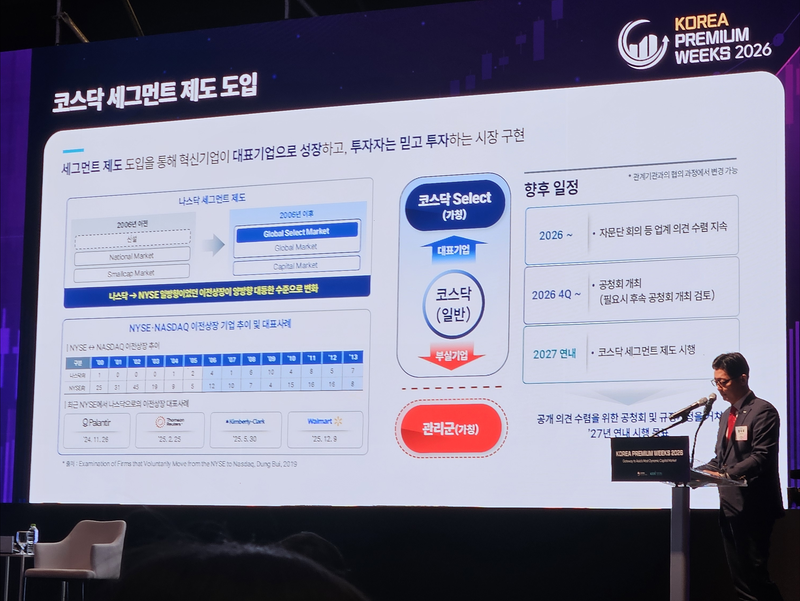
[Financial News] Korea Exchange (KRX) will introduce a promotion-and-relegation segment system for the KOSDAQ market next year. Newly listed companies that meet the standards to represent their industries will be placed in the top-tier segment, tentatively called 'KOSDAQ Select,' immediately after listing.
Choi Ji-woo made the remarks on the 29th while presenting a plan to introduce the KOSDAQ segment system at Korea Premium Weeks 2026, held at The Grand Lotte Seoul in Jung-gu, Seoul.
At present, companies with different growth stages, financial conditions and investment risks are mixed together in the KOSDAQ market. KRX plans to divide the market into tiers so investors can more easily understand the characteristics of high-quality and risky companies. It will also introduce a promotion-and-relegation system under which companies can move between segments as their growth and competitiveness change.
The new system will consist of 'KOSDAQ Select' (tentative name), centered on leading companies; the general KOSDAQ segment; and a managed group (tentative name) for the separate management of risky companies, including those with weak finances or business performance. Companies will move between segments depending on their growth stage and whether they meet the relevant requirements.
In particular, KRX is considering placing newly listed companies in Select immediately after listing if they meet certain criteria, such as representing their industries, rather than assigning all of them to the general segment. It also plans to diversify the criteria for entering Select so that the segment can include companies distinguished not only by their stability but also by their innovation and growth potential.
Choi said, "Different companies at different stages of growth and with different characteristics coexist within KOSDAQ, making it burdensome for investors to select investment targets. The segment system is not designed simply to rank companies. It is a market-structure reform intended to motivate companies to grow into leading businesses and help investors find good companies more easily."
KRX plans to identify financially troubled companies at an early stage through the managed group and strengthen investor protection. It also aims to encourage companies included in Select to compete voluntarily by strengthening disclosures, improving corporate governance and expanding shareholder returns. The management criteria for companies with weak finances or performance, as well as the requirements for entry into and retention in each segment, will be finalized after gathering market feedback and holding public hearings.
KRX also plans to develop segment-based indexes, ETFs and other financial products to create channels for institutional and foreign funds to enter the market. According to KRX, the segment system is not a 'zero-sum' policy that merely divides existing investment funds, but one intended to attract new liquidity seeking high-quality innovative growth companies.
KRX has been designing the system since last May through external research commissioned for the project and a KOSDAQ segment advisory panel. After continuing to gather opinions from the advisory panel, it plans to hold a public hearing in the fourth quarter of this year to collect views from the public.
Min Kyung-wook, head of KRX's KOSDAQ Market Division, said in a keynote speech that day, "KOSDAQ must also become a market that commands a premium rather than trading at a discount. We are pursuing fundamental improvements in the market's structure and listing system."
He emphasized, "We will provide innovative companies with growth potential flexible entry routes, including tailored special listings, while swiftly removing marginal companies that disrupt market order or become targets of unfair trading. Just as entry requirements are flexible, we will apply stricter standards to exits."
The securities industry called for improvements in institutional fund flows and the availability of corporate information alongside the introduction of the segment system. Hong Seung-taek, head of the research center and an executive vice president at Hana Securities, said in a presentation titled 'Diagnosis of the KOSDAQ Market: KOSDAQ Through the Market's Eyes,' "KOSDAQ is vulnerable to fund-flow volatility because of the heavy concentration of retail investors. We need to increase the participation of long-term investors, including institutions and pension funds, and expand related indexes and ETF products centered on high-quality companies."
Regarding the need to remove financially troubled companies, Hong said, "Just as a market needs to undergo metabolism, companies must do so as well. Some companies grow and become the market's muscle, while companies that have lost their competitiveness must be excluded from the market to maintain its health."
However, he stressed that companies should not be classified during the process of removing troubled businesses based solely on a single criterion, such as market capitalization. Their qualitative competitiveness, including their ability to generate profits and growth potential, should also be considered. His point was that the promotion-and-relegation system should go beyond filtering out troubled companies; it should identify companies with growth potential and connect them to institutional fund inflows and the development of financial products.
He added, "Quite a few companies are passive about analyst meetings and investor relations (IR) activities despite having solid performance and growth prospects. Companies must also strengthen their information provision and IR activities so investors can assess their value."
[email protected] Lee Jung-hwa Reporter