South Chungcheong Gov. Park Soo-hyun at Ruling Party-Government Talks: "Local Allocation of the Future Response Fund Must Be Increased"
- Input
- 2026-09-29 15:13:16
- Updated
- 2026-09-29 15:13:16
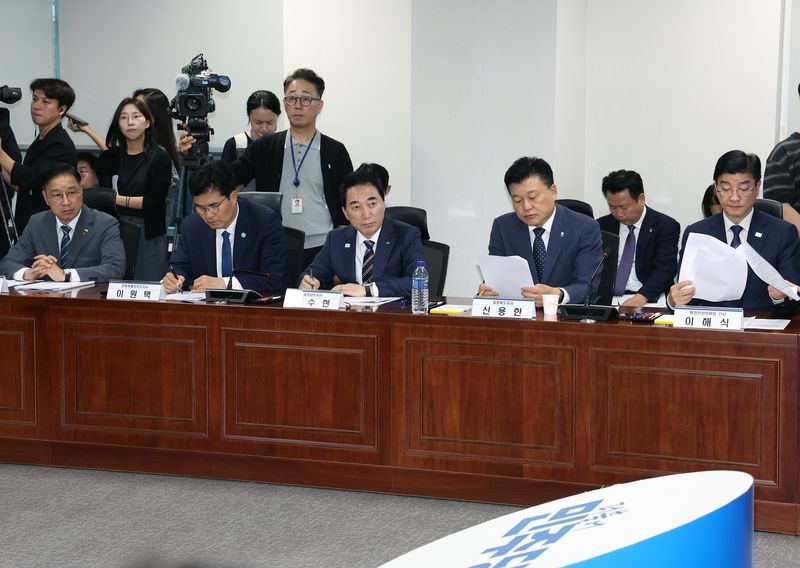
South Chungcheong Gov. Park Soo-hyun attended the Future Response Fund and Local Grant Tax Reform Ruling Party-Government Consultation Meeting at the National Assembly Members' Office Building in Seoul on the 29th. He conveyed the financial difficulties facing local governments and called for countermeasures. The meeting was attended by senior ruling party leaders, the chair of the Budget and Accounts Committee, ministers from relevant ministries, and the heads of 12 cities and provinces nationwide.
Park expressed support for the creation of the Future Response Fund, which aims to focus investment on future growth engines amid sweeping changes driven by population decline, super-aging, artificial intelligence (AI), and the transition to advanced industries. However, he stressed that the stability of local government finances, including the expansion of autonomous revenues, must be secured first to establish the foundation for long-term national growth.
According to an analysis by South Chungcheong Province, if the amount allocated to the Future Response Fund is excluded from the tax base for domestic taxes, the total Local Grant Tax will not benefit from increased tax revenue. Under the existing calculation method, the Local Grant Tax was expected to total 107.6 trillion won nationwide and 8.5 trillion won in South Chungcheong Province. However, the province estimates that fund allocations would reduce those amounts by 30.5 trillion won nationwide and approximately 2.6 trillion won in South Chungcheong Province.
South Chungcheong Province expects local governments' fiscal autonomy and stability to suffer a critical blow if the Local Grant Tax reduction occurs on top of an anticipated fiscal gap exceeding 1 trillion won, resulting from revenue shortfalls and additional expenditure needs in the second half of the year.
Park asked the government to promptly implement key national policy tasks, including compensating for the Local Grant Tax reduction resulting from the introduction of the Future Response Fund, raising the statutory Local Grant Tax rate from 19.24% to 22%, and adjusting the national-to-local tax ratio to 7-to-3. He also proposed increasing the share allocated to local accounts within the Future Response Fund and using fund resources to cover the full cost of fund-backed projects.
Recently, errors in the central government's tax revenue forecasts have coincided with fund-centered fiscal policies, making cuts to local governments' own projects and the burden of issuing local bonds a reality. Because welfare spending and essential infrastructure maintenance costs rise steadily each year, local governments' sudden loss of the Local Grant Tax, a dependent source of revenue, poses a significant risk of interruptions or delays to essential regional projects.
Park said, "This year's excess tax revenue should not be transferred in full to the Future Response Fund; it should instead be used to alleviate local governments' difficulties. Only when local government finances are stable can the national task of expanding future growth engines finally bear fruit."
[email protected] Kim Won-jun Reporter