"Bad Loans Are Scarier Than Interest Rates"... Credit Loss Expenses at A-Rated Capital Companies Reach 81% of Net Income [FN Market Watch]
- Input
- 2026-09-29 15:19:28
- Updated
- 2026-09-29 15:19:28
According to KIS's report, "The Credit Finance Industry's Response Capability Put to the Test as Rising Interest Rates Return," released on the 29th, if market rates rise by an additional 25 basis points every six months through 2027 (1 basis point = 0.01 percentage points), the increase in the weighted-average interest rate on corporate bonds is estimated at 0.5 percentage points for card companies, 0.6 percentage points for AA-rated capital companies, and 0.8 percentage points for A-rated-and-below capital companies. These figures represent 40–60% of the increases recorded during the 2022–2024 rate-hike period.
Chae Young-seo, a senior analyst at KIS, explained, "Because the interest rates on previously issued corporate bonds are already high, the increase in average funding costs is expected to be relatively limited even under a scenario in which market rates rise further."
The burden grows as credit ratings decline. Additional interest expenses resulting from corporate bond refinancing were estimated at KRW 416.7 billion for card companies, KRW 702.2 billion for AA-rated capital companies, and KRW 273.9 billion for A-rated-and-below capital companies. These amounts represent 12.8%, 17.5%, and 27.0%, respectively, of annualized net income over the estimation period.
Asset quality is an even bigger concern. Capital companies' PF exposure fell from KRW 26.8 trillion at the end of 2022 to KRW 18.2 trillion at the end of June this year, a decrease of KRW 8.6 trillion, or 32%.
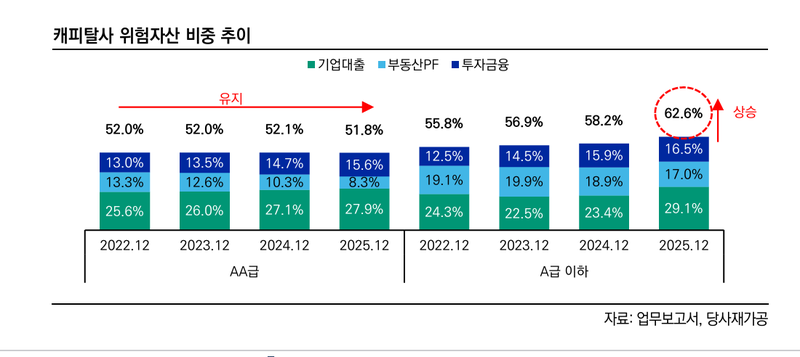
As PF exposure declined, corporate lending and investment finance expanded. The share of risk assets at AA-rated capital companies changed little, while it actually increased among A-rated-and-below companies.
Chae noted, "As the reduction in PF exposure was replaced by corporate lending and investment finance, among other assets, the overall share of risk assets changed little at AA-rated companies and instead increased among A-rated-and-below companies." Chae added, "It is difficult to conclude that the risks of asset portfolios have declined overall."
Investment finance is particularly difficult to assess fully using only credit-focused indicators such as delinquency rates. KIS analyzed that delays in recovering investment assets or declines in their value could lead to substantial losses.
The stress test also highlighted the burden on lower-rated capital companies. KIS divided rated capital companies into 13 AA-rated firms and 11 A-rated-and-below firms for the analysis. Applying a 20% provisioning rate to newly delinquent loans, additional credit loss provisions were estimated at KRW 735.1 billion for AA-rated companies and KRW 351.3 billion for A-rated-and-below companies, equivalent to 21% and 33%, respectively, of average net income. If the provisioning rate were raised to 50% under a more severe asset-quality scenario, those ratios would increase to 52% and 81%, respectively. For A-rated-and-below capital companies, this means that additional credit loss expenses could reach 81 if their usual net income is 100.
For card companies, the share of high-risk card loans declined from 9.3% at the end of 2021 to 6.2% at the end of June this year. However, delinquency roll rates for card loans and cash advances remain above their long-term averages.
Chae predicted, "The core burden of this rate-hike cycle is expected to stem not from a funding shock shared across the industry, but from the quality of risk assets and companies' ability to manage existing and new bad loans." Chae added, "Differences in asset quality and earnings-generating capacity among companies will widen depending on the level of risk-asset exposure and their ability to manage problem assets."
[email protected] Kim Hyun-jung Reporter