Korea Aerospace Research Institute (KARI) Launches Full-Scale Development of Reusable Launch Vehicle Technology, Begins Assembly of Flight Model No. 1
- Input
- 2026-09-29 14:30:32
- Updated
- 2026-09-29 14:30:32
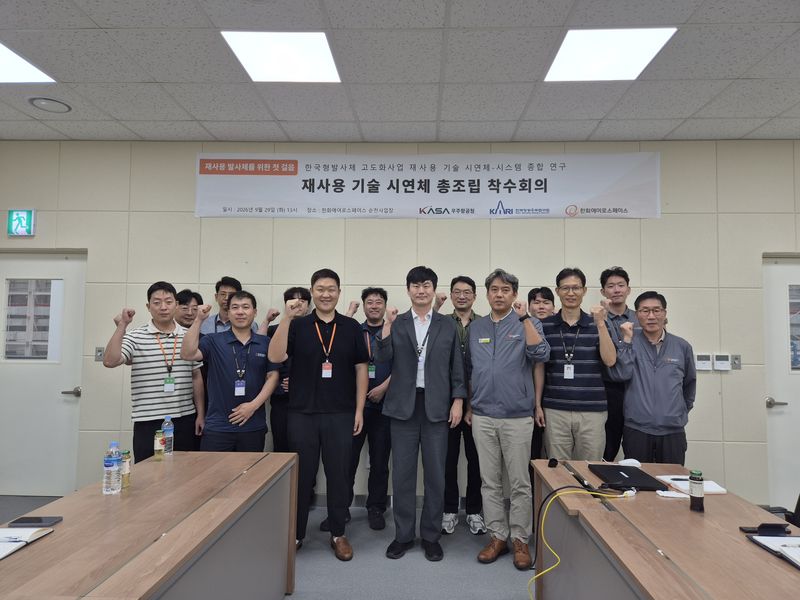
[Financial News] The Korea Aerospace Research Institute said on the 29th that it had begun assembling Flight Model No. 1 of a reusable technology demonstrator at Hanwha Aerospace's assembly site in Suncheon to verify in advance the technologies needed to develop reusable launch vehicles.
The reusable technology demonstrator is a test vehicle designed to verify related technologies before the development of an actual reusable launch vehicle. It is intended to confirm core technologies through low-altitude vertical takeoff and landing tests using a small engine, accumulate development experience and reduce potential risks in the future development of reusable launch vehicles.
The United States, Japan and Europe have also used demonstrators to verify related technologies ahead of reusable launch vehicle development. In July this year, Japan successfully conducted vertical takeoff and landing tests with RV-X, a small reusable vehicle demonstrator measuring 7.3 meters in length and 1.8 meters in diameter, reaching an altitude of 11 meters. The country subsequently joined the full-scale development of reusable launch vehicles.
South Korea confirmed last year that it would change the direction of its next-generation launch vehicle project to develop it as a reusable launch vehicle. Accordingly, it plans to verify its own reusable technologies in advance using a low-altitude vertical takeoff and landing demonstrator and reduce technological risks during the development of the next-generation launch vehicle.
The reusable technology demonstrator now entering assembly stands 12.2 meters tall and weighs 6.4 tons. It will be equipped with an 8-ton-class engine, which is smaller than the 80-ton-class engine being developed for the reusable next-generation launch vehicle. Following full assembly and various ground tests, the project aims to conduct a low-altitude vertical takeoff and landing flight test at the Naro Space Center in 2028.
Since 2023, KARI has been developing the reusable technology demonstrator in cooperation with Hanwha Aerospace, Vitzro Nextech and Hanyang ENG. Hanwha Aerospace is responsible for the system, Vitzro Nextech for the engine and Hanyang ENG for the ground facilities.
By the end of this year, the project will conduct combustion tests on the engine development model and manufacture its components. By 2027, it plans to complete combustion tests on two engine flight models, as well as the assembly and functional testing of Flight Model No. 1 of the demonstrator. In 2028, following a ground combustion test of Flight Model No. 1, two flight tests will be conducted to verify its vertical takeoff and landing performance and the technologies required for reuse.
Lee Sang-chul, president of KARI, said, "The reusable technology demonstrator is meaningful because it allows us to verify in advance the technologies needed for reusable launch vehicle development and accumulate development experience." He added, "We will work with private companies to pursue engine verification, demonstrator development and flight tests in stages, laying the technological foundation needed to develop reusable launch vehicles."
[email protected] Yeon Ji-an Reporter