Samsung Biologics Labor-Management Talks Make Little Headway in Post-Mediation Process... Some Say Union Is Building a Case for Another Strike
- Input
- 2026-09-30 10:34:35
- Updated
- 2026-09-30 10:34:35
According to industry sources on the 30th, Samsung Biologics labor and management held their second labor-management-government post-mediation meeting on the 22nd and agreed to hold the third meeting on Oct. 1.
The company is reportedly planning to explain the results of its review of the demands presented by the union and offer alternatives to demands it would be unable to accept at the third meeting. It has also agreed to the government's request for a decision-maker to participate in the negotiations, with Gyu-ho Lee, head of the People Center and a vice president, scheduled to attend the negotiating table in person.
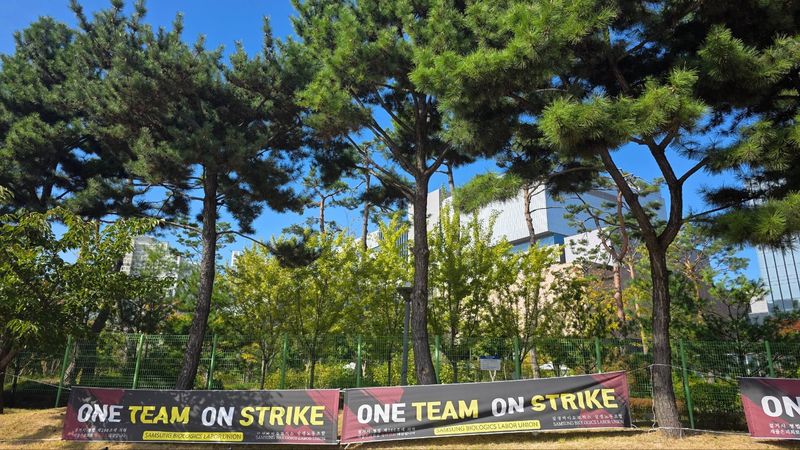
Against this backdrop, the union reinstalled strike-related banners and union flags at its worksites on the 23rd, the day after the second meeting. The union said it had begun preparing for collective action because the company had not yet presented a proposal, while maintaining that dialogue through post-mediation would continue.
The dispute between Samsung Biologics labor and management reached a critical juncture in May this year when a full-scale strike became a reality for the first time since the company's founding. The union launched the strike to demand higher wages, improvements to the personnel system and revisions to the collective bargaining agreement. At the time, it heightened the atmosphere of labor action by putting up banners and union flags throughout the worksites.
After dialogue between labor and management resumed, the union removed the banners and flags it had installed at the worksites. However, the two sides continued to disagree over key issues, including wages and the collective bargaining agreement, and the dispute persisted. Negotiations ultimately continued through a labor-management-government post-mediation process.
With the union once again installing strike-related banners and flags, dialogue and preparations for collective action are now proceeding simultaneously. The union says it needs to prepare for industrial action separately from the post-mediation process, but some in the industry are concerned that the hard-won negotiating process could become strained again.
According to industry sources, the Samsung Biologics union recently adjusted some of its wage demands in its second revised proposal. It initially called for a 9.3% standard increase, a flat-rate payment of KRW 3.5 million and a 5% performance-based increase, which was expected to result in an overall wage increase of about 21% for new employees. In its second revised proposal, the union adjusted those demands to a 6.5% standard increase, a flat-rate payment of KRW 3 million and a 3% performance-based increase. It also recalculated the lump-sum payment, initially set at KRW 30 million, to around KRW 22.5 million.
However, some in the industry say the union's wage increase demand remains excessive, as it is higher than those in the semiconductor industry, which is enjoying a boom driven by surging memory demand. This year, Samsung Electronics settled on a 6.2% wage increase, while SK hynix agreed to a 6.3% increase.
The proposed revisions to the collective bargaining agreement are another point of contention. The union says it has reduced its initial list of roughly 90 requested revisions to 18 key issues. However, some of the remaining provisions concern personnel matters and management rights, so considerable difficulty is expected before labor and management can find common ground.
As the union prepares for collective action while post-mediation continues, the third meeting scheduled for Oct. 1 is expected to be a watershed moment for future labor-management relations. The union maintains that preparing for legitimate industrial action is necessary to secure negotiating leverage, but some in the industry warn that conducting strike preparations alongside post-mediation could once again harden the negotiating atmosphere.
An industry source said, "Since labor, management and the government have worked hard to establish the negotiating table, they first need to narrow their differences through dialogue," adding, "The key question is how much common ground the two sides can find at the third mediation meeting on Oct. 1."
[email protected] Jung Sang-hee Reporter