South Korea's Highly Educated Population Is 'No. 1 in the OECD'—Yet Employment and Wages Fall Below Average
- Input
- 2026-09-29 18:00:00
- Updated
- 2026-09-29 18:00:00
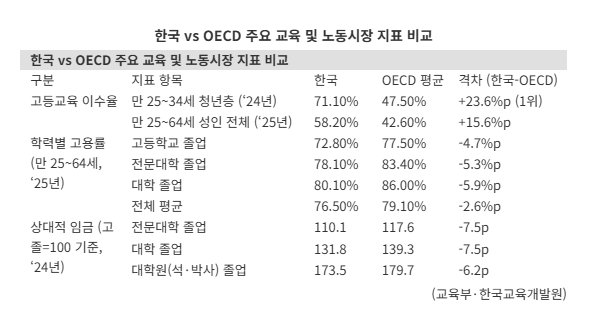
Even when the age range was expanded to 25 to 64, South Korea's tertiary education attainment rate stood at 58.2%, exceeding the OECD average of 42.6%. The proportion of adults with tertiary education in South Korea was therefore higher than the OECD average.
■ High Employment Rates Remain Elusive Despite High Tertiary Education Attainment
However, a difference emerged in employment rates. In 2025, South Korea's employment rate for those aged 25 to 64 was 76.5%, 2.6 percentage points below the OECD average of 79.1%. Although it rose 0.4 percentage points from 76.1% in 2024, the gap with the OECD average remained.
By educational attainment, the employment rate was 72.8% for high school graduates, 78.1% for junior college graduates, and 80.1% for university graduates. Employment rates increased with educational attainment, but each figure was below the OECD averages of 77.5%, 83.4%, and 86.0%, respectively. The rates were 4.7 percentage points lower for high school graduates, 5.3 percentage points lower for junior college graduates, and 5.9 percentage points lower for university graduates.
■ Relative Earnings of University Graduates Also Below OECD Average
There was also a gap with the OECD average in relative earnings. When the earnings of high school graduates were set at 100 in 2024, relative earnings were 110.1 for junior college graduates, 131.8 for university graduates, and 173.5 for those with graduate degrees. The OECD averages were 117.6, 139.3, and 179.7, respectively, all higher than South Korea's figures. A difference therefore remained between South Korea and the OECD average in relative earnings compared with those of high school graduates.
Compared with 2023, relative earnings increased by 0.2 points for junior college graduates, while they fell by 0.7 points for university graduates and 2.8 points for those with graduate degrees.
Public expenditure on educational institutions per tertiary student was also lower than the OECD average. In 2023, South Korea spent $16,479 per tertiary student, up 12.1% from $14,695 the previous year. The OECD average was $22,878, or $6,399 more than South Korea's figure.
Public expenditure per student across all students was $18,256, down 7.8% from the previous year. Expenditure was $16,365 per primary student, down 17.1%, and $21,980 per secondary student, down 13.0%. However, South Korea's per-student expenditure for primary and secondary education was higher than the OECD averages of $13,639 and $15,003, respectively.
By level of education, per-student public expenditure increased from the previous year only for tertiary education, while it declined for both primary and secondary education. Tertiary education expenditure rose by $1,784, while primary and secondary education expenditure fell by $3,384 and $3,287, respectively.
Meanwhile, South Korea had 20.9 students per primary school class in 2024, similar to the OECD average of 20.6. Middle schools had 25.6 students per class, higher than the OECD average of 22.7. The number of students per teacher was 16.1 in primary schools, 13.8 in middle schools, and 11.5 in high schools. Compared with OECD averages of 13.9, 12.8, and 12.9, respectively, the figures were higher in primary and middle schools but lower in high schools.
However, caution is needed when making a simple comparison with the previous year's figures because the calculation method for the number of students per teacher changed in 2024. Teachers on leave and those dispatched to institutions outside schools were excluded from the calculation.
[email protected] Kim Man-ki Reporter