Even Profitable Companies Fear Delisting... Despite Calls for 'KOSDAQ (Korea Securities Dealers Automated Quotations) 3,000,' Even Profitable Firms Remain on a Knife-Edge [Why the Stock Market]
- Input
- 2026-09-30 06:00:00
- Updated
- 2026-09-30 06:00:00
[Financial News] Stricter listing-maintenance requirements introduced to expedite the delisting of financially troubled KOSDAQ companies have also ensnared companies whose performance has improved. Among companies designated as administrative issues for failing to meet market-capitalization and share-price requirements, approximately 19% met all three conditions: no capital impairment, increased sales, and positive operating profit and operating cash flow. Although the government has prepared transfer listing to KONEX as a supplementary measure, critics say the market-price-centered criteria need to be reviewed.
Seven Companies That Turned Profitable Also Designated as Administrative Issues... Could a Move to KONEX Be the Solution?
According to the Korea Capital Market Institute on the 29th, 60 KOSDAQ companies were designated as administrative issues from July through this month for failing to meet the strengthened market-capitalization and share-price requirements. Thirty-eight companies had market capitalizations below KRW 20 billion, while 30 had share prices below KRW 1000. Eight companies met both criteria.Among the 59 companies for which first-half financial data was available, 52 (88.1%) had no capital impairment. Of these, 11 (18.6%) met all the requirements, including increased sales and positive operating profit and operating cash flow. In particular, seven companies turned a first-half operating loss last year into a profit this year. Their performance improved, but they were still designated as administrative issues because they failed to meet the market-price criteria.
The companies responded after their designation by using measures such as rights offerings and reverse stock splits. Of the 60 companies, 27 (45.0%) took at least one such measure, including 13 rights offerings and 10 reverse stock splits.
The impact of reverse stock splits was limited. Among 124 companies that carried out a share consolidation and whose stock prices could be checked 20 trading days after the listing change, 17 (13.7%) had fallen below KRW 1000 again. During the same period, the median stock-price return was minus 24.2%.
On the 4th, the government allowed companies meeting certain financial requirements to transfer-list on KONEX without liquidation trading. It also postponed from next January to July the date for raising the market-capitalization threshold from KRW 20 billion to KRW 30 billion.
Ahn Yu-mi, a senior research fellow at the Korea Capital Market Institute, said, "Some companies in relatively sound financial condition were identified even though they failed to meet the market-price requirements. It is necessary to review the results of applying the current KRW 20 billion threshold and the characteristics of companies actually delisted, and to continue examining the impact of any further increase in the threshold on companies and the market."
Despite Calls for 'KOSDAQ 3,000'... September Gain Stalls at 1.86%
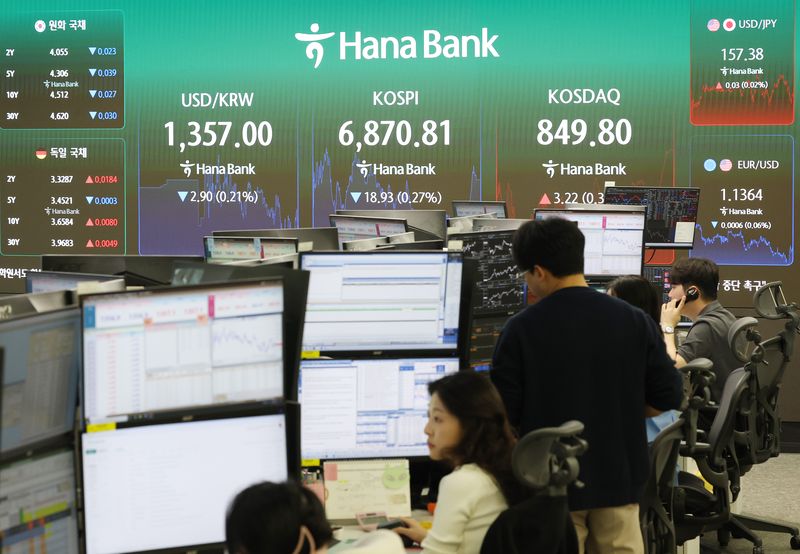
The government is pursuing market revitalization with a goal of 'KOSDAQ 3,000,' but the index's recovery has been slow.The KOSDAQ index closed at 849.80 on the 29th, up 3.22 points (0.38%) from the previous trading day. It was 19.07% below the closing level of 1050.03 on the first trading day of June and 7.25% below the end of June. Its monthly gain was just 1.86%. Based on closing prices, it remained below 1000 for 69 consecutive trading days.
The outlook for market flows through year-end is also unfavorable. According to SK Securities, the KOSDAQ outperformed the KOSPI Composite Index between Chuseok and year-end in only five instances from 2005 to 2025. The analysis found that year-end selling by major shareholders to avoid capital gains taxes weighs on the KOSDAQ, while demand for dividends and institutional portfolio rebalancing tends to be concentrated in large-cap stocks.
During periods when the KOSDAQ performed strongly, gaps in large-cap stock rallies, leading themes among the largest companies by market capitalization, and net buying by foreign and institutional investors came together. This year, interest has emerged in semiconductor equipment and robotics, but market-flow conditions are still considered insufficient.
Na Seung-doo, a researcher at SK Securities, said, "Although market-flow conditions have not yet been sufficiently met, it is difficult to take our eyes off the market because government policies to revitalize the KOSDAQ could create an environment for net institutional buying. That is why we need to pay close attention to the earnings and policy trends of major companies after Chuseok."
[email protected] Choi Du-seon Reporter