Long-Blocked Renewable Energy Grid Connections in Honam to Open Up... Grid-Management Substation Designations to Be Lifted on October 1
- Input
- 2026-09-29 12:59:01
- Updated
- 2026-09-29 12:59:01
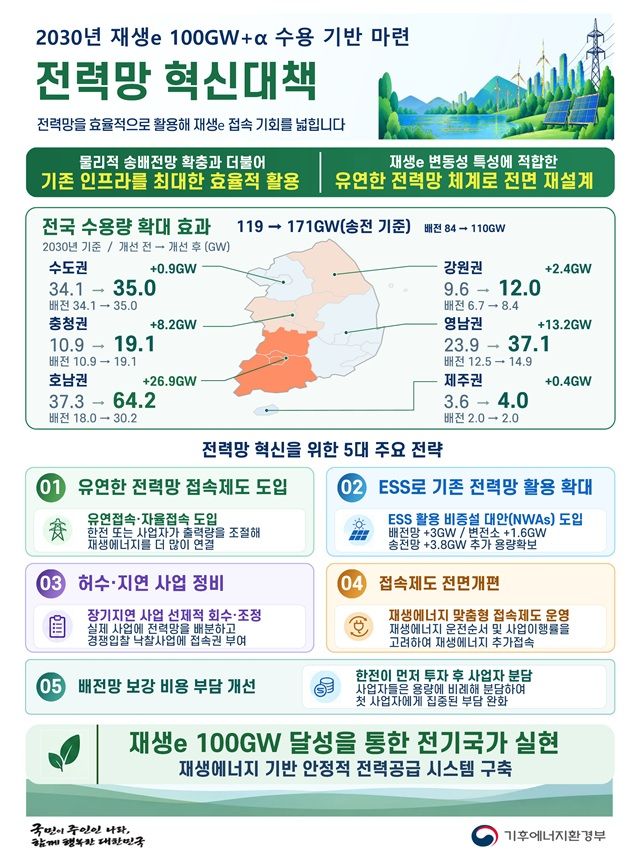
[Financial News] Restrictions on grid connections in Honam, where new renewable energy projects had been possible only after 2034 because of insufficient transmission capacity, will be lifted. Rather than waiting for new power grids to be built, the government plans to make more intensive use of existing networks to accommodate more than 100 GW of renewable energy by 2030.
The Ministry of Climate, Energy and Environment said on the 29th that it had reported the Power Grid Innovation Measures to a Cabinet meeting. As a result, the designation of substations in the Honam region as grid-management substations will be lifted on October 1, allowing new facilities to connect. Some areas of Chungcheong, where new facilities had been barred from entering the grid, will also gain access. In the East Coast of Korea, the designation is expected to be lifted in the first half of next year, when Phase 1 of the East Coast–Shingapyeong high-voltage direct-current (HVDC) transmission line is completed.
The core of the measures is to change the conservative approach of allocating grid capacity based on the maximum generation output. The government will first introduce flexible connections on a full scale. Instead of determining connection eligibility based on the peak output of solar facilities, which occurs for only a few hours a year, the new approach will allow connections exceeding grid capacity and temporarily curtail generation only when output exceeds that capacity. The connection limit will rise from 14 MW to 16 MW for distribution lines and from 50 MW to 60 MW for substations. The ministry explained that this would allow Honam alone to accommodate an additional 2.6 GW of solar power without building new grids. Self-directed connections, under which project operators build facilities larger than their connection capacity and regulate output with energy storage systems (ESS), will also be introduced after a pilot project.
ESS will also produce the effect of expanding the grid. By 2030, distribution-grid ESS will enable an additional 3 GW of solar power to be connected, while substation ESS will enable an additional 1.6 GW. Capacity on transmission lines that had been kept in reserve for contingencies will also be used for routine power transmission after the installation of ESS for fault contingencies.
The government will also address projects that occupy grid capacity while delaying development. To date, it has recovered about 9 GW of connection rights by reviewing projects lacking substance. Going forward, the connection dates for projects facing long-term delays will be postponed to points when they can actually proceed. Honam offshore wind projects secured connection rights for 15.8 GW through 2030, but the actual volume expected to come online is about 3 GW. As a result, the connection schedule for approximately 10 GW of that capacity is expected to be adjusted. For capacity entering the grid after 2031, additional connection rights will be allocated by reflecting a project implementation rate of 67.2%.
The criteria for reviewing grid connections will also change. Until now, connection assessments assumed that new renewable energy facilities would begin operating after coal- and liquefied natural gas (LNG)-fired power plants. In the future, assessments will assume that renewable energy facilities generate power first, in line with actual grid operations. This will allow an additional 20 GW of renewable energy to be accommodated in areas such as Yeongnam and Gangwon, where thermal power plants are concentrated. Starting in January 2027, grid-connection rights that were previously granted on a first-come, first-served basis will be provided only to projects that win competitive bids under the Renewable Portfolio Standard (RPS) reform. The government will also establish a plan to change the system for funding shared distribution-grid reinforcement. Instead of having the first project bear the entire cost, Korea Electric Power Corporation (KEPCO) will invest upfront, with subsequent project operators sharing the cost according to the capacity they use.
The Ministry of Climate, Energy and Environment expects the measures to increase renewable energy accommodation capacity by 2030 from 119 GW to 171 GW on the transmission side and from 84 GW to 110 GW on the distribution side. In Honam, transmission capacity will rise from 37 GW to 64 GW, while distribution capacity will increase from 18 GW to 30 GW.
However, the entire Honam region will not open immediately. Of the 87 substations in Honam, 46 will be able to accept new connections immediately. The remaining 41 will have their connection restrictions lifted in stages from 2028 to 2030 as substation ESS is installed and new substations are built. The available spare capacity will first be allocated to existing project operators that are waiting for connections. Applications for early connections from existing operators will be accepted starting October 1, while applications for new projects will begin in January next year.
Kim Seong-hwan, minister of the Ministry of Climate, Energy and Environment, said, "This means that we will make the most efficient use possible of the power grid we have now, rather than waiting until a new power grid is built."
[email protected] Lee Yu-beom Reporter