Voice-phishing losses down 76% in one year, lowest since 2023
- Input
- 2026-09-29 16:30:00
- Updated
- 2026-09-29 16:30:00

[Financial News] Voice-phishing losses have fallen sharply since police and related agencies established a joint response system for telecommunications financial fraud. Losses last month declined by more than 76% from a year earlier, reaching their lowest level since 2023.
The Korean National Police Agency said on the 29th that it held an event at KT Gwanghwamun Building in Jongno-gu, Seoul, to mark the first anniversary of the launch of the Joint Response Team for Telecommunications Financial Fraud and review its performance over the past year. The team began operations on September 29 of last year under the government's comprehensive measures to eradicate voice phishing, announced in August of the same year. Officials from the Korean National Police Agency, the Ministry of Science and ICT, the Korea Media and Communications Commission (KMCC), the Financial Services Commission (FSC), the Financial Supervisory Service, the Korea Internet & Security Agency (KISA) and the Financial Security Institute work together as part of the team.
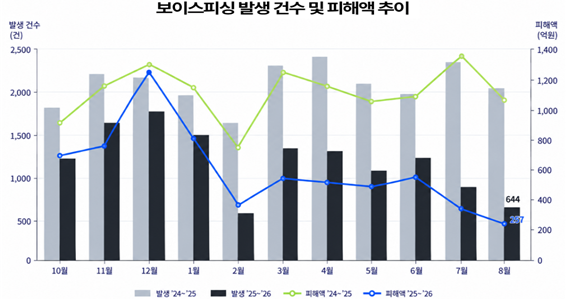
The number of voice-phishing cases and the resulting losses have declined since the Joint Response Team for Telecommunications Financial Fraud was launched. After peaking in July last year, both measures remained below year-earlier levels for 11 consecutive months, from October last year through August. Losses last month totaled 25.7 billion won, down 76.4% from 109 billion won in the same month last year and the lowest level since 2023.
There were 8,584 voice-phishing cases from January through August, down 49% from 16,765 cases during the same period last year. Losses also fell 56%, from 885.6 billion won to 387.1 billion won. Emerging scams had trended upward after October last year but began to decline in July. Last month, 1,127 cases caused 58.4 billion won in losses, with both figures reaching their lowest levels since the Joint Response Team for Telecommunications Financial Fraud was launched.
The reporting and consultation system was also strengthened. Since its launch, the Joint Response Team for Telecommunications Financial Fraud had handled consultations related to 281,178 reports and tips by the end of last month. It consolidated consultation services into the Report Response Center, more than doubled its staff and established shift teams to create a 24-hour, 365-day response system. The response rate, which had fallen to 62.9% in July last year, rose to an average of 97.4% from the team's launch through last month. The 1394 Anti-Voice Phishing Hotline has also been operating since February.
Measures to cut off telecommunications tools used in crimes at an early stage were also expanded. Since November last year, the authorities have operated an emergency-blocking system that blocks phone numbers used for crimes within 10 minutes of receiving a report, stopping 118,927 numbers by last month. The authorities worked with the three telecommunications carriers and Samsung Electronics to shorten the suspension period, which had previously taken more than two days. Since January, they have analyzed about 44,300 phone lines opened for criminal purposes and proactively detected and blocked them.
The authorities also sent emergency alerts to users who might have been victims based on signs of malicious-app use or access to phishing sites, and dispatched police officers directly when necessary. According to the Joint Response Team for Telecommunications Financial Fraud, these measures had prevented losses for 32,753 people by last month. For emerging scams such as investment chatroom fraud and romance scams, the team shared information about criminal methods with platform companies including NAVER and Kakao. It blocked about 61,000 social networking service (SNS) accounts used in crimes and sent about 53,000 risk-alert messages.
Support for victims was also expanded. The Joint Response Team for Telecommunications Financial Fraud established a support system with KB Financial Group and the Credit Counseling and Recovery Service (CCRS), while investigation teams at police stations have been distributing relevant guides to victims. Victims can apply for financial assistance, including debt adjustments, as well as professional psychological counseling and telephone consultations with attorneys providing legal aid.
Additional measures were introduced to address a limitation under the current Act on the Refund of Telecommunications Fraud Victims, which excludes some emerging scams from the accounts subject to payment suspension. Since June 30, the police have operated a system to suspend transactions in accounts suspected of being linked to emerging scams in cooperation with the Financial Services Commission and the Financial Intelligence Unit (FIU). The government is also pursuing legislation for the Act on Preventing Multiple-Victim Fraud Using Telecommunications to comprehensively address "multiple-victim fraud," including new and variant scams.
Kim Jongcheol, acting commissioner general of the Korean National Police Agency, said, "The Joint Response Team for Telecommunications Financial Fraud has established a one-stop, comprehensive response system spanning finance, telecommunications and investigations, and shifted from a primarily post-incident response to proactive prevention and blocking. Please work with relevant agencies to prevent evolving phishing crimes at their source."
[email protected] Kim Ye-ji Reporter