Lee: "Anyone who fabricates cases should be barred from police work altogether"
- Input
- 2026-09-29 11:44:49
- Updated
- 2026-09-29 11:44:49
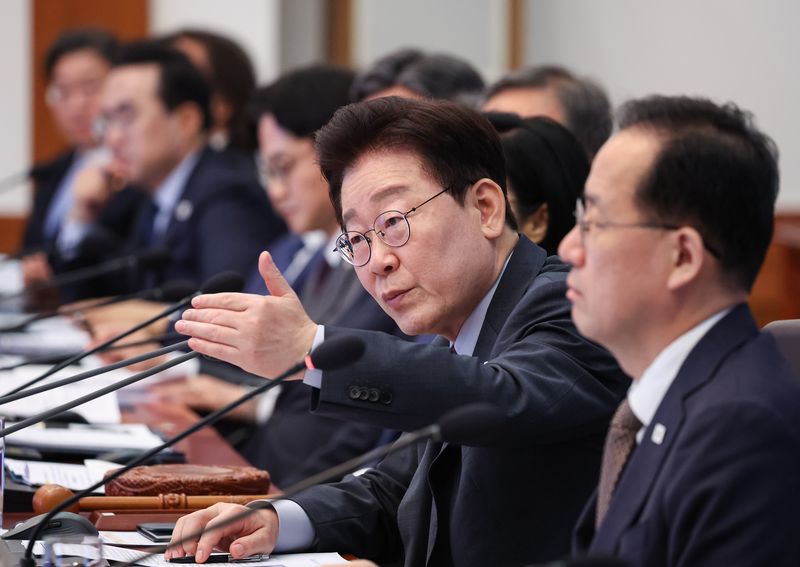
[Financial News] President Lee Jae-myung called for severe disciplinary action, including dismissal, over investigative misconduct such as police fabricating cases and concealing evidence on the 29th, saying, "Minor disciplinary action does not seem to make any sense."
At the 42nd Cabinet Meeting held at Cheong Wa Dae that day, President Lee told Kim Jongcheol, acting commissioner general of the Korean National Police Agency, "If disciplinary action is taken, it should at least mean barring them from police work altogether or dismissing them. Minor disciplinary action does not seem to make any sense."
President Lee referred to media reports that police officers had received only minor disciplinary measures despite recently fabricating cases. He pointed out, "From the public's perspective, there are cases in which people suffer unjust harm, cannot obtain relief because the case was fabricated, and even have the perpetrator and victim switched, creating situations that haunt them for the rest of their lives."
He added, "If someone conceals or fabricates evidence, or fabricates a case after gaining sole decision-making authority over investigations, it does not seem appropriate to impose the same level of accountability as in the past."
Kim Jongcheol responded, "The police leadership is aware of the public's concerns about case fabrication and concealment. For serious misconduct that could affect the substance of a case, such as accepting bribes or leaking information about major investigations or crackdowns, the basic rule is to investigate the suspect under detention."
He also explained, "Removal from service is likewise the principle in disciplinary action. We have revised the relevant regulations so that officials responsible for misconduct related to their duties, including those in investigative and internal inspection departments, can be excluded from their posts."
President Lee also addressed the institutional changes under which the prosecution's investigative authority will be removed, with the Serious Crime Investigation Agency, the Corruption Investigation Office for High-ranking Officials (CIO), and the police taking charge of investigations. In this regard, he said, "From the perspective of our citizens, many are concerned that the police might fail to properly handle cases or that problems could arise in providing relief to victims."
Regarding the police's internal control mechanisms, he stressed, "It has now become genuinely difficult, in practical terms, for outside bodies to check the investigative process. As responsibility has grown much greater, the police must thoroughly establish internal systems to ensure that investigations are fair and objective, as well as systems to correct mistakes when they occur."
He urged officials to give serious consideration to "strengthening the inspection function and ensuring that it can operate independently."
[email protected] Seong Seok-woo Reporter