Where Did the Phishing Victims' Money Go? Police Return 26.3 Billion Won Frozen at Exchanges
- Input
- 2026-09-29 12:00:00
- Updated
- 2026-09-29 12:00:00
[Financial News] A total of 1,137 voice-phishing victims have received refunds totaling approximately 26.3 billion won after police traced money transferred to virtual asset exchanges and froze the accounts, preventing the victims from recovering their funds. In most cases, refunds were difficult because the money was frozen at exchanges, but the victims could not be identified.
On the 29th, the Metropolitan Investigation Division and Metropolitan Investigation Team of the Seoul Metropolitan Police Agency announced that they had worked with five domestic virtual asset exchanges to refund 26.376 billion won in voice-phishing losses to 1,137 victims. The refunded funds had been frozen in exchange accounts between 2017 and August last year.
In 2023, police discovered while discussing measures to prevent voice-phishing losses with exchanges that approximately 12.2 billion won in stolen funds remained frozen in accounts without being refunded.
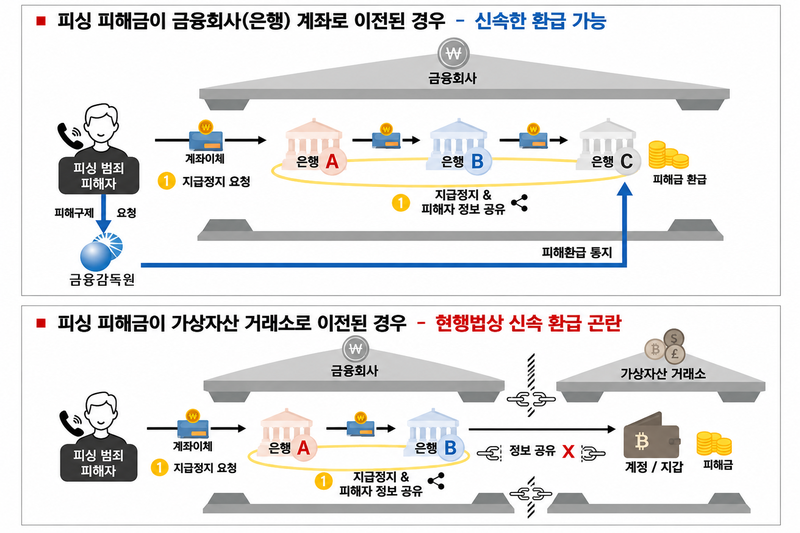
The problem involved information sharing between banks and exchanges. When stolen funds are transferred to a bank account, payment suspension and refund procedures can be carried out through information sharing among financial institutions. Exchanges, however, could freeze the accounts receiving the funds but had no legal grounds to obtain victim information from banks, making it difficult to identify those eligible for refunds. In some cases, victims did not know that their money had been transferred to an exchange and therefore did not apply for a refund.
A 56-year-old office worker identified only by his surname, Lee, living in Sejong City, transferred 95 million won after being deceived by a voice-phishing scammer who said he first had to repay an existing loan to qualify for a low-interest loan. He realized only later that it was a scam and reported it, but no money remained in the account used for the crime. After struggling to make ends meet and even selling his home in a distressed sale, Lee recovered approximately 22 million won through the latest refund process.
Beginning in April 2023, police traced the flow of funds through 1,050 exchange digital wallets and approximately 163,000 related bank accounts. They identified the victims, shared information with the exchanges, and guided the victims through the refund process. Police said that nearly three years of tracing enabled them to return most of the funds that had been frozen at the exchanges.
Police also identified cases in which frozen victim funds were disposed of without authorization. Some exchange accounts were unfrozen after the freezing period expired, and the account holders were found to have withdrawn or otherwise disposed of approximately 3.04 billion won in victim funds. Police are investigating 130 account holders and plan to recover the funds while seeking pre-indictment preservation of forfeiture and collection.
Starting on the first day of next month, the amended Special Act on the Prevention of Loss Caused by Telecommunications-Based Financial Fraud and Refund will take effect, adding virtual asset service providers to the scope of financial institutions. Police expect that once victim information can be shared between banks and exchanges, voice-phishing funds transferred to exchanges will be refunded more promptly.
[email protected] Choi Seung-han Reporter