Daejeon Urban Corporation Earns 4.1 Billion Won by Selling Blasted Rock from a Landfill
- Input
- 2026-09-29 12:46:14
- Updated
- 2026-09-29 12:46:14
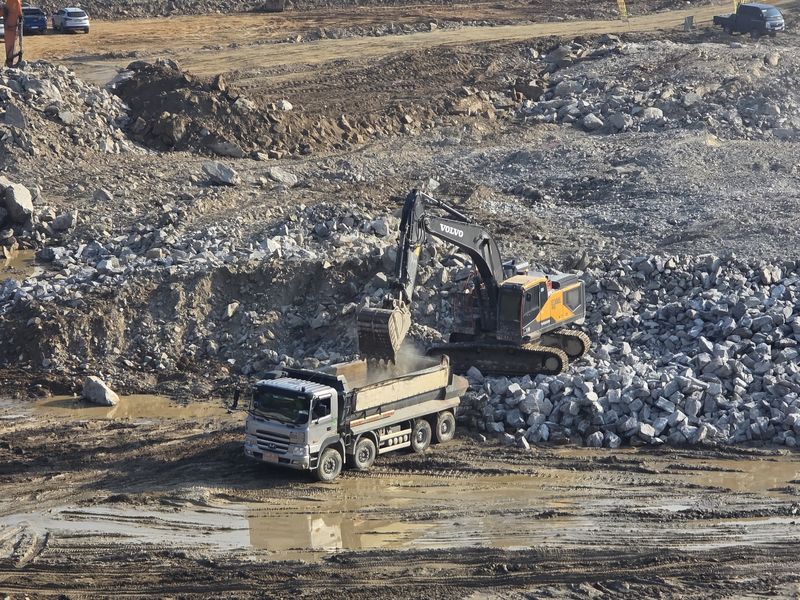
According to Daejeon Urban Corporation on the 29th, the corporation sold approximately 350,000 cubic meters of rock generated during site grading for the Second Landfill (Phase 1) Development Project in Geumgo-dong, Yuseong District, through an open competitive bid, generating total financial revenue of 4.1 billion won.
The Second Landfill (Phase 1) Development Project is being carried out with Daejeon Metropolitan City as the project operator and Daejeon Urban Corporation as the agency responsible for implementation. From the initial detailed design stage, Daejeon Urban Corporation redefined rock generated at the construction site as a recyclable resource rather than merely a construction byproduct and incorporated a revenue-generating sales structure into the design in advance.
The sale was conducted through an open competitive bid using the Ministry of Land, Infrastructure and Transport's Earth and Rock Information Sharing System (TOCY). Based on a reserve price established through an appraisal by a specialized institution, the highest-bid method was applied to ensure both procedural transparency and profitability. Daejeon Urban Corporation signed the sales contract in January 2024 and began full-scale removal operations in November of the same year. To date, it has paid the entire 4.1 billion won to Daejeon Metropolitan City as non-tax revenue.
Blasted rock and earth and stone generated at large civil engineering construction sites have long been criticized for increasing the financial burden on local governments and public institutions when they cannot be matched with suitable buyers, as they may be stockpiled on-site for extended periods or disposed of at additional cost. However, Daejeon Urban Corporation's proactive sale is being viewed as an excellent model of resource circulation in public civil engineering projects. The effort goes beyond saving the cost of disposing of construction byproducts by converting them into resources and returning the proceeds to the local government as non-tax revenue.
Building on this achievement, Daejeon Urban Corporation plans to expand and apply its system for selling and recycling excavated rock and earth to all public development project sites it undertakes in the future.
Jung Kuk-young, president of Daejeon Urban Corporation, said, "This result came from a shift in perspective that viewed rock easily discarded at construction sites not as waste to be disposed of, but as a usable resource." He added, "We will continue to identify innovative ways to promote resource circulation and reduce project costs across the various projects undertaken by the corporation."
[email protected] Kim Won-jun Reporter