Government and Ruling Party Pull Out All Stops to Improve Low-PBR Stocks... Disclosure and 5% Rule Reforms, Bear-Hug Legislation by Year-End
- Input
- 2026-09-29 11:30:06
- Updated
- 2026-09-29 11:30:06
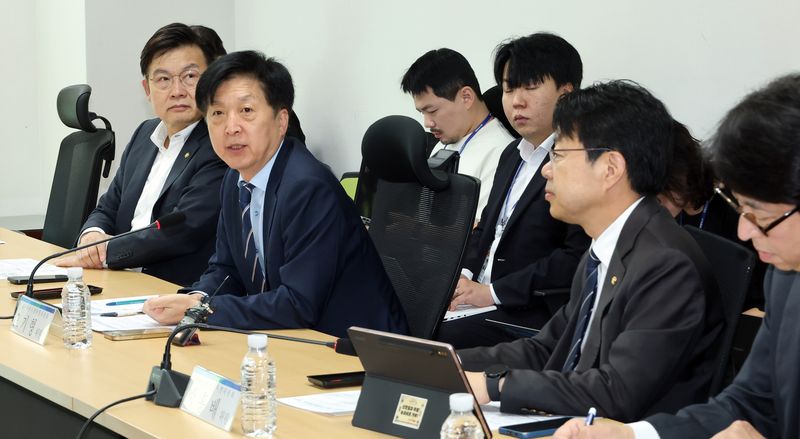
The DPK's K-Capital Market Special Committee, the Ministry of Economy and Finance, and the Financial Services Commission (FSC) held a working-level party-government consultation at the National Assembly on the 29th to discuss legislation aimed at preventing stock-price suppression and measures to improve the capital market system. After the meeting, the committee told reporters that the party and the government had reached a consensus on various capital market improvement measures.
First, the party and the government plan to continue efforts to improve the disclosure system. In particular, the so-called naming-and-shaming system, under which the Korea Exchange (KRX) discloses companies with low price-to-book ratios (PBRs), is expected to be implemented around November 2, as previously reported. The system publicly identifies companies with low PBRs. Its purpose is to ensure that market participants can identify such companies in advance while giving them an incentive to improve their low PBRs.
The party and the government next set a goal of introducing the bear-hug system by year-end. Under the system, during a merger and acquisition (M&A), the prospective acquirer must disclose the proposed acquisition terms to ordinary minority shareholders as well.
Oh Gi-hyoung, a DPK lawmaker and chairman of the committee, explained the need for the bear-hug system, saying, "If a low-PBR company's book value is sound, it becomes a value stock and is in fact an M&A target. We need to improve the system so that M&A can take place through market functions in the capital market and low PBRs can be resolved."
The party and the government plan to revise the so-called 5% rule to encourage institutional investors' stewardship code activities. Under the rule, an investor holding 5% or more of a listed company's shares or other securities must report to the Financial Supervisory Service (FSS) within five days if its stake changes by 1% or more or its investment purpose changes. Violations are subject to criminal punishment. In addition, when multiple investors agree to exercise voting rights jointly, they are treated as joint holders and their stakes are aggregated. This means that a change in holdings is also subject to mandatory disclosure when the combined stake of joint holders exceeds 5%.
Kim Nam-geun, a member of the committee and a DPK lawmaker, emphasized the need for institutional improvements, saying, "From the perspective of our companies, the institutional investor with the largest stake is the National Pension Service (NPS), at around 5% to 8%. With only this, it is difficult to have a decisive impact in a vote or contest at a shareholders meeting. In other countries, institutional investors form alliances and jointly exercise voting rights. But in Korea, joint voting must legally be disclosed in advance, and jointly exercising voting rights without disclosure is subject to criminal punishment. This is excessive regulation."
The party and the government also agreed to continue discussions on the amendment bill to the Inheritance and Gift Tax Act, which can be viewed as the prototype of legislation aimed at preventing stock-price suppression. Under the DPK's proposal, shares of listed companies with a PBR below 0.8 would be uniformly valued at 80% of their net asset value, establishing a lower limit for calculating inheritance and gift tax. The government, meanwhile, prepared a somewhat more stringent approach by adding conditions such as being among the bottom 25% of the KOSPI Composite Index by industry, the bottom 10% of KOSDAQ (Korea Securities Dealers Automated Quotations), and having maintained a low PBR for six consecutive years. This exposed differences between the party and the government.
Oh said, "Regarding the amendment to the Inheritance and Gift Tax Act, we are looking for points where alternatives can be explored while both the government proposal and the lawmakers' proposal are on the table. We will accumulate discussions in various forms, and the bill must be handled in some form during November."
[email protected] Kim Hyeong-gu Reporter