East Sea Coastal Sand Erosion: Seeking Answers in Underwater Seagrass
- Input
- 2026-09-29 11:13:12
- Updated
- 2026-09-29 11:13:12
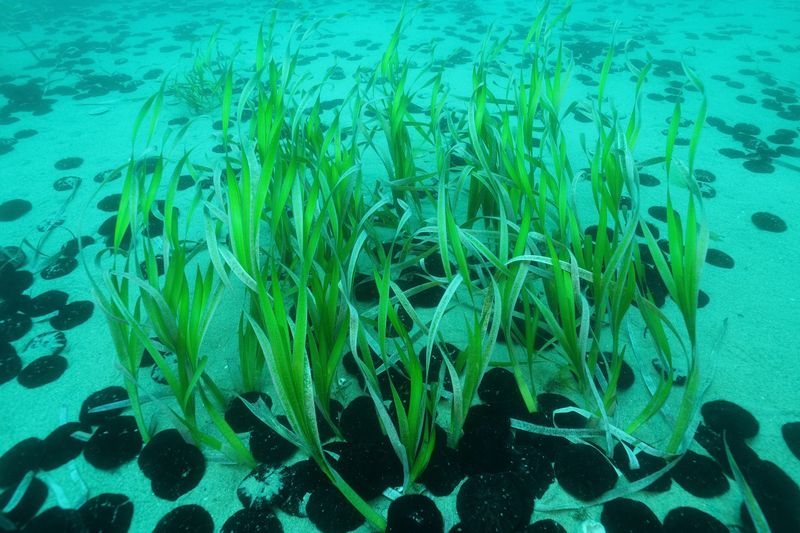
[Financial News] The erosion of sand along the East Sea coast is emerging as a more serious problem than expected. In the East Sea region, 60 sites have already been classified as being at the "serious" or "concern" stage of erosion. Research is now being launched to restore the East Sea coast using seagrass, an underwater plant.
The Korea Institute of Ocean Science and Technology (KIOST) announced on the 29th that its "East Sea Coastal Self-Sustaining Blue Infrastructure Construction Technology Development Project" had been selected as one of the Ministry of Science and ICT's "2027 Top 10 R&D Projects with Tangible Benefits for the Public."
Of the 10 selected projects, this is the only one both carried out by a government-funded research institute and funded through a contribution from the Ministry of Oceans and Fisheries (MOF).
A research team led by Dr. Do Jong-dae at the KIOST East Sea Research Institute will develop technologies using East Sea-native seagrass to address coastal erosion and declining fishery resources. The project will identify the functions of seagrass habitats and secure technology for creating mid- to deep-water seagrass meadows, known as "self-sustaining blue infrastructure." A total research budget of 24.7 billion won will be invested over five years starting next year.
Self-sustaining blue infrastructure refers to a living natural breakwater established underwater. Seagrass forests reduce wave energy and hold sand in place, naturally supplementing the role of existing coastal structures such as breakwaters and artificial reefs.
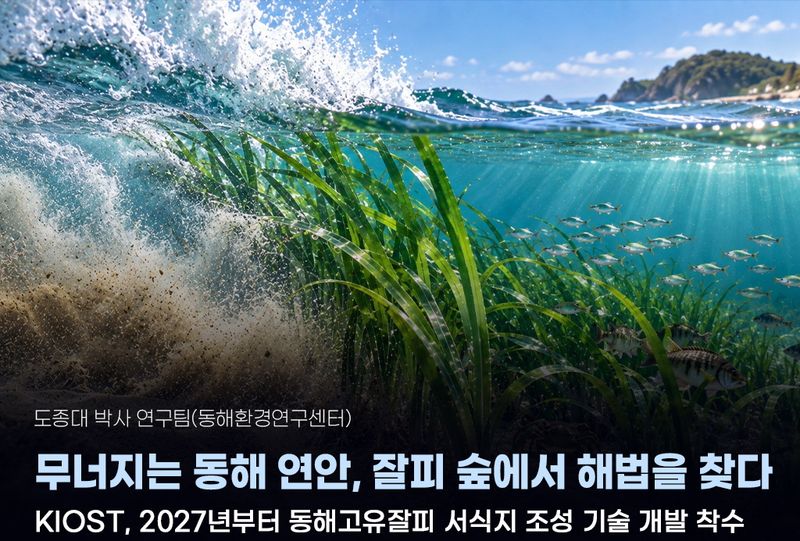
The research will be conducted in two phases. During Phase 1, which will run through 2029, the team will verify in the field the effects of East Sea-native seagrass on coastal areas.
Observation equipment will be installed in seagrass habitats to measure the reduction in wave energy and the amount of sand movement. Data collected through satellites, drones, and underwater sensors will then be analyzed using artificial intelligence (AI) to create a distribution map of seagrass in the East Sea.
During Phase 2, which will continue for the following two years, the technologies developed in Phase 1 will be tested in the field. A demonstration site will be selected along the East Sea coast, where a seagrass habitat will be established.
Through long-term observations, the team plans to verify the project's effects in reducing coastal erosion, enhancing biodiversity, and increasing fishery resources. The findings will be developed into management guidelines tailored to different marine conditions and applied to other areas along the East Sea coast.
Dr. Do Jong-dae explained, "Coastal erosion and declining fishery resources in the East Sea are recurring problems. The East Sea-native seagrass our research team will use is a living coastal blue infrastructure that reduces wave energy, protects sand, and even helps increase fishery resources. Because it can grow and maintain itself after being established, it can reduce management costs while addressing a national issue. The carbon absorbed by seagrass also helps combat climate change."
[email protected] Byun Ok-hwan Reporter