Korean Meteorological Administration to provide hourly weather forecasts for solar and wind power generation, up to five days ahead
- Input
- 2026-09-29 11:00:00
- Updated
- 2026-09-29 11:00:00
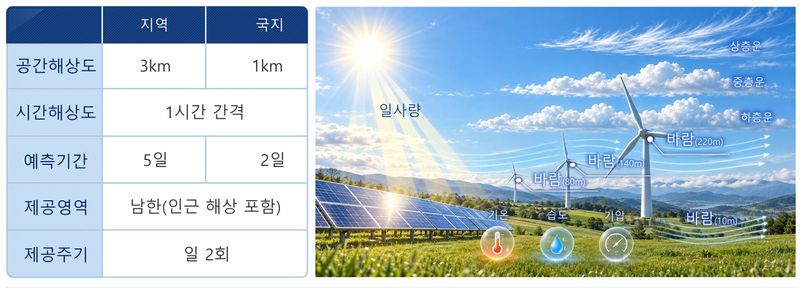
[Financial News] Starting on the 29th, the Korean Meteorological Administration will provide information on sunlight and wind across the country at hourly intervals, enabling more accurate forecasts of solar and wind power generation. It will divide the country into dense 1–3 km zones and forecast weather changes up to five days in advance. Because sunlight and wind can vary significantly by hour even on the same day, the service is intended to more accurately estimate when electricity production will be high or low and reduce errors in power supply and demand. The Korean Meteorological Administration presented an analysis that "in the era of 100 GW of renewable energy, reducing forecast errors for power generation by 20% could cut costs by approximately 1 trillion won annually."
The Korean Meteorological Administration said that, starting that day, it would provide detailed energy weather forecast information using the regional and local models of the Korean Integrated Model (KIM). The regional model makes forecasts up to five days ahead at 3 km resolution, while the local model forecasts up to two days ahead at 1 km resolution. Both models produce data at one-hour intervals and provide it twice a day for South Korea and nearby waters. The data include solar irradiance, wind, temperature, humidity and atmospheric pressure. For solar power, the service also provides horizontal-plane and normal-plane solar irradiance, upper-, middle- and lower-level cloud cover, temperature and humidity. For wind power, it provides wind direction and speed not only at 10 meters above ground but also at altitudes of 80, 140 and 220 meters, reflecting the actual heights of wind turbines.
The information is provided at one-hour intervals because solar and wind power generation can vary significantly depending on the weather. Even on the same day, solar power generation can surge if the morning is cloudy but the afternoon becomes clear, while wind power generation can fall quickly when the wind weakens. Until now, it had been difficult to fully capture such changes using only daily averages or information covering broad areas. Going forward, forecasts of sunlight and wind by time and region will make it possible to estimate more precisely when electricity production will be high or low.
The Korean Meteorological Administration has so far provided observation data from 100 solar power and 119 wind power sites, along with analyses of solar irradiance and wind speed characteristics, through its renewable energy weather information platform. It also operates wind energy resource maps and reconstructed wind fields, as well as solar energy resource maps. For nine regions, it has provided minimum, maximum and average values for solar irradiance and wind speed over the following three days, along with rates of change from the previous day. By adding detailed nationwide forecast data, the service has expanded from being centered on observation and analysis to include power generation forecasts.
The importance of weather forecasting is also growing as the share of renewable energy increases. The Korean Meteorological Administration explained that advance information on solar and wind power generation can be used to prepare for surplus or insufficient electricity, determine when to inspect generation facilities, and develop plans for responding to hazardous weather. Real-time data are available through the KMA API Hub and the Public Data Portal. Lee Mi-seon, head of the Korean Meteorological Administration, said, "To expand renewable energy and ensure a stable power supply, it is important to provide detailed weather information needed to forecast power generation in a timely manner." Lee added, "We will continue improving numerical weather prediction and work with relevant power-sector agencies to provide the energy weather information needed for power generation forecasting and power grid operations."
[email protected] Lee Bo-mi Reporter