South Korea, One of the World's Seven Space Powers, Launches Civil-Military Push to Revitalize Space Ecosystem and Build Independent Capabilities
- Input
- 2026-09-29 13:39:35
- Updated
- 2026-09-29 13:39:35
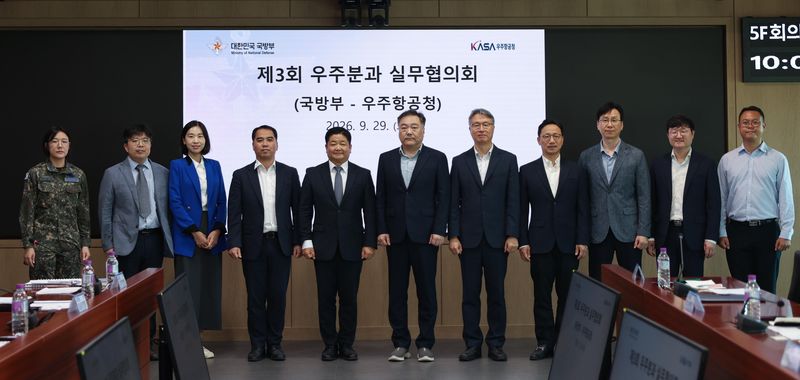
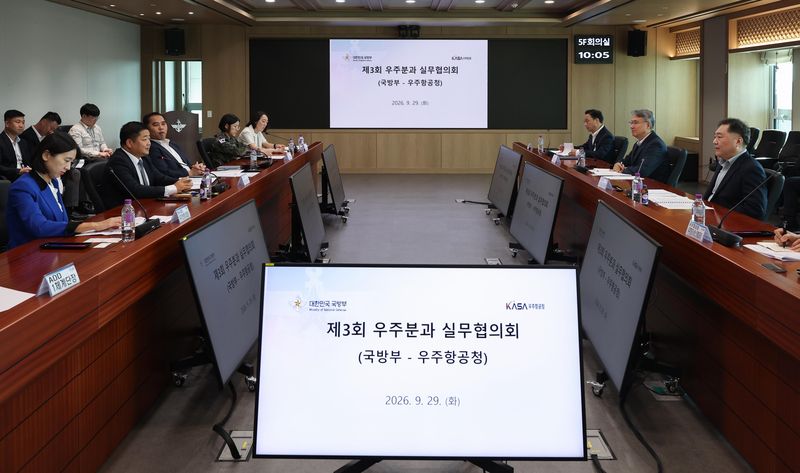
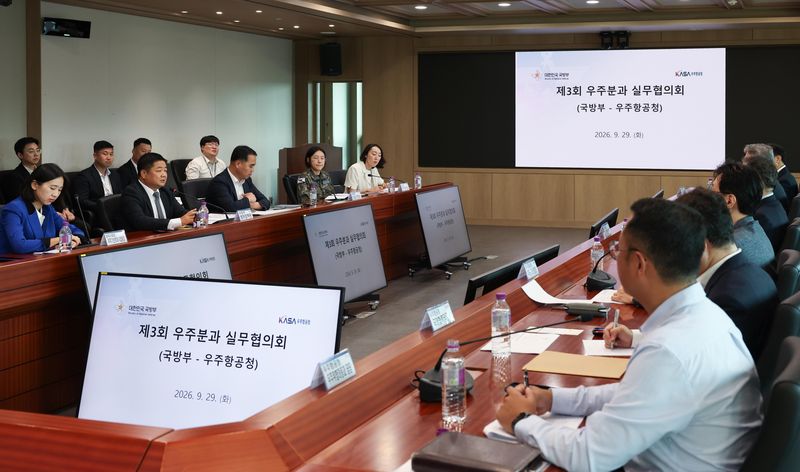
The Ministry of National Defense and the Korea Aerospace Administration (KASA) jointly held a meeting of the space division of the third Future Defense Science and Technology Policy Council at the Ministry of National Defense headquarters in Seoul on the 29th. They held in-depth discussions on strategies to expand space transportation capabilities, including space launch vehicles and spaceports, through civil-military cooperation. The two institutions agreed to pool national capabilities to revitalize the domestic space industry by actively using domestically developed launch vehicles to launch the military's satellites in the future.
Choi Yong-sam, defense policy director at the Ministry of National Defense, said, "The space division has achieved tangible results, including support for launches of solid-fuel rockets for defense purposes," and stressed the seamless implementation of the agreements. Hyun Young-mok, acting director of KASA's Space and Aviation Policy Bureau, likewise said, "Civil-military space cooperation is developing beyond individual issues into a practical system that efficiently brings together the nation's space capabilities," pledging mutual reinforcement between civilian and defense capabilities.
The meeting drew attention because it took place as the global contest for space dominance intensifies. U.S. space capabilities, currently the world's most advanced, have reached the point of controlling tactical communications networks worldwide through privately led constellations of low-Earth-orbit satellites. SpaceX's Starlink has already deployed more than 10,000 satellites in low Earth orbit and is pursuing a plan to ultimately launch 40,000, covering the entire planet with a dense surveillance and communications network.
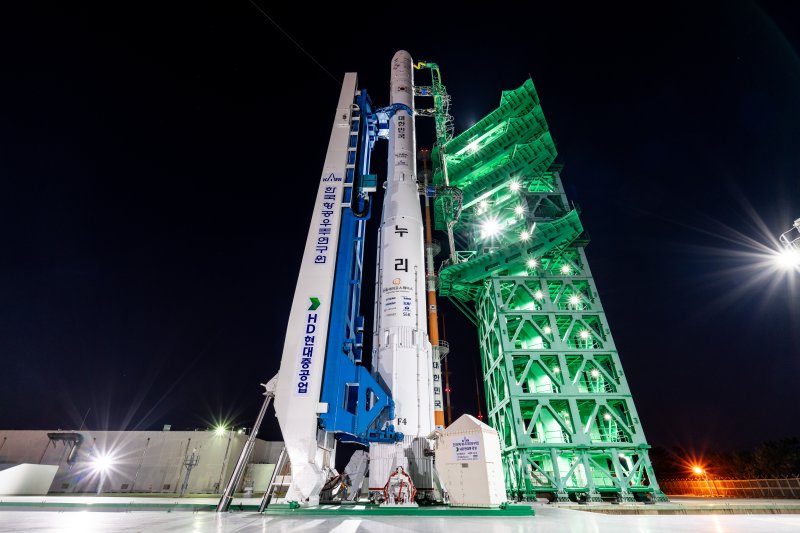
South Korea is the world's seventh country to secure indigenous launch vehicle technology capable of independently launching practical satellites. In particular, the solid-fuel rocket technology developed under the defense sector's leadership after the termination of the U.S.-South Korea missile guidelines has a simple design and can be stored for long periods. It has also been assessed by U.S. military experts as the most efficient "immediate-response" technology for launching large numbers of reconnaissance satellites into low Earth orbit within a short period. The country's indigenous satellite manufacturing and launch vehicle capabilities, achieved in a relatively short time, are a source of considerable pride for the Korean people.
The government has also completed institutional reforms to expand the capabilities of domestic launch vehicles and advance the country's space capabilities. Last August, the Space Development Promotion Act was amended to allow the Minister of National Defense to directly review and authorize space launches for defense purposes. Accordingly, the two institutions will begin follow-up measures, including revising subordinate legislation and establishing Ministry of National Defense directives in line with the law's effective date in February 2027. With the ministry now able to directly and swiftly control military satellite launches, the time required to field an independent military satellite capability is expected to be significantly reduced. Security-critical initiatives are also taking shape, including plans to establish a "radar-based space surveillance system" through civil-military cooperation and the operation of a consultative body for sharing space surveillance information.
[email protected] Lee Jong-yoon Reporter