"I write my personal statement entirely with AI"...More than half of job seekers say "the screening stage should be abolished"
- Input
- 2026-09-29 10:48:24
- Updated
- 2026-09-29 10:48:24
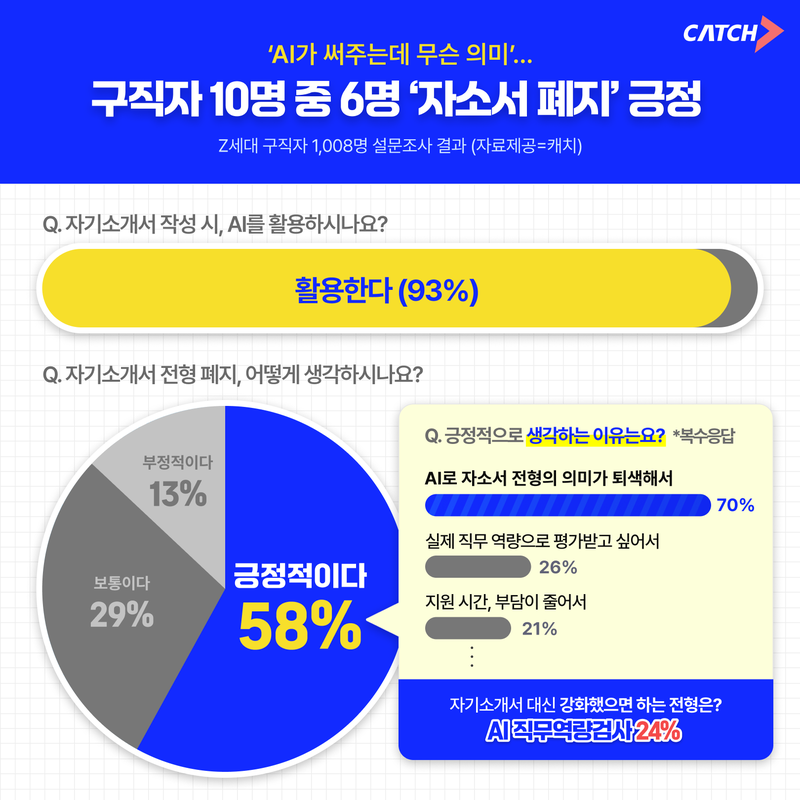
According to a survey of 1,008 job seekers conducted by Jinhaksa Catch on the 29th, 58% of respondents viewed abolishing the personal-statement screening stage positively. Another 29% said their view was "neutral," while 13% responded negatively.
Among those who viewed the abolition positively, 70% cited "the diminished significance of the personal-statement screening stage due to AI." This was followed by wanting to be evaluated on their actual job-related abilities at 26%, and reduced application time and burden at 21%.
In fact, 93% of job seekers said they had experience using AI to write a personal statement.
Their use of AI was not limited to simple spell-checking. The most common response, at 47%, was using AI to organize experiences and develop ideas, followed by drafting personal statements at 30%, refining spelling and wording at 27%, and rewriting statements for specific companies at 22%.
As AI use has become commonplace, questions have also grown over how well personal statements can demonstrate an applicant's actual abilities. Some 54% said evaluating applicants' abilities through personal statements was "inappropriate," compared with 35% who considered it "appropriate."
Instead, job seekers favored assessments that could verify their actual work capabilities. AI job competency assessments were the most popular response, at 24%, when respondents were asked which selection methods should be strengthened in place of personal statements. They were followed by practical assignments and projects at 21%, in-depth interviews at 17%, and portfolios at 13%.
The findings also suggested that eliminating personal statements could affect companies' ability to attract applicants. Some 78% said they would be more likely to apply to companies that had abolished the personal-statement screening stage. Another 19% said it would make no difference, while 3% said they would be less likely to apply.
There were also concerns about abolishing personal statements. Among job seekers who opposed the move, the most frequently cited concern was that it would "reduce opportunities to highlight their strengths and experience" at 62%. They also worried that other screening methods could be added, at 35%, or that evaluations focused on quantitative criteria such as educational background and qualifications could be strengthened, at 24%.
As the spread of AI enables anyone to produce a personal statement of a certain standard, interest is expected to grow in hiring methods that assess applicants' actual experience and ability to perform the job rather than the polish of their writing.
Kim Jung-hyun, head of Jinhaksa Catch, said, "As AI use has become widespread, it is becoming difficult to distinguish applicants' abilities based solely on personal statements. Going forward, selection methods that directly assess applicants' experience and abilities—including project experience, video personal statements, and AI proficiency—will become more important."
[email protected] Lee Jumi Reporter