AI to Monitor Chronic Disease Patients in Island Villages Who Struggle to Reach Hospitals
- Input
- 2026-09-29 10:55:35
- Updated
- 2026-09-29 10:55:35
【Financial News, Incheon—Reporter Han Gap-su】 A project has begun to use artificial intelligence (AI) and wearable technology to address the lack of medical access faced by people with chronic diseases who live on islands and must travel long distances to reach hospitals.
Gachon University Gil Medical Center announced on the 29th that it had been selected for the Korea Health Industry Development Institute's "Demonstration Project for Commercializing a Collaborative-Care Platform for Chronic Diseases in Medically Underserved Areas Using an AI-Based Call Center" and began the project last August.
In medically underserved areas, even people with chronic conditions such as hypertension have difficulty visiting hospitals regularly to check their blood pressure and electrocardiograms and monitor their medication adherence. The problem can be more serious on islands, where a shortage of medical institutions and specialists can lead to larger gaps in care when patients receive treatment only after health problems arise. This project focuses on addressing these limitations in medical access through digital technology.
Seven hub institutions in Incheon island and medically underserved areas are participating, including Ganghwa Hospital, Ganghwa BS Hospital, Baengnyeong Hospital, Ho Se Yo Yang Won, Neulpyeonanhan Nursing Home, Deokjeok Public Health Subcenter and Yeonpyeong Public Health Subcenter. The demonstration project will involve 200 people with chronic diseases.
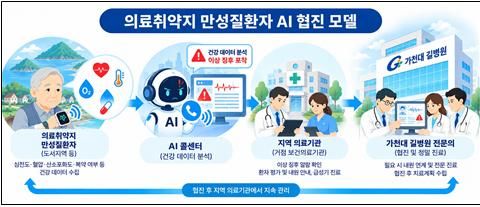
Participants will be provided with 12-channel wearable electrocardiographs. Their health data, including electrocardiograms, blood pressure and oxygen saturation, will be monitored continuously, while an AI call center will check their symptoms, health status and medication adherence by phone.
If abnormal signs are detected, the AI will send an alert to local medical professionals, who will assess the patient's condition. Patients requiring additional care will be treated at local medical institutions. Those needing an assessment by a university hospital specialist will be referred to Gachon University Gil Medical Center. Local medical institutions will then continue to monitor and manage the patients.
While traditional medical services have followed a "patient goes to the hospital" model, this project will first assess patients' conditions and connect them with medical professionals. AI will not replace doctors; rather, it will support medical professionals by helping them avoid missing patients' warning signs.
Since 2023, Gachon University Gil Medical Center has conducted remote medical services and teleconsultation projects for nursing homes in medically underserved areas. Building on that experience, it plans to expand the program into a system that continuously manages people with chronic diseases in their daily lives.
Through this demonstration project, Gachon University Gil Medical Center will assess the effectiveness of chronic disease management and the efficiency of medical care. It will also examine the project's effects on the early detection of emergencies, prevention of disease deterioration and improvement of medical access.
Park Jeong-ung, the project lead and director of the Public Specialized Respiratory Care Center at Gachon University Gil Medical Center's Department of Pulmonology and Allergy, said, "AI and wearable technologies will not replace medical professionals. Instead, they will help detect patients' warning signs earlier and quickly connect them with local medical professionals and university hospital specialists."
[email protected] Han Gap-su Reporter