First Encountered English Books at Age 4.8
- Input
- 2026-09-29 10:43:13
- Updated
- 2026-09-29 10:43:13
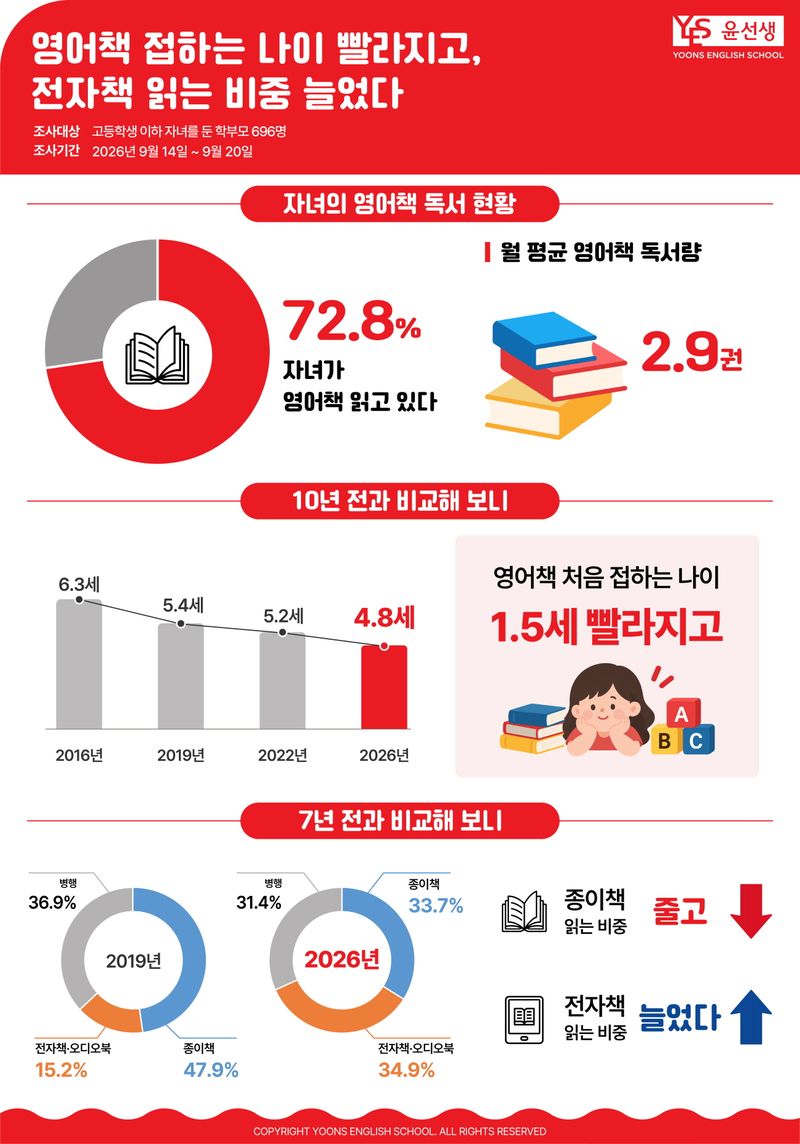
[Financial News] The average age at which children in South Korea first encounter English books has fallen to 4.8 years. At the same time, the early English education market is rapidly shifting toward digital platforms, with the share of English reading using digital devices such as e-books and audiobooks rising sharply as the market moves away from a paper book-centered environment.
According to the results of a survey of 696 parents with children in high school or younger, released by Yoons English on the 29th, children first encountered English books at an average age of 4.8 years, or 58 months, whether they were read to by their parents or read on their own. This was 1.5 years earlier than the average of 6.3 years recorded in 2016, a decade earlier. The age of first exposure to English books has continued to decline, from 5.4 years in 2019 to 5.2 years in 2022.
The main media through which children encounter English is also rapidly shifting toward digital platforms. The share of respondents who selected "digital devices such as e-books and audiobooks" as the format of the English books their children primarily read was 34.9%, up 19.7 percentage points from 15.2% in 2019, seven years earlier. By contrast, the share who mainly used "paper books" fell from 47.9% to 33.7% over the same period, a decline of 14.2 percentage points. As a result, digital reading surpassed paper books. The share of respondents who said their children used both paper books and digital devices was 31.4%.
Overall, 72.8% of parents said their children currently read English books, while the average monthly reading volume was 2.9 books. The most common purpose for having children read English books, with multiple responses allowed, was "improving English skills" (69.8%), followed by "school or academy homework" (46.5%) and "establishing a self-directed reading habit" (29.2%). When choosing English books, parents prioritized whether the books matched their child's English level (85.0%) and whether they would help with learning (52.3%).
Meanwhile, parents who said their children did not read English books (27.2%) cited "lack of interest among the children" (49.7%), "the use of other English education methods" (47.1%), and "a focus on reading Korean-language books" (24.9%) as reasons. Regarding how their children usually consume English content, the most common response, at 42.4%, was that the proportions of text and books versus video and audio were "similar." This suggests that multimedia-based English learning has become widespread.
[email protected] Kim Man-gi Reporter