“Teaching Where Surgery Is Performed”... Kangnam Sacred Heart Hospital Opens Robotic Endoscopic Spine Surgery Education Center
- Input
- 2026-09-29 10:31:27
- Updated
- 2026-09-29 10:31:27
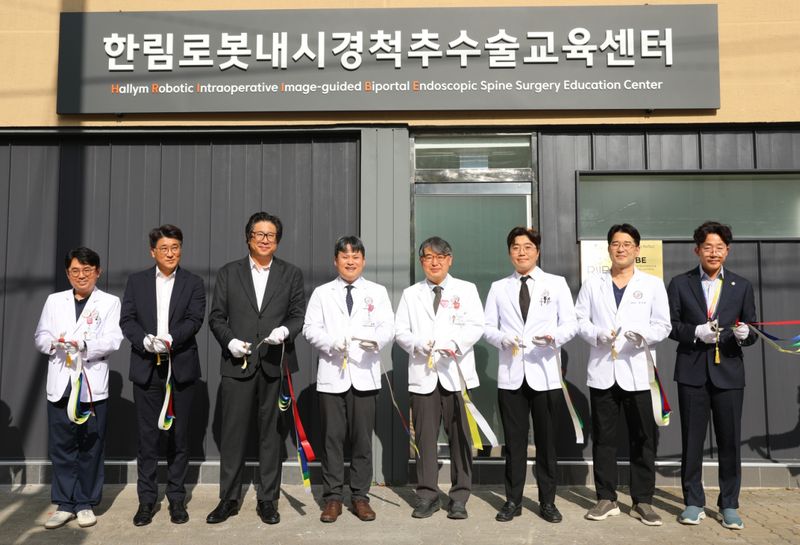
[Financial News] Medical professionals who perform spinal surgeries teach the procedures themselves, while trainees can immediately observe surgeries in the operating room. A robotic endoscopic spine surgery education center built around the idea of 'teaching where surgery is performed' has opened in Seoul.
Hallym University Kangnam Sacred Heart Hospital opened the world's first Hallym Robotic Endoscopic Spine Surgery Education Center on the 18th and signed a memorandum of understanding with CGBIO to promote robotic endoscopic spine surgery and train medical professionals from Korea and abroad.
The Operating Surgeon Is Also the Instructor—From Theory to Observing Surgery
The center was established to pass on the principles and techniques of robotic endoscopic spine surgery to spine specialists in Korea and abroad. It combines the hospital's 10 years of clinical and research experience in biportal endoscopic spine surgery with robotic and navigation technologies.
The program is intended for domestic residents, fellows and spine specialists, as well as medical professionals from overseas. Participants progress through the program in stages, beginning with theoretical lectures, followed by hands-on training using phantom models and observation of actual surgeries. The center's defining feature is its direct connection between clinical practice and education.
Professor Park Hyun-jin of the Spine Center, who has provided overseas medical professionals with training in and opportunities to observe biportal endoscopic spine surgery, plans to expand the program to robotic endoscopic spine surgery and develop it into a systematic global training program. The goal is to standardize surgical techniques, train specialized medical professionals and establish the center as an international education hub.
Professor Park said, "Over the past 10 years, we have continued research to expand the applications of biportal endoscopic spine surgery and improve its accuracy and safety. We will now expand that experience through robotic and navigation technologies, accumulate clinical data and standardize surgical techniques while creating an educational system for sharing our experience with medical professionals in Korea and abroad."
Hospital Director Lee Dong-jin stated, "We have previously connected clinical practice and education by training medical professionals in Korea and abroad in robotic surgery techniques through the Hallym Robotic Joint Replacement Surgery Education Center. We will actively support this new center so that it not only enhances medical professionals' expertise but also grows into a facility that provides patients with more accurate and safer treatment."
The Endoscope Is the 'Eye'; the Robot Is the 'Guide'
Before opening the center, the hospital introduced the CUVIS-spine endoscopic spine surgery robot and established a minimally invasive spine surgery system that combines biportal endoscopic spine surgery with robotic and navigation technologies.
Biportal endoscopic spine surgery uses two small incisions, with an endoscope inserted through one and surgical instruments through the other to treat the lesion. Because surgeons can operate while directly viewing an enlarged image of the surgical site, the procedure can reduce damage to normal muscles and surrounding tissues compared with open surgery.
Adding robotic and navigation technologies allows surgeons to plan the position, insertion angle and trajectory of screws in advance based on the patient's imaging data and verify them during surgery. If the endoscope is the 'eye' that shows the surgical site, the robot and navigation system serve as a 'guide' that accurately directs the instruments to the planned locations. This preserves the benefits of minimally invasive surgery while reducing the use of C-arm fluoroscopy for repeated imaging to confirm positioning, thereby lowering medical professionals' exposure to radiation. It can be particularly useful for patients with conditions such as degenerative lumbar spondylolisthesis, who require both neural decompression and spinal fixation and fusion.
Professor Yoo Gi-han of the Spine Center is also pursuing clinical research to expand the applications of robotic surgery. The research will examine the potential use of robotic and navigation technologies not only for pedicle screw placement but also for treating spinal fractures, oblique lumbar interbody fusion (OLIF), spinal tumor surgery and iliac screw fixation.
Professor Yoo said, "The advantage of a spine surgery robot is that it helps accurately and reproducibly carry out the surgical path planned by the medical team. We will examine and expand its clinical applications for various spinal conditions, including fractures, spinal deformities and tumors."
Since 2016, Professor Park Hyun-jin has continued developing techniques and conducting clinical research in biportal endoscopic spine surgery. He has expanded the range of treatments, which was initially limited, and has consistently published the results of collaborative research with researchers in Korea and abroad in international journals.
During his training at the Icahn School of Medicine at Mount Sinai in New York, he conducted research on combining biportal endoscopic spine surgery with stereotactic navigation. The study applied navigation to biportal endoscopic transforaminal lumbar interbody fusion for patients with degenerative lumbar spondylolisthesis, allowing surgeons to confirm the position and trajectory during key steps, including screw placement, neural decompression, disc removal and cage insertion. The technique was published in the international journal 'JBJS Essential Surgical Techniques' in 2025.
This research laid the foundation for the progression from 'biportal endoscopic spine surgery → navigation integration → robotic endoscopic spine surgery.' The hospital plans to accumulate related clinical data, strengthen the standardization of surgical techniques and expand training for medical professionals in Korea and abroad, establishing itself as a global education hub for robotic endoscopic spine surgery.
[email protected] Jeong Myeong-jin, Medical Correspondent Reporter