"Why drag Tzuyang and Heebab into this because of me?"... 440,000-subscriber YouTuber reveals the real reason for demonetization
- Input
- 2026-09-29 10:49:14
- Updated
- 2026-09-29 10:49:14
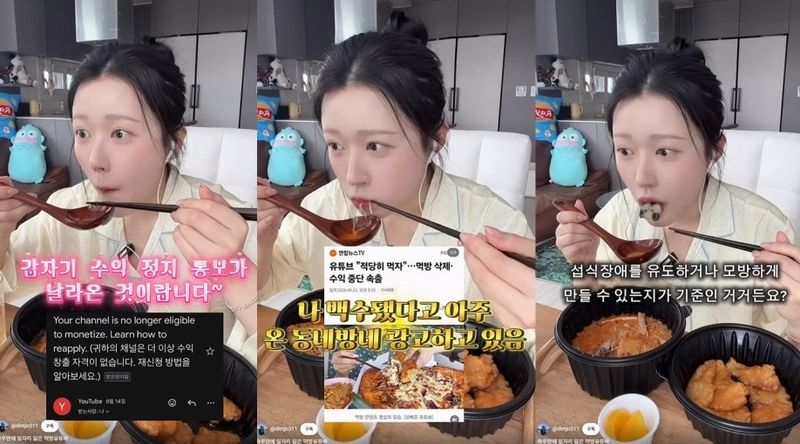
[Financial News] Fallout is spreading among creators of mukbang and diet content as global video platform YouTube significantly tightens its guidelines on eating-disorder-related content and its monetization requirements. Tensions are rising across the industry as actual sanctions continue to follow, including the suspension of monetization on the channel of a prominent creator with 440,000 subscribers.
DietJo, a mukbang and diet YouTuber with approximately 440,000 subscribers, recently said on his YouTube channel, "Monetization on my channel is currently completely suspended." He added, "YouTube has recently begun strictly enforcing its guidelines on binge eating and eating disorders, imposing strong restrictions on channels that feature related videos."
DietJo explained the circumstances behind the sanction in a video uploaded on the 24th titled 'Mukbang YouTuber Who Lost His Job in One Day.'
He confessed, "I am the person at the center of the news reports saying that mukbang YouTubers are losing their income." He continued, "Videos featuring frequent dieting and binge eating that I uploaded four or five years ago began disappearing one by one several months ago without warning, and eventually I received notice that my monetization had been suspended."
He also pushed back against speculation that large mukbang creators such as Tzuyang and Heebab could face restrictions on their activities.
He said, "I am the one whose monetization was cut off, so I don't know why Tzuyang and Heebab are being dragged into this as well." He stressed, "The key criterion is not simply whether someone eats a lot, but whether the content could encourage an eating disorder or lead viewers to imitate it."
He added, "Since exposure of excessively thin bodies, references that encourage binge eating, and the abuse of vomiting or laxatives are among the main targets of regulation, ordinary mukbang channels that simply show people eating a lot and enjoying their food do not need to be overly concerned."
YouTube has gradually tightened its regulations after revising its guidelines on eating-disorder-related content. In the past, it blocked only content that directly praised or glorified eating disorders. Following the revision, however, its scope expanded to include dangerous eating habits and imitation behaviors that viewers, including minors, could follow.
In particular, YouTube has linked its advertising policies to its Community Guidelines and categorically excludes from ad revenue content featuring behaviors that pose a risk of imitation, such as binge eating, hiding or excessively stockpiling food, vomiting, and abusing laxatives. To have the sanctions lifted, creators must delete all problematic past videos, wait 90 days, and then apply for a new review, causing substantial practical harm to their businesses.
As the platform's regulatory stance has hardened, even major mukbang channels have been seen seeking to change their content. Tzuyang, a YouTuber with more than 10 million subscribers, recently hinted at the possibility of adjusting her content's tone. While choosing a snack-bar menu in a video, she said, "Let's order a reasonable amount. Apparently, eating a lot isn't the trend these days." She added, "From now on, I will become a YouTuber who eats in moderation."
An industry source analyzed the situation, saying, "Content ethics regulations by global Big Tech companies, designed to protect viewers' health rights—particularly those of adolescents—and prevent the risk of imitation are expected to become even stricter." The source added, "The existing mukbang ecosystem, which has emphasized sensational overeating or extreme weight-loss methods, will inevitably be reorganized around well-being and sustainability."
[email protected] Moon Young-jin Reporter