Doctors Added Over the Past Decade Concentrated in the Capital Region... Gangwon State, Gyeongsangbuk-do and North Jeolla Province See Declines
- Input
- 2026-09-29 12:00:00
- Updated
- 2026-09-29 12:00:00
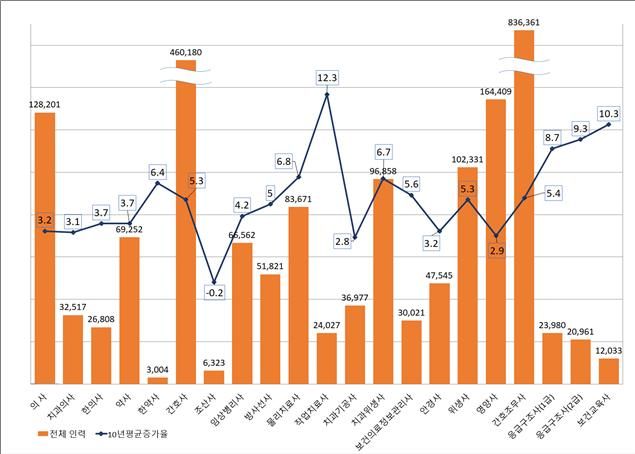
[Financial News] The number of doctors working at hospitals and clinics increased by 30,000 over the past decade, but the doctors added during that period concentrated in the capital region. The region's share of doctors rose to 55.6%, while the number of doctors in Gangwon State, Gyeongsangbuk-do and North Jeolla Province began to decline over the past three years.
The Ministry of Health and Welfare (MOHW) announced the results of its second survey on the state of the healthcare workforce on the 29th. The Korea Institute for Health and Social Affairs (KIHASA) and the National Health Insurance Service (NHIS) linked licensing and qualification, health insurance and healthcare institution reporting data for 2,324,000 personnel across 20 healthcare occupations to analyze changes over the 10 years from 2013 to 2023.
Capital Region's Share of Doctors: 53.2% → 55.6%
Among doctors working at healthcare institutions, the share in Seoul, Gyeonggi Province and Incheon increased from 53.2% in 2013 to 55.6% in 2023. The number of doctors in the capital region rose by 19,000 during this period. By contrast, the share of non-capital metropolitan cities fell from 22.9% to 21.5%, while that of provincial areas declined from 23.8% to 22.5%.
Excluding Sejong City, the areas with the fewest doctors were North Chungcheong Province, Ulsan and Jeju Province in both 2013 and 2023. The number of doctors in Gangwon State, Gyeongsangbuk-do and North Jeolla Province began to decline over the three years from 2021 to 2023. Doctors in provincial areas outside the capital region also aged faster than those in the capital region.
As the population aged and risk aversion increased, the types of institutions where the number of doctors grew also changed. The number of doctors working at healthcare institutions rose from 82,000 to 112,000 over the decade, an average annual increase of 3.2%. The figure was 12.8% at large long-term care hospitals with 300 beds or more. This was followed by 100- to 299-bed general hospitals at 5.7% and hospital-level institutions at 4.4%. By contrast, the growth rates were lower at tertiary general hospitals providing acute care, at 2.0%, and at 300- to 499-bed general hospitals, at 0.8%.
Nurses, meanwhile, moved toward large hospitals. The number of nurses working at healthcare institutions increased from 143,000 to 252,000, an average annual growth rate of 5.8%. The shares of tertiary general hospitals and general hospitals increased, while the share of hospitals fell from 19% to 14.4%. More than 80% of dentists and pharmacists continued to work at dental clinics and pharmacies, respectively.
2.32 Million License Holders... One in Three Is 'Not Practicing'
In 2023, the number of people holding healthcare licenses or qualifications stood at 2,324,000, about 900,000 more than a decade earlier. Nursing assistants accounted for the largest share at 836,000, or 36.0%, followed by nurses at 460,000, or 19.8%; dietitians at 164,000, or 7.1%; and doctors at 128,000, or 5.5%. Nursing assistants recorded the largest absolute increase, at 344,000, while occupational therapists posted the highest average annual growth rate, at 12.3%.
The number of active healthcare personnel actually working in the healthcare sector was 1,557,000, for an activity rate of 67.0%. Although this was 5.3 percentage points higher than the 61.7% recorded in 2013, 766,000 people, or 33.0%, still held licenses but did not work. The non-practicing rates were 26.1% for nurses, 23.6% for pharmacists, 12.1% for Korean medicine doctors, 10.0% for dentists and 7.9% for doctors. Midwives were the only occupation to see a decline, with the number of active personnel falling from 2,997 to 2,789.
Doctors' Annual Compensation: 285.18 Million Won... Up 5.6% Annually Over the Decade
Average compensation for personnel working at healthcare institutions increased across all occupations over the decade. The average annual growth rates were 5.6% for doctors, 3.5% for nurses, 3.1% for dentists, 2.7% for pharmacists and 0.6% for Korean medicine doctors.
In 2023, average annual compensation was 285.18 million won for doctors, 202.77 million won for dentists, 103.68 million won for Korean medicine doctors, 84.26 million won for pharmacists and 51.95 million won for nurses. Doctors' compensation was higher at hospitals, at 354.27 million won, and clinics, at 325.99 million won, than at general hospitals, at 251.45 million won, and tertiary general hospitals, at 199.76 million won. Compensation figures for doctors, dentists and Korean medicine doctors are based on full-time workers working 40 or more hours per week, excluding interns and residents.
The gender composition also changed. The share of female doctors rose from 22.5% to 26.5%, while the share of male nurses increased from 2.4% to 6.7%, easing gender imbalances across occupations. Average age increased across all major occupations, with the average age of doctors rising from 44.6 in 2015 to 47.1 in 2023.
Lim Eul-gi, director general for healthcare resources policy at MOHW, said, "We will continue to monitor changes in the field through regular surveys. At the same time, we will use the findings as a basis for policymaking so that excellent personnel can be systematically trained and personnel supply and demand can be smoothly managed by region and field."
[email protected] Jung Myung-jin, medical correspondent Reporter