"What Are the Elderly and Self-Employed Supposed to Do?" Vulnerable Groups Fuming Over News of Shorter Bank Hours [Field Report]
- Input
- 2026-09-29 17:22:28
- Updated
- 2026-09-29 17:22:28
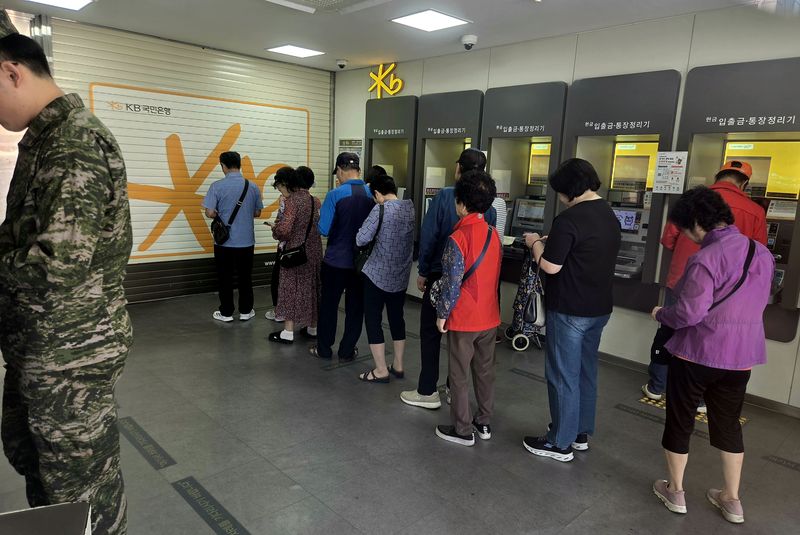
[Financial News] "I have been waiting for the bank to open for 10 minutes because I need to deposit the cash I earned yesterday into my account and get change for today's business."
At around 8:50 a.m. on the 29th, Kim, a 67-year-old self-employed man whom we met at KB Kookmin Bank's Eungam-dong Comprehensive Financial Center in Eunpyeong District, Seoul, said, "I have to prepare to open the shop at 9:30, so my morning is tight." Kim, who runs a business at nearby Daerim Alley Market, added, "There are still many customers in this neighborhood who come carrying cash."
Labor and management in the banking industry have tentatively agreed to shorten branch hours starting next April, prompting concerns particularly among older adults. For financially vulnerable groups who have difficulty using financial services outside bank counters, access to banks could become even more difficult. In fact, more than 10 older people who had come to conduct banking business formed a queue outside KB Kookmin Bank's Eungam-dong Comprehensive Financial Center, which opened at exactly 9 a.m. that morning. Some customers were using the automated teller machine (ATM) next door, but most older customers waited for the branch to open in front of the firmly closed metal doors.
Accessibility for Older Adults and People with Disabilities Down... Where Is Inclusive Finance Headed?
On the 28th, the Korean Financial Industry Workers’ Union and the Financial Industry Employers’ Council tentatively agreed to delay the opening of bank branches by 30 minutes, from 9 a.m. to 9:30 a.m. They also agreed to introduce a so-called "last-call" system under which new customers would not be accepted starting 30 minutes before closing on Fridays. The union explained that the agreement reflects the spirit of "reducing actual working hours," one of the Lee Jae Myung administration’s national policy priorities.
However, older banking customers are voicing their frustration. Kim, an octogenarian, complained, "Young people may not understand, but for people like us, 9 a.m. is already late in the day," adding, "Banks already open late by our standards, so what are older people supposed to do if they open even later?" Kim grumbled, "I don't even know how to send or receive money using a cellphone. My children won't even show me how, saying it's because of voice phishing and all that." Jeong, 91, who was standing behind him, said, "I came out because I have to pay my phone bill," and added, "Older people with plenty of time can come anytime, but people who run businesses will have a hard time if banks open late."
By contrast, the inside of a bank branch near Yeouido in Yeongdeungpo District, Seoul, was quiet at the same time. The bank's deputy president said, "The hours when each branch gets busy vary widely. At branches that customers rarely visit, only one or two people may come in all day, so we sometimes set the ticket numbers to start at 101 rather than 001." This is why some are calling for banks to respond flexibly based on conditions in areas with many financially vulnerable people and downtown areas with fewer such customers, rather than standardizing operating hours nationwide.
According to the "2025 Survey on the Digital Divide," released by the Ministry of Science and ICT, older adults scored 71.8 and people with disabilities 84.1 when the general public’s level of digital informatization was set at 100. The overall access level for vulnerable groups was 96.6, but their competency level was only 65.9 and their usage level just 80.5.
People aged 60 and over also have a relatively high share of cash use, which is consistent with this pattern. According to the "2024 Survey on Payment Methods and Mobile Financial Service Usage," released by the Bank of Korea (BOK), cash accounted for 41.3% of payment use in 2013 but fell into the 20% range in the 2019 survey at 26.4% and the 2021 survey at 21.6%. An industry official pointed out, "People aged 60 and over use cash more often than other age groups. One reason is that their regular income declines after retirement, making it harder for them to obtain credit cards."
Four-and-a-Half-Day Workweek as a "Stepping Stone"... Bank Employees "Welcome" It
Bank employees working at counters appear to view the agreement as a "return to normal starting hours." An employee at a commercial bank said, "I come to work more than 30 minutes early to be ready for the 9 a.m. opening. If the opening time is pushed back to 9:30, I will be able to come in at the normal time of 9 a.m."
Some also hope that introducing the Friday last-call system could lead to discussions about a four-and-a-half-day workweek in the future. Under the last-call system, new customers are not accepted starting 30 minutes before closing on Fridays.
Another employee at a commercial bank said, "The union's demands included reducing working hours through the introduction of a four-and-a-half-day workweek," and added, "Working hours will not be reduced immediately, but the agreement is meaningful because it is the first step toward a four-and-a-half-day workweek." [email protected] Park Moon-soo and Lee Hyun-jung, Reporters
Some also hope that introducing the Friday last-call system could lead to discussions about a four-and-a-half-day workweek in the future. Under the last-call system, new customers are not accepted starting 30 minutes before closing on Fridays.
Another employee at a commercial bank said, "The union's demands included reducing working hours through the introduction of a four-and-a-half-day workweek," and added, "Working hours will not be reduced immediately, but the agreement is meaningful because it is the first step toward a four-and-a-half-day workweek." [email protected] Park Moon-soo and Lee Hyun-jung, Reporters
[email protected] Park Moon-soo and Lee Hyun-jung Reporter