North Korea's "Sophistry": "South Korea Will Realize Its Nuclear Ambitions" ... No Response to Being Named the Culprit in DMZ Blast
- Input
- 2026-09-29 09:01:47
- Updated
- 2026-09-29 09:01:47
The Ministry of Foreign Affairs of the Democratic People's Republic of Korea said through the Korean Central News Agency (KCNA) on the 29th that it denounced the United States' buildup of nuclear forces and extended deterrence for its allies as "nuclear proliferation activities." It also claimed that the nuclear-powered submarines approved by the United States for South Korea would eventually lead to South Korea acquiring nuclear weapons.
It said that by approving uranium enrichment activities and other measures during the 2015 negotiations to revise the nuclear agreement, the United States "gave the green light to South Korea's nuclear ambitions to rise as a 'quasi-nuclear state.'"
It further made the far-fetched claim that "US-South Korea cooperation on nuclear submarines under the banner of using low-enriched uranium fuel will end up realizing South Korea's dangerous nuclear ambitions to secure the right to enrich weapons-grade nuclear materials and even obtain nuclear weapons."
It also alleged that the United States had transferred technology that could be diverted to nuclear weapons development through the "nuclear agreement" it signed with South Korea in 1956 and other arrangements, and had deliberately covered up indications that plutonium was extracted from South Korean reactors in 1998 and 2003.
The DPRK Foreign Ministry also took aim at AUKUS (Australia-United Kingdom-United States security partnership). It described the AUKUS agreement, whose "two key pillars" are the provision of nuclear-powered submarines and the transfer of nuclear technology, as a US scheme to create "the world's largest nuclear submarine alliance in name and in fact." It added the claim that Australia could produce 160 nuclear warheads using the nuclear submarine fuel it would receive.
The DPRK Foreign Ministry criticized the history of US nuclear development point by point. Beginning with the United States' first nuclear test in 1945, it cited the size of the country's nuclear arsenal and the process of its nuclear arms reduction negotiations with the former Soviet Union, along with specific figures, and blamed the United States for undermining the Treaty on the Non-Proliferation of Nuclear Weapons (NPT), signed in 1968.
It presented figures showing that US nuclear weapons deployed in the Asia-Pacific region, including Japan, South Korea, the Philippines and Taiwan, increased from approximately 1,700 around 1960 to approximately 3,200 in 1967. It also said that approximately 1,720 nuclear weapons had been deployed in South Korea by 1985.
The DPRK Foreign Ministry particularly pointed out that the formulation of a new US nuclear strategy focused on tactical nuclear weapons "shows that they are being firmly established as operational weapons for deployment on the battlefield in the event of a contingency, rather than as non-deployed 'deterrents' intended to 'eliminate threats' from adversary states."
The DPRK Foreign Ministry claimed, "The current geopolitical situation, in which the international nuclear order has reached a state of complete collapse due to the United States' radical buildup of nuclear forces and blatant nuclear proliferation schemes, requires our country to play a more active role in safeguarding world peace and global strategic stability."
It then justified the advancement of its nuclear forces, saying, "As a nuclear-weapon state, the Democratic People's Republic of Korea's choice of action will be based entirely on the grave reality that no international organization or international treaty has been able to restrain the United States' nuclear buildup and nuclear proliferation schemes, which have gone beyond all limits."
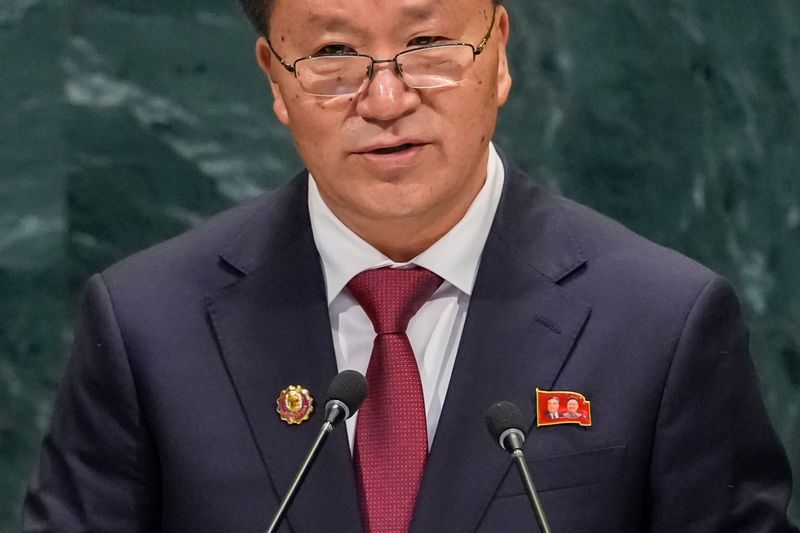
North Korea also asserted the legitimacy of its nuclear weapons at the UN General Assembly. Vice Foreign Minister Kim Son-gyong said in a speech to the UN General Assembly on the 28th (local time), "We reaffirm our official position that the status of a nuclear-weapon state can never be reversed by anything under any circumstances."
In a speech during the general debate of the 81st UN General Assembly at United Nations Headquarters in New York, Kim said, "The nuclear deterrent possessed by the Democratic People's Republic of Korea is an absolute force and an irresistible power for defending sovereignty, security and peace against external aggression and threats." Kim also strongly opposed US-led joint military exercises and took aim at South Korea's push to possess nuclear-powered submarines.
He criticized the situation, saying, "The current military trend, in which the United States has approved and actively promoted Seoul's ambition to possess nuclear-powered submarines while moving and deploying various types of equipment, including state-of-the-art missiles and drones, on the Korean Peninsula and in surrounding areas, is making the already unstable regional security situation even more vulnerable."
[email protected] Kim Kyung-soo Reporter