LG Innotek Conducts Real-World Driving in Korea with Autonomous Vehicle Equipped with 'Eyes,' Strengthening Sensing Solution Competitiveness
- Input
- 2026-09-29 08:40:16
- Updated
- 2026-09-29 08:40:16
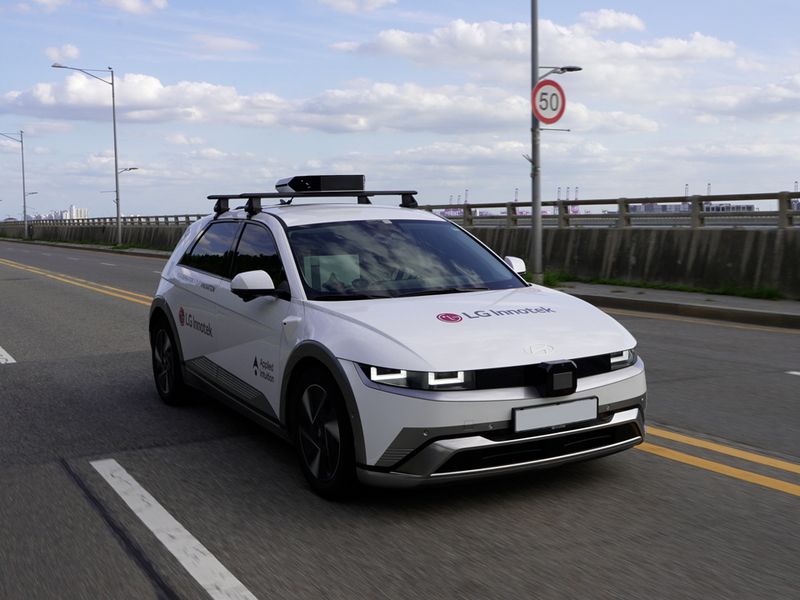
[Financial News] LG Innotek will begin directly collecting autonomous-driving sensing data in Korea. The company plans to use data gathered in real-world driving environments to improve the performance of cameras, radar and lidar, thereby strengthening the competitiveness of its autonomous-driving sensing solutions.
LG Innotek announced on the 29th that it would operate autonomous-driving sensing data collection vehicles in Korea with Applied Intuition, an autonomous-driving software company. The two companies formed a strategic partnership last March to advance autonomous-driving sensing solutions.
LG Innotek will begin operations mainly in Seoul, Incheon and Gyeonggi Province. By 2028, it plans to operate a fleet of around 20 vehicles in Korea, including data collection vehicles and vehicles used to develop autonomous-driving software. A fleet refers to a group of vehicles owned and operated by a particular company.
The data collection vehicles will be equipped with various sensors, including cameras, radar and lidar. LG Innotek plans to process information collected during driving, such as road conditions, vehicle movements, object locations and weather changes, and use it to improve individual sensor performance and validate systems. The company also plans to integrate the data with digital twins that recreate real-world road environments virtually. This structure allows sensor information identified during actual driving to be incorporated into product development and validation.
The main area of development will be sensor fusion technology, which combines and calibrates information from multiple sensors to recognize the surrounding environment. The approach improves recognition accuracy by using image data from cameras, distance and speed data from radar, and three-dimensional spatial data from lidar together.
The company will also collect edge-case data involving exceptional road conditions. Examples include a black vehicle in heavy rain, intense backlighting at a tunnel exit, and irregular lane markings at a construction site—situations in which sensor recognition performance may decline under specific conditions. LG Innotek plans to use this data to improve sensor accuracy and reliability across a range of environments.
LG Innotek plans to use the data it collects to develop integrated sensing solutions covering automotive cameras, radar and lidar, while seeking new customers in North America and Europe. According to the company, few companies worldwide can supply all three types of sensing modules using their own technology.
Vehicles operated by Applied Intuition for data collection and equipped with LG Innotek's sensing modules will run not only in Korea but also in the United States, Europe and Japan. The two companies plan to analyze real-world driving data from multiple regions and reflect environment-specific improvements in their products.
Minjyon, LG Innotek's CTO (executive director), said, "Autonomous-driving solutions are evolving from advancing the performance of individual sensors toward jointly optimizing sensors and software based on data." Minjyon added, "By leading with LG Innotek's own advanced integrated sensing solutions built on data, we will rapidly take the lead in the physical AI sensing market, including autonomous driving."
[email protected] Park Ji-yeon Reporter