If the Five Power Generation Companies Merge, Even 24 Trillion Won in Corporate Bonds Could 'Change Status'··· Seismic Shift in the Bond Market [fn Market Watch]
- Input
- 2026-09-29 08:28:56
- Updated
- 2026-09-29 08:28:56
In a report on the 29th, Lee Kyung-rok, an analyst at Shinyoung Securities, cited the possibility of AAA-rated corporate bonds shifting to the special bond market depending on the merger structure of the five power generation companies as a key variable. He analyzed, "If established as a public corporation based on the law, we can expect a reduction in spreads due to the upgrading of bonds to special bonds and an expansion of inclusion limits for institutional investors."
Simply put, a narrowing of the spread means that the additional interest rate payable to the market during bond issuance decreases. If the linkage with the government and the possibility of support are reflected in the price, lowering the risk premium demanded by investors, Korea Power's financing costs could also decrease.
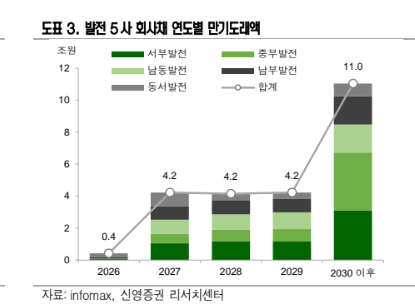
According to Shinyoung Securities, as of the 23rd, the outstanding balance of won-denominated corporate bonds held by the five power generation companies was approximately 24.1 trillion won. Korea Power is scheduled to launch next October. If it is established as a statutory public corporation directly funded by the government, as proposed in the bill introduced in the National Assembly, rather than as a wholly owned subsidiary of KEPCO, future bonds issued could be classified as special bonds.
"Accordingly, a change in supply and demand is expected, with the supply of AAA-rated corporate bonds from power generation subsidiaries decreasing and the supply of special bonds increasing," he said. However, whether the existing 24.1 trillion won in corporate bonds will be immediately converted into special bonds depends on the method of debt assumption by the merged entity and relevant laws.
There is also a variable moving in the opposite direction. Currently, the five power generation companies are separate issuers, but after the merger, they will be grouped into a single entity, Korea Power. The researcher analyzed that "preliminary adjustments to the volume may be necessary due to exceeding the investment limit for a single issuer." This implies that while the conversion to special bonds could expand investment capacity, the concentration on a single issuer could actually restrict institutional demand.
The maturities of the five power generation companies' won-denominated bonds amount to 4.2 trillion won in 2027, 4.2 trillion won in 2028, and 4.2 trillion won in 2029. As refinancing demand in the 4 trillion won range arises annually around the time of the launch of the integrated entity, whether this volume is absorbed in the corporate bond or special bond market is a supply and demand variable.
The possibility has been raised that the merger of Korea Gas Corporation and Korea National Oil Corporation could actually reduce their capacity to issue bonds. As of the end of last year, Korea Gas Corporation held approximately 10.8 trillion won in capital with assets of 53.6 trillion won and liabilities of 42.8 trillion won, whereas Korea National Oil Corporation was in a state of complete capital impairment with assets of 19.4 trillion won and liabilities of 21.9 trillion won.
The current Korea Gas Corporation Act limits the issuance of corporate bonds to within five times the sum of capital and reserves. The researcher pointed out, "If the accumulated losses of the Korea National Oil Corporation are reflected, there is a possibility that the bond issuance limit of the merged entity could actually be lower than that of the existing Korea Gas Corporation." This means that while the size of the entity grows through the merger of public enterprises, its capacity to issue bonds could actually decrease.
[email protected] Kim Hyun-jung Reporter