LH Union Warns: "General Strike if Forced to Split"... Opposes Government Restructuring Plan
- Input
- 2026-09-29 15:01:34
- Updated
- 2026-09-29 15:01:34
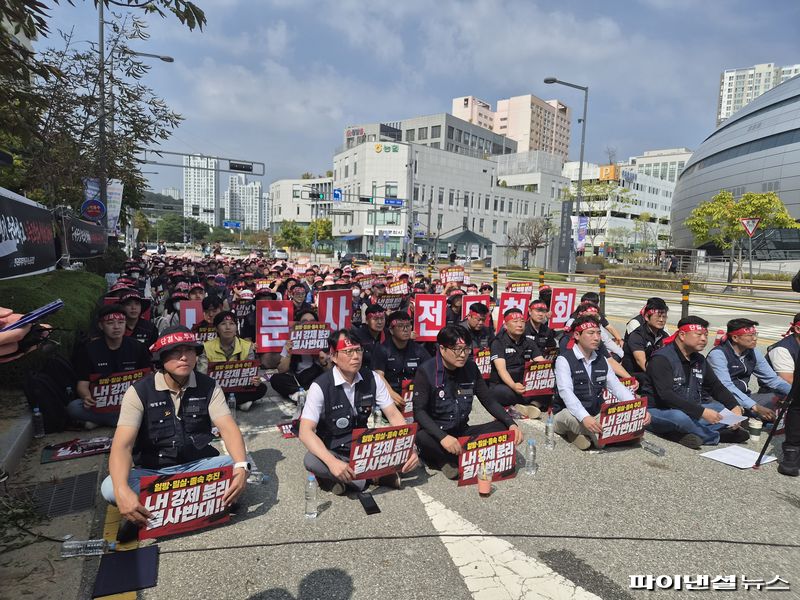
On the 29th, the LH union held a rally to oppose the spin-off in front of the main gate of MOLIT at Government Complex Sejong. The union also delivered to MOLIT a petition opposing the split, signed by 14,334 LH employees and their family members.
About 300 members, according to the union's estimate, attended the rally. Participants held banners reading 'Absolutely oppose the forced separation of LH' and chanted slogans such as, "We completely reject the unilateral split and restructuring of LH."
The union argued that the policy rationale behind the merger of the Land Corporation and the Korean National Housing Corporation conflicts with the direction of the current restructuring. In a resolution, the branch chief said that 16 years ago, the government had stated, "Only by organically linking land development, housing construction and housing welfare can national inefficiencies be eliminated."
The union then criticized the government, saying, "What on earth is the logic behind the government's complete reversal—saying now that it will forcibly split LH under the pretexts of 'slower supply' and 'growing debt'?" It added, "Was the efficiency rationale the government put forward 16 years ago right then but wrong now?"
The government unveiled a plan on the 3rd to divide LH into the Housing and Urban Development Corporation and the Housing and Urban Asset Corporation. The plan is intended to improve the efficiency of housing supply by separating development and construction from welfare and land stockpiling. It would split the organization again 17 years after LH was launched through the 2009 merger of the Land Corporation and the Korean National Housing Corporation.
The union called the process of drawing up the restructuring plan 'closed-door, deskbound administration,' saying that the views of the employees directly involved had not been reflected. It argued that separating functions that had been linked for 17 years since the merger could sever the connection between development and asset management and generate substantial administrative costs.
The union also raised concerns that the restructuring could hinder the government's housing supply targets. In addition to housing supply, LH is responsible for various policy projects, including the development of land, cities and industrial complexes, housing welfare, and balanced regional development.
According to the union, LH's annual housing supply target, which had been about 60,000 units, has risen to around 110,000 under the current government. During the same period, its annual project volume expanded from about 20 trillion won to around 80 trillion won.
The union explained that LH directly carries out or is involved in about 120 types of policies and projects, including national semiconductor industrial complexes, the relocation of public institutions to regional areas, balanced regional development, and housing support for young people, newlywed couples and older adults.
The union pointed out that dividing the development and asset management divisions as proposed by the government would make personnel reassignments and the transfer of duties unavoidable. It argued that pursuing organizational restructuring while housing supply must be sharply expanded could weaken the field's ability to carry out projects.
The union also said LH's 174 trillion won debt was not the result of lax management. It explained that the debt was 'policy-driven state debt,' accumulating at about 100 million won each time a public rental housing unit is supplied. The union plans to determine its response after reviewing the outcome of its first collective bargaining session with management, scheduled for the 30th. At a press conference on the 17th to declare a struggle against the government, held by the Joint Countermeasures Committee of the Public-Sector Unions of the Two Major Trade Union Federations, it warned that it could launch the first general strike since the company's founding depending on the bargaining outcome.
The demands are: △ restoring the unilateral innovation plan to its original form and securing the momentum and personnel needed for implementation; △ immediately forming a labor-government consultation body; and △ codifying the government's responsibility for the results of policy implementation.
The union said, "If the government ignores the call for substantive labor-government consultations and ultimately pushes through the forced split, we will immediately launch an all-out struggle against the government at the highest level, including a general strike by our 8,000 members."
[email protected] Choi Ga-young Reporter