Cheering after seeing the 4x100-meter relay scoreboard, then left aghast... The worst officiating blunder ever nearly shattered Korean athletics' morale [Nagoya Asian Games]
- Input
- 2026-09-29 07:46:07
- Updated
- 2026-09-29 07:46:07
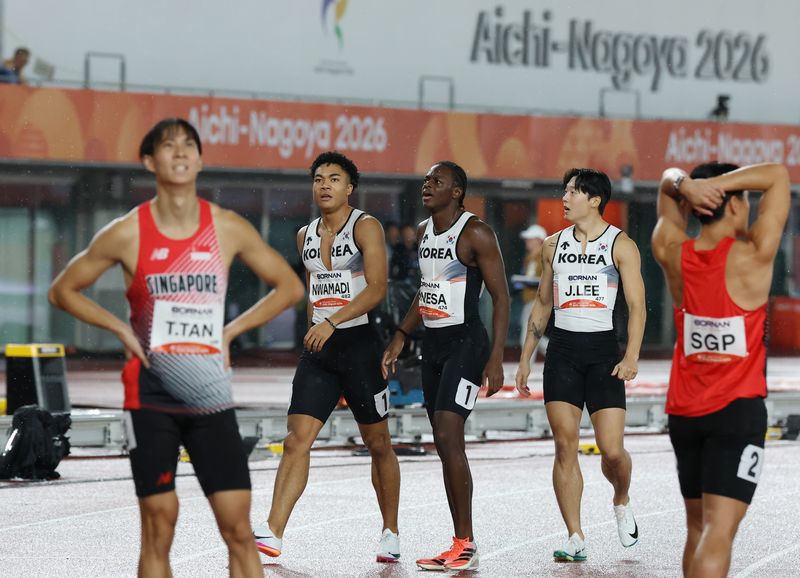
[Financial News] Despite setting a Korean national record and confidently crossing the finish line in third place, South Korea nearly had its bronze medal taken away right before its eyes. The Japanese team's objection and the Nagoya Asian Games organizing committee's incomprehensible, chaotic administration produced a farce of historic proportions. Without the furious protests from the South Korean athletics team, the glory of its hard-earned national record could have vanished into thin air.
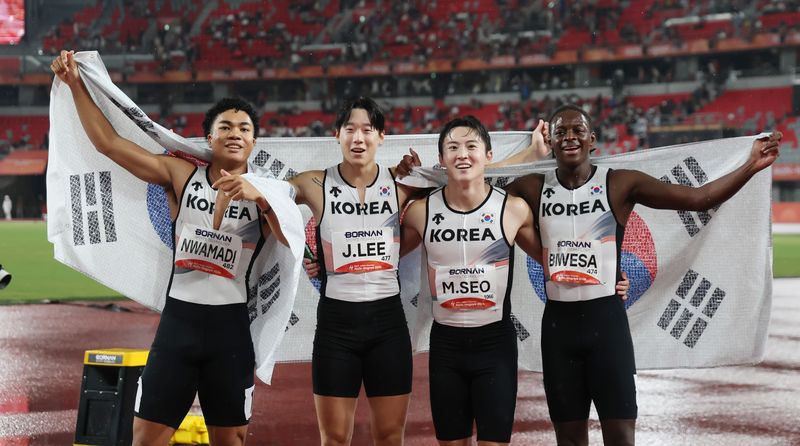
The men's 4x100-meter relay team, consisting of Seo Min-jun (Seocheon County Office), Joel Jin Nwamadi (Yecheon County Office), Lee Jaesung (Jeonnam Gwangju City Hall) and Biewesa Daniel Gasama (Ansan City Hall), set a Korean national record of 38.43 seconds in the final at the Nagoya Mizuho Park athletics stadium on the 28th. It was a flawless race, with the team crossing the finish line third behind China, which clocked 38.17 seconds, and Taiwan, which finished in 38.32 seconds.
But the team, celebrating on the track, was soon left aghast. The competition's official website listed Thailand, which had finished fourth in 38.49 seconds, as the bronze medalist.
Ha Kyung-soo, head coach of the men's sprint team, said angrily, "I heard that the Japanese team had filed an objection. But without giving us any clear explanation, the organizing committee posted a result on its website that was difficult to understand." Japan had protested, yet Thailand—an unrelated party—ended up receiving the bronze medal in an utterly nonsensical turn of events.
The team's coaching staff immediately rushed to the headquarters and lodged a strong protest. With the times and rankings clearly established, the organizing committee's unilateral announcement was an issue that could not be overlooked. After floundering for a long time, the committee finally revised its announcement under intense pressure, quietly listing South Korea as the bronze medalist. Had the team remained silent, it could have suffered the absurd loss of a bronze medal it had rightfully earned.
The incident has once again put the Nagoya Asian Games' small-town-sports-meet-level administration under scrutiny. On the 23rd, the organizers made a fatal error in the 800-meter swimming relay by listing Kim Young-beom, who had not even competed, as a bronze medalist. After problems involving accommodation, transportation and training conditions, the event is now bringing international embarrassment upon itself with a barrage of amateurish officiating errors—even in athletics finals, where times and rankings are everything.
Korean athletics, in particular, has endured a persistently troubled relationship with the organizing committee's flawed rulings throughout these Games. Earlier, the men's 4x100-meter relay team was unfairly disqualified in the preliminary round for allegedly leaving the baton exchange zone, only to miraculously have the decision overturned through its own video appeal. In the mixed 4x100-meter relay preliminaries on the 29th, South Korea was harmed by another team's violation but was disqualified instead; after appealing once again, it had the ruling overturned and was forced to compete in an additional race.
With the final's near-theft of a medal added to the list, the South Korean delegation is waging a three-front battle on Japan's home soil—not against rival athletes, but against the organizing committee's "bad calls." Amid incompetent administration and rulings widely perceived as biased, the fighting spirit of the Korean athletes, who held their nerve and ultimately claimed both a Korean national record and a bronze medal, is the only thing shining through the night in Nagoya.
[email protected] Jeon Sang-il Reporter